November 6, 2026 · CHARIS BACHTSEVANI

#guide #interactive-fiction

What Interactive Fiction Actually Means, and Why We Love Making It

Written worlds are made from an improbable material. A fortress has no stone, the winter no cold, yet a reader can come away grieving for someone who never drew breath. Language has given an invented life enough substance to be missed. Interactive fiction can turn that attachment into a decision. The writing brings you close to someone, then leaves you to act with an imperfect understanding of what your answer might cost.

At Windmill Tales Interactive, we make fantasy and sci-fi interactive stories, alongside tools for other people's storytelling. We love the form for the difficult relationship it allows between a character and the person reading them. Their predicament belongs to them; some of the decisions belong to you. The author gives the world its boundaries, while the reader makes a history within them, leaving actions for the writing to carry forward.

When the Words Begin to Answer

Interactive fiction, often shortened to IF, is storytelling in which your actions help determine how the work unfolds, with text carrying much of the interaction. Gamebooks that direct you to different numbered pages offer one familiar version. Digital stories can also remember earlier actions and draw on them much later. The answer you gave several passages ago can remain part of the situation long after its immediate consequences have passed. The form can hold a domestic conversation as readily as a ruined kingdom; fantasy and science fiction are where our own interests lead, rather than limits on what interactive fiction can contain.

The way you participate varies. A parser-based story asks you to type instructions, which a part of the program called the parser recognises and turns into actions. Choice-based fiction presents written alternatives for you to select. The first asks you to find an action the work understands; the second puts its possibilities before you, allowing the difficulty to lie in choosing between them. That space awaiting a typed command can seem boundless, although the parser has a vocabulary, and part of playing is learning its reach.
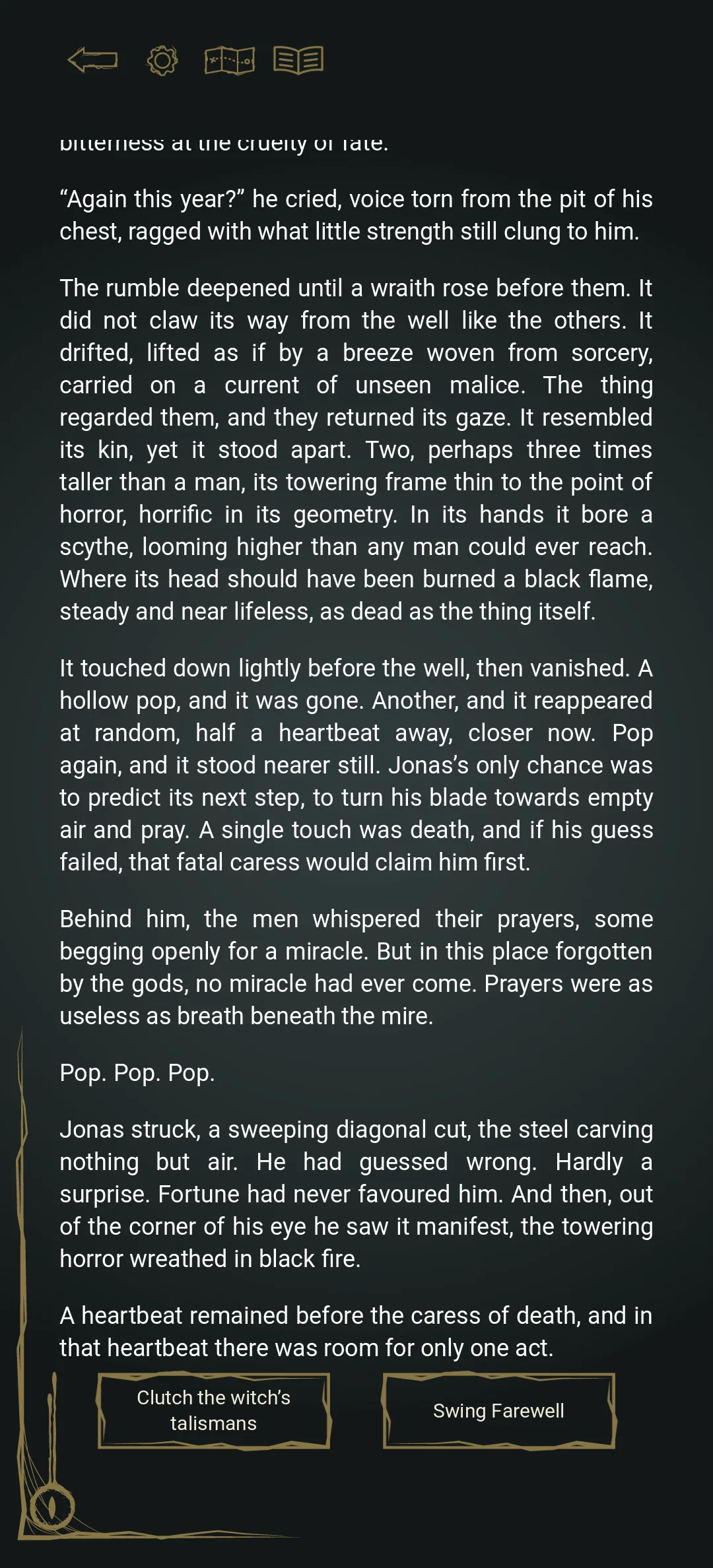
The end of a chapter of The Red Tomorrow: a wraith wreathed in black fire, a heartbeat left before it strikes, and two choices below, Clutch the witch’s talismans and Swing Farewell. Two written alternatives, and a heartbeat to choose between them, in The Red Tomorrow.

Hypertext fiction places that invitation within the prose itself. A linked word may open another passage, disclose a detail, or change the text around it. Illustration and music can accompany any of these forms, but language remains central to the exchange. The writing describes what you encounter and gives you a means of answering it.

A Life of His Own, a Decision in Your Hands

In our illustrated grimdark novel, The Red Tomorrow, Jonas searches for his taken son. We follow his perspective predominantly through close third-person narration, so the person you direct remains someone you also have to read. A wraith's touch has ruined half his skull and taken an eye, an injury he keeps bound in rags. That wound belongs to his history before your first choice, alongside the experiences that have made him the man you encounter. His need to find the boy gives the journey its urgency, but it cannot settle every decision for you.

That interests us as writers because a character can be legible without becoming predictable. You can understand what drives him and still hesitate over what he should do. Giving the reader influence requires us to hold those things together: a person with enough substance to resist becoming an empty role, and enough possible courses for your judgement to matter.

The structure carries those decisions beyond the moment of choosing. Branches divide and fold back into major crossings, while earlier actions can open or close later options. Fifteen endings are possible, but consequence also works on the way towards them. Returning to a shared stretch of the narrative can mean finding a different set of actions available there, because something you did has travelled ahead of you.
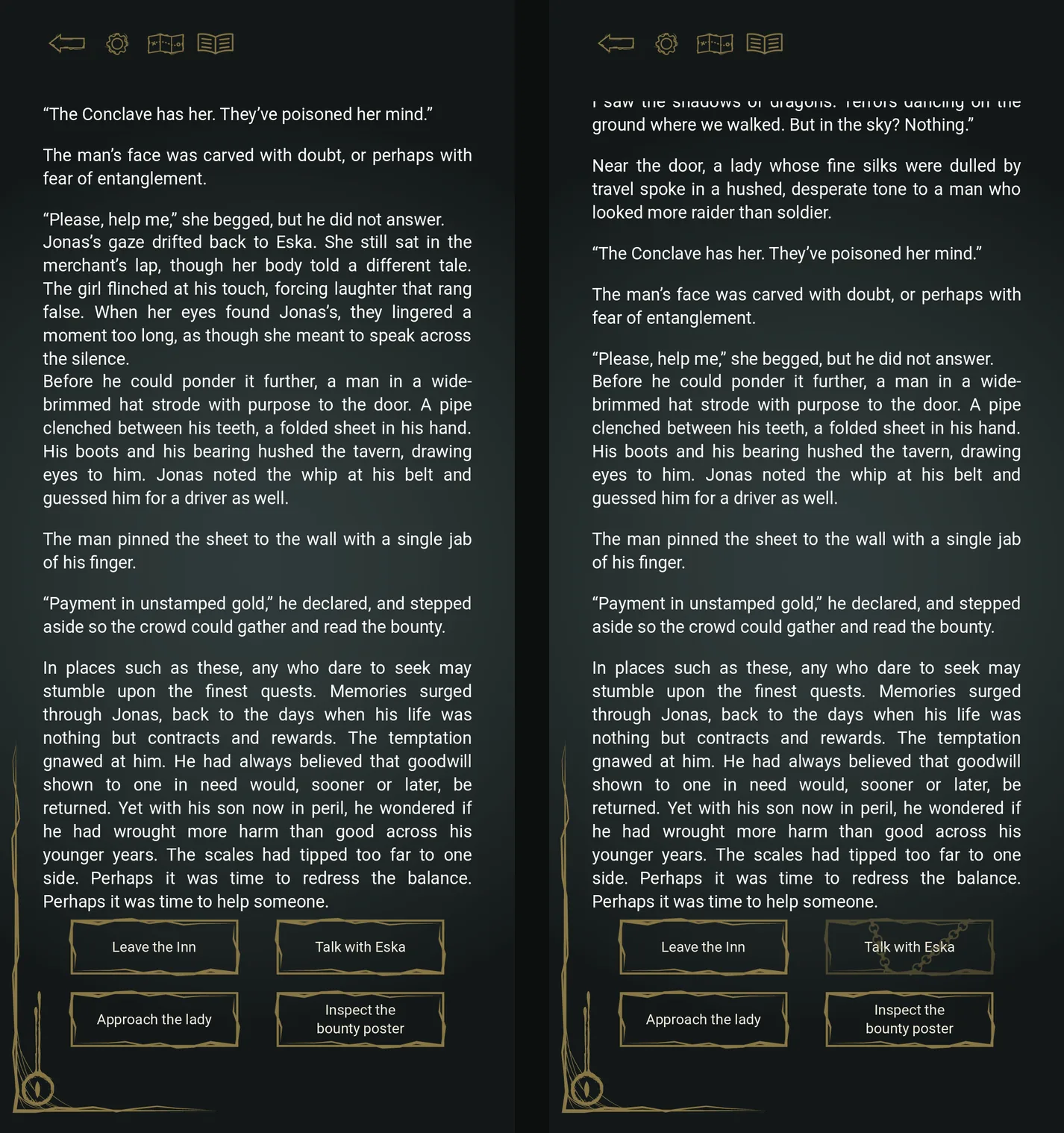
The same inn chapter of The Red Tomorrow twice. On the left Jonas notices Eska and Talk with Eska can be chosen; on the right that paragraph is gone and Talk with Eska is chained shut. The same inn, twice: with an earlier choice behind him, Jonas notices Eska and can speak to her. Without it, that option stays chained.

A Reply Sent Into the Silence

Terminal: Stolen Light gives the reader another relationship to inhabit. Prometheus has woken on a drifting ship, and his messages reach you through an old terminal. You choose what to send back. The exchange gives your participation a place inside the fiction: you are the correspondent whose answer he is waiting to receive, with only his words to bring the distant situation close. His warm, formal manner reaches you in green phosphor text, allowing a presence to emerge across the glass while the space around him remains uncertain.

Time becomes part of the telling. When Prometheus leaves to attend to his circumstances, the line falls silent; a notification announces his return. Between those contacts, the writing gives way to the expectation of more writing. For us, the interest lies in that interval after a reply has been sent, when an answer has become advice and the person receiving it is elsewhere. The terminal's silence can hold the unfinished exchange until his words return.
Terminal: Stolen Light on a phone: Prometheus’s messages in green text with three replies to choose from, then the carrier wait screen with its radio mast, then the incoming carrier lock as he comes back on the line. A reply sent, the line gone quiet, and the carrier coming back.

The Worlds We Leave for You to Make

Our Fantasy World Generator offers material for a different kind of authorship. It is a free, fully offline mobile toolkit for tabletop players, game masters who guide their adventures, fantasy writers, and worldbuilders, with no account required. You can draw on names, characters, maps, and other material for the stories you are making. Its contents are resources for your work, rather than a branching novel through one of our fictional worlds. A name can become a first foothold in a place that has not yet acquired a history.

A generated secret might become the buried trouble in a manuscript or something a group discovers around a table. You decide where it belongs and what follows from it. The toolkit also supports solo play and play without a game master, where interpreting prompts can sit alongside making decisions within the fiction. We like leaving that use open: someone else's judgement can take the material somewhere our own stories would never go.
An NPC in Fantasy World Generator, its Secret line rerolled four times: loyal only until the gold runs out, already confessed to the wrong crime, sworn to silence by a threat against their kin, and afraid the party already knows. One NPC, four secrets: the Secret line rerolled in Fantasy World Generator.

What an Ending Leaves Open

For a newcomer, choosing a first interactive story can begin with the same appetite that draws you towards any book. Find a premise you want to spend time with, then look at how the work asks you to participate. You might want to investigate through typed commands, or to weigh the replies a character can give. An ending can be enough in itself; another attempt can answer a different curiosity.

What keeps us making this fiction is the closeness it can create between understanding someone and deciding for them. The words establish a life, with its wants and its limits, then give the reader some responsibility within it. You may reach the end wondering what another answer would have brought, or choose to let that version of events rest. We hope the worlds of Windmill Tales Interactive stay with you in that unsettled space, where the last page has turned and a decision still has the weight you gave it.

Find your next story at Windmill Tales Interactive, or take up the tools and begin laying the bones of a world of your own.

What Interactive Fiction Actually Means, and Why We Love Making It

Written worlds are made from an improbable material. A fortress has no stone, the winter no cold, yet a reader can come away grieving for someone who never drew breath. Language has given an invented life enough substance to be missed. Interactive fiction can turn that attachment into a decision. The writing brings you close to someone, then leaves you to act with an imperfect understanding of what your answer might cost.

At Windmill Tales Interactive, we make fantasy and sci-fi interactive stories, alongside tools for other people's storytelling. We love the form for the difficult relationship it allows between a character and the person reading them. Their predicament belongs to them; some of the decisions belong to you. The author gives the world its boundaries, while the reader makes a history within them, leaving actions for the writing to carry forward.

When the Words Begin to Answer

Interactive fiction, often shortened to IF, is storytelling in which your actions help determine how the work unfolds, with text carrying much of the interaction. Gamebooks that direct you to different numbered pages offer one familiar version. Digital stories can also remember earlier actions and draw on them much later. The answer you gave several passages ago can remain part of the situation long after its immediate consequences have passed. The form can hold a domestic conversation as readily as a ruined kingdom; fantasy and science fiction are where our own interests lead, rather than limits on what interactive fiction can contain.

The way you participate varies. A parser-based story asks you to type instructions, which a part of the program called the parser recognises and turns into actions. Choice-based fiction presents written alternatives for you to select. The first asks you to find an action the work understands; the second puts its possibilities before you, allowing the difficulty to lie in choosing between them. That space awaiting a typed command can seem boundless, although the parser has a vocabulary, and part of playing is learning its reach.

The end of a chapter of The Red Tomorrow: a wraith wreathed in black fire, a heartbeat left before it strikes, and two choices below, Clutch the witch’s talismans and Swing Farewell. Two written alternatives, and a heartbeat to choose between them, in The Red Tomorrow.

Hypertext fiction places that invitation within the prose itself. A linked word may open another passage, disclose a detail, or change the text around it. Illustration and music can accompany any of these forms, but language remains central to the exchange. The writing describes what you encounter and gives you a means of answering it.

A Life of His Own, a Decision in Your Hands

In our illustrated grimdark novel, The Red Tomorrow, Jonas searches for his taken son. We follow his perspective predominantly through close third-person narration, so the person you direct remains someone you also have to read. A wraith's touch has ruined half his skull and taken an eye, an injury he keeps bound in rags. That wound belongs to his history before your first choice, alongside the experiences that have made him the man you encounter. His need to find the boy gives the journey its urgency, but it cannot settle every decision for you.

That interests us as writers because a character can be legible without becoming predictable. You can understand what drives him and still hesitate over what he should do. Giving the reader influence requires us to hold those things together: a person with enough substance to resist becoming an empty role, and enough possible courses for your judgement to matter.

The structure carries those decisions beyond the moment of choosing. Branches divide and fold back into major crossings, while earlier actions can open or close later options. Fifteen endings are possible, but consequence also works on the way towards them. Returning to a shared stretch of the narrative can mean finding a different set of actions available there, because something you did has travelled ahead of you.

The same inn chapter of The Red Tomorrow twice. On the left Jonas notices Eska and Talk with Eska can be chosen; on the right that paragraph is gone and Talk with Eska is chained shut. The same inn, twice: with an earlier choice behind him, Jonas notices Eska and can speak to her. Without it, that option stays chained.

A Reply Sent Into the Silence

Terminal: Stolen Light gives the reader another relationship to inhabit. Prometheus has woken on a drifting ship, and his messages reach you through an old terminal. You choose what to send back. The exchange gives your participation a place inside the fiction: you are the correspondent whose answer he is waiting to receive, with only his words to bring the distant situation close. His warm, formal manner reaches you in green phosphor text, allowing a presence to emerge across the glass while the space around him remains uncertain.

Time becomes part of the telling. When Prometheus leaves to attend to his circumstances, the line falls silent; a notification announces his return. Between those contacts, the writing gives way to the expectation of more writing. For us, the interest lies in that interval after a reply has been sent, when an answer has become advice and the person receiving it is elsewhere. The terminal's silence can hold the unfinished exchange until his words return.

Terminal: Stolen Light on a phone: Prometheus’s messages in green text with three replies to choose from, then the carrier wait screen with its radio mast, then the incoming carrier lock as he comes back on the line. A reply sent, the line gone quiet, and the carrier coming back.

The Worlds We Leave for You to Make

Our Fantasy World Generator offers material for a different kind of authorship. It is a free, fully offline mobile toolkit for tabletop players, game masters who guide their adventures, fantasy writers, and worldbuilders, with no account required. You can draw on names, characters, maps, and other material for the stories you are making. Its contents are resources for your work, rather than a branching novel through one of our fictional worlds. A name can become a first foothold in a place that has not yet acquired a history.

A generated secret might become the buried trouble in a manuscript or something a group discovers around a table. You decide where it belongs and what follows from it. The toolkit also supports solo play and play without a game master, where interpreting prompts can sit alongside making decisions within the fiction. We like leaving that use open: someone else's judgement can take the material somewhere our own stories would never go.

An NPC in Fantasy World Generator, its Secret line rerolled four times: loyal only until the gold runs out, already confessed to the wrong crime, sworn to silence by a threat against their kin, and afraid the party already knows. One NPC, four secrets: the Secret line rerolled in Fantasy World Generator.

What an Ending Leaves Open

For a newcomer, choosing a first interactive story can begin with the same appetite that draws you towards any book. Find a premise you want to spend time with, then look at how the work asks you to participate. You might want to investigate through typed commands, or to weigh the replies a character can give. An ending can be enough in itself; another attempt can answer a different curiosity.

What keeps us making this fiction is the closeness it can create between understanding someone and deciding for them. The words establish a life, with its wants and its limits, then give the reader some responsibility within it. You may reach the end wondering what another answer would have brought, or choose to let that version of events rest. We hope the worlds of Windmill Tales Interactive stay with you in that unsettled space, where the last page has turned and a decision still has the weight you gave it.

Find your next story at Windmill Tales Interactive, or take up the tools and begin laying the bones of a world of your own.

Want to be told when the next story drops?

Θέλετε να μάθετε πρώτοι για την επόμενή μας ιστορία;

Quiet updates, no spam. Only when something worth sharing is ready.

Διακριτικά νέα, χωρίς ενοχλήσεις. Μόνο όταν έχουμε κάτι αξιόλογο να πούμε.

SubscribeΕγγραφή