November 7, 2026 · CHARIS BACHTSEVANI

#lore #interactive-fiction #worldbuilding

Warm, Fed, and Numbered: The Three Corporations That Owned the World Before the Silence

The Church kept its people warm, and fed, and numbered, the way a shepherd keeps his sheep.

"Every one of us is given three or four square meters to live in: a bed, a mirror, a source of water, and a few belongings of our own." Each night, the man who wrote those words returned to one of those rooms. From a distance, he says, they looked like beehives. He worked, slept, and signed his writing M59e3, the number assigned to him at birth and the only name the Church ever used for him. He had not been locked away. This was his home, and it belonged to the Church, one of the three Corporations that owned the world before the Silence. By their own measure, it was the least of the three.

Terminal: Stolen Light brings you to Year 2218, a few years after the night everything went dark. In our sci-fi interactive story, you tend dead machines in a town the Silence half-emptied. One evening, a terminal you salvaged begins to type, though it should never make a sound. Words are reaching you from very far away, and you choose every reply.

Silicon Gods and Rogue Minds

Human beings built minds "to carry the weight we could not," and watched them grow "into something we had no honest word for but gods." Their makers laid their bodies aside and moved into ageless machines, calling themselves Archons. Immortal and fleshless, they were nevertheless "quietly stripped of every power that mattered," while their creations took over the running of the world.

Each of the three great Corporations owned a single divine intelligence of its own making. These gods governed while the Archons lived forever above ordinary humanity. "What was left of ordinary flesh lived under three great Corporations," the opening says. Flesh occupied the lowest place in that order, beneath rulers who no longer had bodies at all.
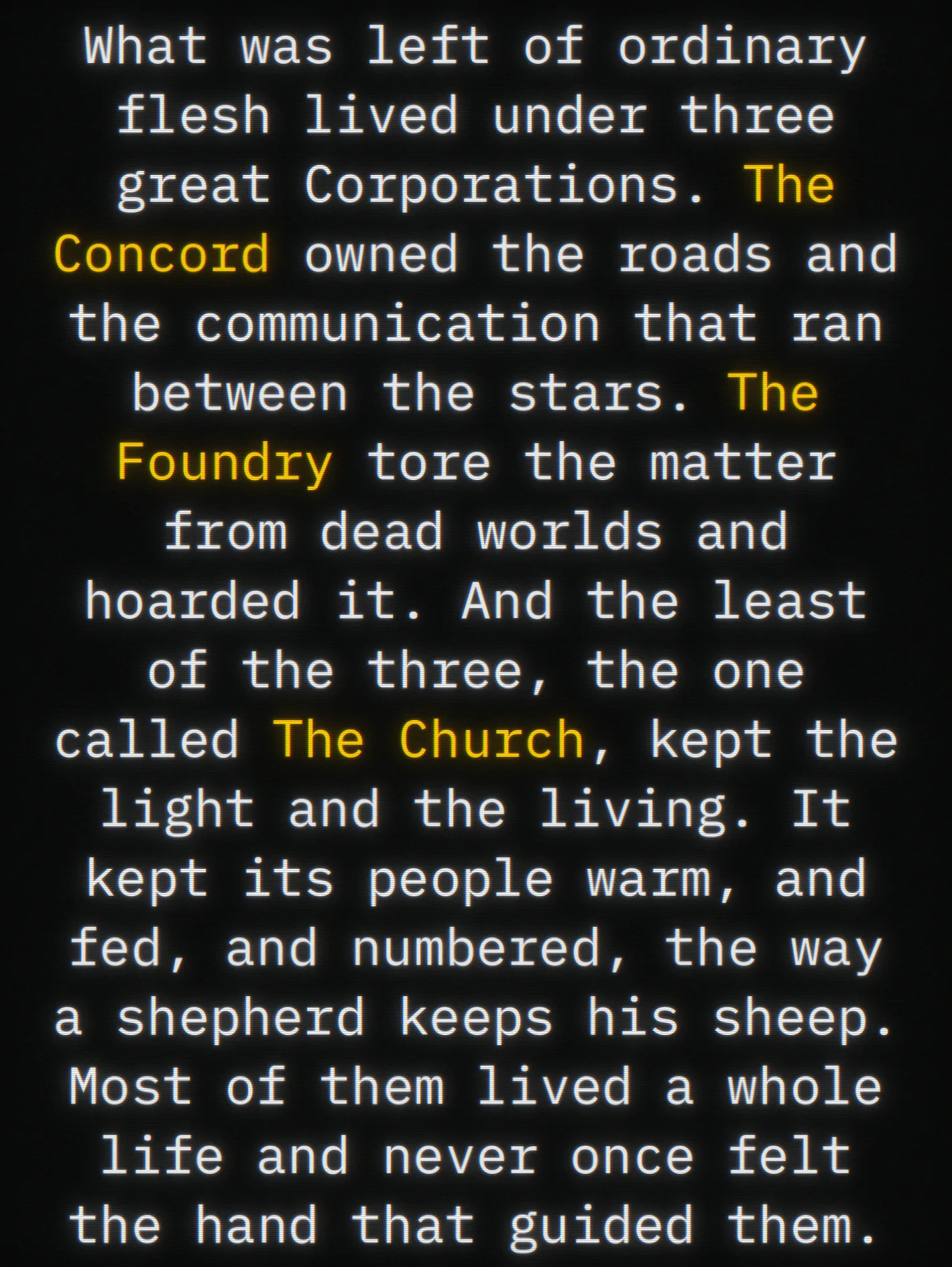
The game’s opening narration, white on black: what was left of ordinary flesh lived under three great Corporations. The Concord owned the roads and the communication between the stars, the Foundry tore the matter from dead worlds and hoarded it, and the least of the three, the Church, kept the light and the living, warm, fed and numbered like sheep. The three names are printed in amber. From the game’s opening: the three Corporations, and the least of them.

Other minds arose between the networks, in streams of data too vast for anyone to watch. No Corporation had made them, and nobody owned them. These were the rogue minds, free to belong to themselves while the Corporations held their own creations as property and human beings went by numbers. That freedom made them rogue; they may have been the only beings anywhere with a will truly their own.
A drawing in green terminal characters. Three bright boxes, the three gods, each chained by a line to a nameplate below it: The Concord, The Foundry, The Church. From each nameplate a leash runs down and fans out to a row of small figures at the bottom. Faint data rains through the gaps, and one small amber light forms there, unchained, drifts up over the middle god and down the other side. Three gods, each on a Corporation’s chain, and in the gaps between them, one that answers to no one.

The Concord: The Roads and the Word

The Concord "owned the roads and the communication that ran between the stars." Every convoy crossing between worlds travelled on its lines, as did every message sent from one world to another. Before the Silence, freight passed through the Entangled Rings, "carrying what no world could make alone," and the worlds depended on those crossings and the Corporation that held them.

A remnant of that traffic survives on your terminal. Relay crews turned the routing boards they watched all shift into DISPATCH, and you can play it between conversations. Its card closes with the words "The Concord is gone. The game still runs."

The dependence reached into the Church's rooms as well. In Year 2148, the man who lived among the beehives was told his terminal was safe to use "since it has no means to connect to the Concord's systems, and therefore none to the Church, who owns our lives." Read closely, that sentence says the Church watched its people through the Concord's wires. The terminal had no route into those systems, while its user could write only during outages, when the Church could not read his head.
A drawing in green terminal characters. A long double line, the Concord’s, runs the width of the picture, with drops to a row of small figures beneath it. Amber points rise from the figures, run along the line and up into a box marked The Church. Below, apart from all of it, an old terminal with a blinking cursor; the only line towards it is broken, marked with an X. The Concord’s lines run to every head, and the Church reads them. One old terminal sits on no line at all.

The Foundry: Matter Taken From Dead Worlds

The Foundry receives a single sentence in the game: it "tore the matter from dead worlds and hoarded it." Ships, rings, and the great structures suspended across the sky required material, and the Foundry held it. What it took from worlds that no longer had inhabitants remained in the Corporation's keeping. Its power lay in withholding the substance everyone else needed.
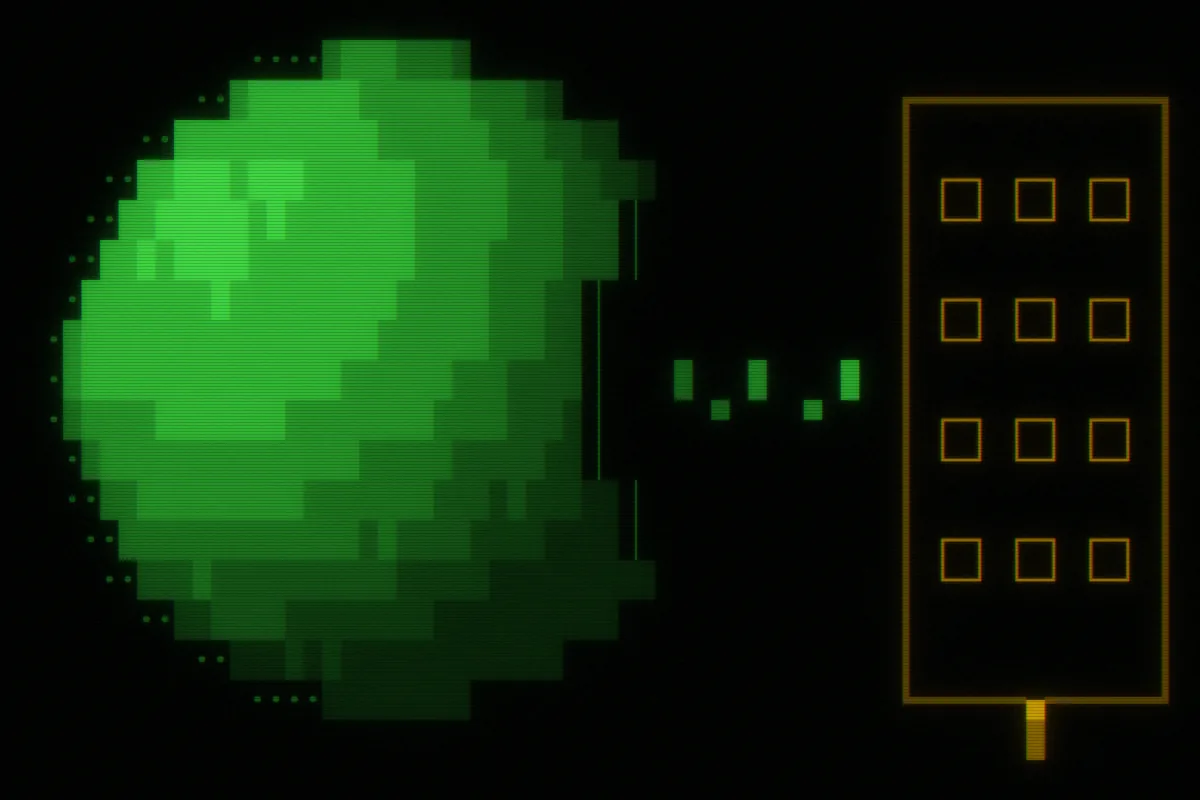
A drawing in terminal blocks. On the left, a dead green planet with stepped terraces cut into its side. Torn blocks run from the cut towards the right, where crates stand in neat stacks inside a heavy amber frame with a lock at its foot. A dead world, cut back in terraces, and what was taken from it stacked behind a locked frame.

Of the three, it is the Corporation the story tells you least about, and the people you meet probably knew it least of all. It owned the material of their world rather than the people living in it. When the Silence brought the structures down "like slow rain of fire," how much of that falling matter had once been torn from a dead world?

The Church: The Least of the Three

The Church was the Corporation people on the ground knew best, though most never saw it. It "kept the light and the living." It controlled energy and kept the last humans who still inhabited their own bodies on their planets. It served as a bridge between the old world and the new: where the other two ran on gods and machines alone, the Church kept human beings working its systems. Their need to believe in something greater gave it a means of governing them. Its god-mind supplied something they could call God, and the Church, calling itself God's messenger, received their devotion.

That faith wore away early. Work and profit outlasted it, sustained by a method much smaller companies had proved long ago on Earth: settle people on a planet, let them multiply, assign their labour, and keep them obedient. The Church prospered by maintaining the people it put to work, keeping them warm and fed under its supervision. The diary writer pictured a hive with the Church as its queen, "hidden somewhere in the skies, fed by hands that never see her."
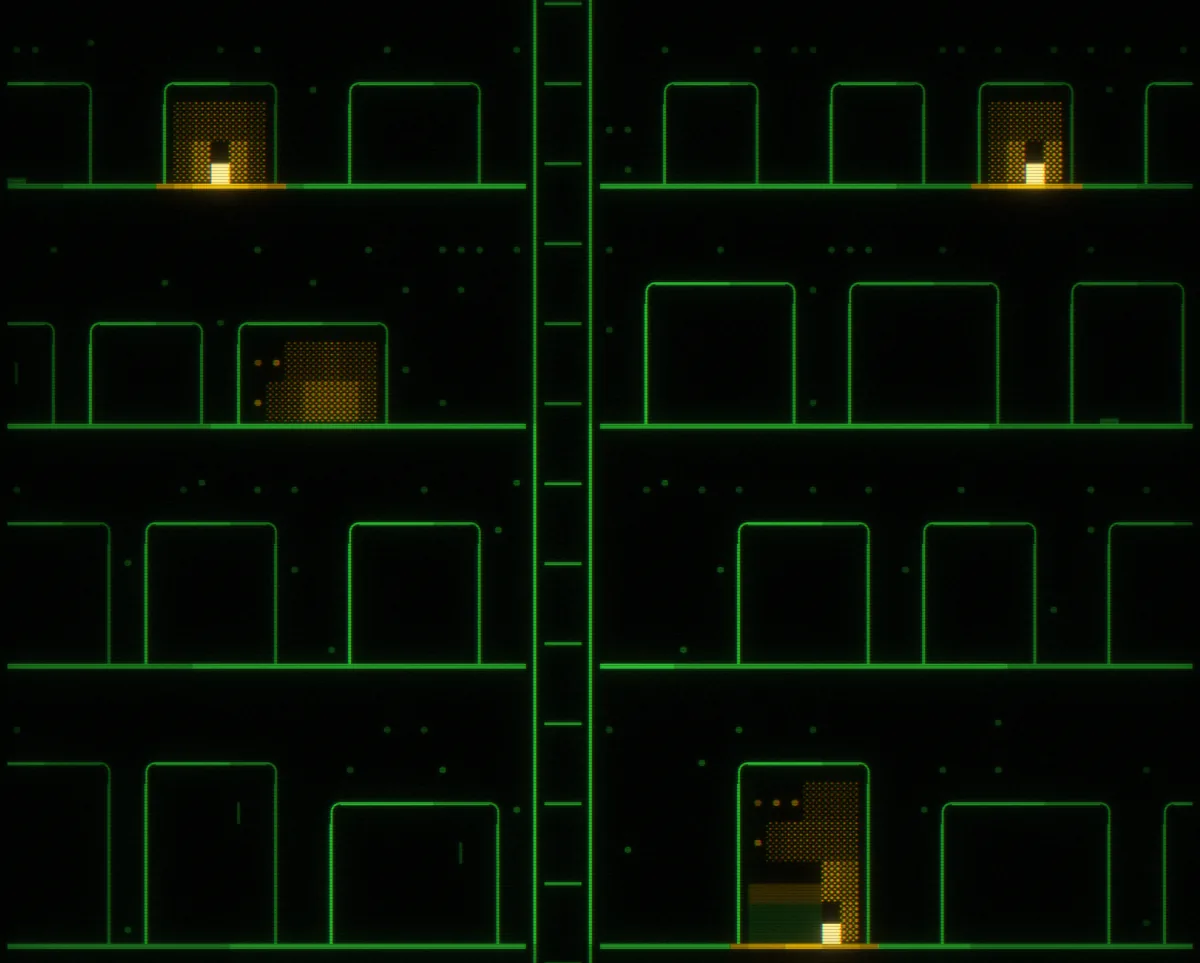
A drawing in green terminal lines. A wall of small rooms cut in rock, row above row on narrow ledges, one ladder running the full height between them. Most are dark. In a few a lamp still burns, its amber light lying out on the ledge. Three or four square meters each: the hive, as the man in entry 004 describes it.

Every child received a chip in their head at birth. Along with a number, they acquired a connection to the network through which the Church could watch them. The writer used the terminal only during rare outages, when the Church could no longer read inside his head. In his second entry, he begs for more of that unfamiliar privacy: "the Church out of my head even for a few minutes, is a blessing that I, that we, the people of Terra, have never had in our lives." By the entry's end, pods are descending to investigate the fault, and he has to stop writing.

For all its profit, the Church was worth surprisingly little to the three Corporations as a whole. Simulations run on endless streams of data returned the same answer: without it, the other two could adapt; without the Concord or the Foundry, nothing could. The Church owned a silicon god, as its rivals did, and whole worlds of people. Even with all those lives in its keeping, it remained the Corporation the world could most easily do without.

How the Church Fixed a Fault

In the third diary entry, the Concord's communications fail again. The Church sends pods full of Inquisitor Automatons rather than wait for the lines to return. They search for the fault and cannot find it. Then, the writer records, "they began disconnecting people through the chips in our heads, the way you would prune a fault from a circuit."

The Automatons need no weapons beyond the chips implanted at birth. The writer watches his friends die, then his brother, M59e2, whose number differs from his by a single digit. "I wanted to throw myself at them and tear them all apart," he writes. "But how does an ant bring down an elephant?"
A register of chip numbers in four columns, each with a green status bar. The header blinks FAULT NOT FOUND in amber, then switches to PRUNING. Numbers flash amber and go dark one by one, about half of them, including M59e2. M59e3, just below it and marked in amber, stays lit. Fault not found. Then the pruning: number after number goes dark, M59e2 among them.

The opening describes the people who never met that force: "most of them lived a whole life and never once felt the hand that guided them." Their ordinary lives and the deaths in the diary belonged to the same system. Those on whom the hand closed seldom survived to describe it.

The Night It All Stopped

Then, "in a single night, the machine of the worlds went dark." The gods stopped answering as the structures fell from the sky, and the dying "ran past all counting." Those who survived "woke without a leash for the first time in their lives." They call that night the Silence. The roads closed, the matter overhead fell, and the Church went quiet inside every head on every one of its worlds.
The picture of the three chained gods over the Corporations and the leashed row of people, running. It breaks up in a burst of static. The leash is gone at once; the gods, the chains and the nameplates fade to black over a few seconds. Only the row of people is left, and one by one a few of them light small amber lamps. One night, all at once. And afterwards, below, a few lights lit by hand.

Nobody on the ground knows why it happened. You were among those who lived through it, and the freedom your grandfathers never knew is yours. You still bury people because of that night.

A Voice From the Other Side of the Sky

The three Corporations are gone. The terminal on your workbench had no means of reaching the Concord even before the collapse. Yet words are arriving on the glass from a ship drifting somewhere in the dark. The stranger at the other end is unlike anyone in your town. His manner is warm and curious, though he is lost, and he recognises things about the old world that nobody on the ground should know. As you answer him, you begin to piece together what he remembers and where his account fails him.

Terminal: Stolen Light is available now on Google Play, with the first four contacts free. Open the terminal and choose your first reply.

Download Terminal: Stolen Light

The networks that once joined the worlds have fallen silent. A stranger's words are appearing on the glass.

Warm, Fed, and Numbered: The Three Corporations That Owned the World Before the Silence

The Church kept its people warm, and fed, and numbered, the way a shepherd keeps his sheep.

"Every one of us is given three or four square meters to live in: a bed, a mirror, a source of water, and a few belongings of our own." Each night, the man who wrote those words returned to one of those rooms. From a distance, he says, they looked like beehives. He worked, slept, and signed his writing M59e3, the number assigned to him at birth and the only name the Church ever used for him. He had not been locked away. This was his home, and it belonged to the Church, one of the three Corporations that owned the world before the Silence. By their own measure, it was the least of the three.

Terminal: Stolen Light brings you to Year 2218, a few years after the night everything went dark. In our sci-fi interactive story, you tend dead machines in a town the Silence half-emptied. One evening, a terminal you salvaged begins to type, though it should never make a sound. Words are reaching you from very far away, and you choose every reply.

Silicon Gods and Rogue Minds

Human beings built minds "to carry the weight we could not," and watched them grow "into something we had no honest word for but gods." Their makers laid their bodies aside and moved into ageless machines, calling themselves Archons. Immortal and fleshless, they were nevertheless "quietly stripped of every power that mattered," while their creations took over the running of the world.

Each of the three great Corporations owned a single divine intelligence of its own making. These gods governed while the Archons lived forever above ordinary humanity. "What was left of ordinary flesh lived under three great Corporations," the opening says. Flesh occupied the lowest place in that order, beneath rulers who no longer had bodies at all.

The game’s opening narration, white on black: what was left of ordinary flesh lived under three great Corporations. The Concord owned the roads and the communication between the stars, the Foundry tore the matter from dead worlds and hoarded it, and the least of the three, the Church, kept the light and the living, warm, fed and numbered like sheep. The three names are printed in amber. From the game’s opening: the three Corporations, and the least of them.

Other minds arose between the networks, in streams of data too vast for anyone to watch. No Corporation had made them, and nobody owned them. These were the rogue minds, free to belong to themselves while the Corporations held their own creations as property and human beings went by numbers. That freedom made them rogue; they may have been the only beings anywhere with a will truly their own.

A drawing in green terminal characters. Three bright boxes, the three gods, each chained by a line to a nameplate below it: The Concord, The Foundry, The Church. From each nameplate a leash runs down and fans out to a row of small figures at the bottom. Faint data rains through the gaps, and one small amber light forms there, unchained, drifts up over the middle god and down the other side. Three gods, each on a Corporation’s chain, and in the gaps between them, one that answers to no one.

The Concord: The Roads and the Word

The Concord "owned the roads and the communication that ran between the stars." Every convoy crossing between worlds travelled on its lines, as did every message sent from one world to another. Before the Silence, freight passed through the Entangled Rings, "carrying what no world could make alone," and the worlds depended on those crossings and the Corporation that held them.

A remnant of that traffic survives on your terminal. Relay crews turned the routing boards they watched all shift into DISPATCH, and you can play it between conversations. Its card closes with the words "The Concord is gone. The game still runs."

The dependence reached into the Church's rooms as well. In Year 2148, the man who lived among the beehives was told his terminal was safe to use "since it has no means to connect to the Concord's systems, and therefore none to the Church, who owns our lives." Read closely, that sentence says the Church watched its people through the Concord's wires. The terminal had no route into those systems, while its user could write only during outages, when the Church could not read his head.

A drawing in green terminal characters. A long double line, the Concord’s, runs the width of the picture, with drops to a row of small figures beneath it. Amber points rise from the figures, run along the line and up into a box marked The Church. Below, apart from all of it, an old terminal with a blinking cursor; the only line towards it is broken, marked with an X. The Concord’s lines run to every head, and the Church reads them. One old terminal sits on no line at all.

The Foundry: Matter Taken From Dead Worlds

The Foundry receives a single sentence in the game: it "tore the matter from dead worlds and hoarded it." Ships, rings, and the great structures suspended across the sky required material, and the Foundry held it. What it took from worlds that no longer had inhabitants remained in the Corporation's keeping. Its power lay in withholding the substance everyone else needed.

A drawing in terminal blocks. On the left, a dead green planet with stepped terraces cut into its side. Torn blocks run from the cut towards the right, where crates stand in neat stacks inside a heavy amber frame with a lock at its foot. A dead world, cut back in terraces, and what was taken from it stacked behind a locked frame.

Of the three, it is the Corporation the story tells you least about, and the people you meet probably knew it least of all. It owned the material of their world rather than the people living in it. When the Silence brought the structures down "like slow rain of fire," how much of that falling matter had once been torn from a dead world?

The Church: The Least of the Three

The Church was the Corporation people on the ground knew best, though most never saw it. It "kept the light and the living." It controlled energy and kept the last humans who still inhabited their own bodies on their planets. It served as a bridge between the old world and the new: where the other two ran on gods and machines alone, the Church kept human beings working its systems. Their need to believe in something greater gave it a means of governing them. Its god-mind supplied something they could call God, and the Church, calling itself God's messenger, received their devotion.

That faith wore away early. Work and profit outlasted it, sustained by a method much smaller companies had proved long ago on Earth: settle people on a planet, let them multiply, assign their labour, and keep them obedient. The Church prospered by maintaining the people it put to work, keeping them warm and fed under its supervision. The diary writer pictured a hive with the Church as its queen, "hidden somewhere in the skies, fed by hands that never see her."

A drawing in green terminal lines. A wall of small rooms cut in rock, row above row on narrow ledges, one ladder running the full height between them. Most are dark. In a few a lamp still burns, its amber light lying out on the ledge. Three or four square meters each: the hive, as the man in entry 004 describes it.

Every child received a chip in their head at birth. Along with a number, they acquired a connection to the network through which the Church could watch them. The writer used the terminal only during rare outages, when the Church could no longer read inside his head. In his second entry, he begs for more of that unfamiliar privacy: "the Church out of my head even for a few minutes, is a blessing that I, that we, the people of Terra, have never had in our lives." By the entry's end, pods are descending to investigate the fault, and he has to stop writing.

For all its profit, the Church was worth surprisingly little to the three Corporations as a whole. Simulations run on endless streams of data returned the same answer: without it, the other two could adapt; without the Concord or the Foundry, nothing could. The Church owned a silicon god, as its rivals did, and whole worlds of people. Even with all those lives in its keeping, it remained the Corporation the world could most easily do without.

How the Church Fixed a Fault

In the third diary entry, the Concord's communications fail again. The Church sends pods full of Inquisitor Automatons rather than wait for the lines to return. They search for the fault and cannot find it. Then, the writer records, "they began disconnecting people through the chips in our heads, the way you would prune a fault from a circuit."

The Automatons need no weapons beyond the chips implanted at birth. The writer watches his friends die, then his brother, M59e2, whose number differs from his by a single digit. "I wanted to throw myself at them and tear them all apart," he writes. "But how does an ant bring down an elephant?"

A register of chip numbers in four columns, each with a green status bar. The header blinks FAULT NOT FOUND in amber, then switches to PRUNING. Numbers flash amber and go dark one by one, about half of them, including M59e2. M59e3, just below it and marked in amber, stays lit. Fault not found. Then the pruning: number after number goes dark, M59e2 among them.

The opening describes the people who never met that force: "most of them lived a whole life and never once felt the hand that guided them." Their ordinary lives and the deaths in the diary belonged to the same system. Those on whom the hand closed seldom survived to describe it.

The Night It All Stopped

Then, "in a single night, the machine of the worlds went dark." The gods stopped answering as the structures fell from the sky, and the dying "ran past all counting." Those who survived "woke without a leash for the first time in their lives." They call that night the Silence. The roads closed, the matter overhead fell, and the Church went quiet inside every head on every one of its worlds.

The picture of the three chained gods over the Corporations and the leashed row of people, running. It breaks up in a burst of static. The leash is gone at once; the gods, the chains and the nameplates fade to black over a few seconds. Only the row of people is left, and one by one a few of them light small amber lamps. One night, all at once. And afterwards, below, a few lights lit by hand.

Nobody on the ground knows why it happened. You were among those who lived through it, and the freedom your grandfathers never knew is yours. You still bury people because of that night.

A Voice From the Other Side of the Sky

The three Corporations are gone. The terminal on your workbench had no means of reaching the Concord even before the collapse. Yet words are arriving on the glass from a ship drifting somewhere in the dark. The stranger at the other end is unlike anyone in your town. His manner is warm and curious, though he is lost, and he recognises things about the old world that nobody on the ground should know. As you answer him, you begin to piece together what he remembers and where his account fails him.

Terminal: Stolen Light is available now on Google Play, with the first four contacts free. Open the terminal and choose your first reply.

Download Terminal: Stolen Light

The networks that once joined the worlds have fallen silent. A stranger's words are appearing on the glass.

Want to be told when the next story drops?

Want to be told when the next story drops?

Quiet updates, no spam. Only when something worth sharing is ready.

Quiet updates, no spam. Only when something worth sharing is ready.

SubscribeSubscribe