
"Only the words. I asked the ship for more than words. This is all it will carry."
The letters arrive one by one, green against black, with enough silence between them for a faraway stranger to seem to be choosing his words. You will never see him or hear his voice, and he will never see or hear you. We spent a great deal of time on what those letters could convey. On this terminal, a full stop lasts six times as long as an ordinary character, a comma two and a half. We set those intervals so that even the pause at the end of a sentence could suggest someone considering what to say next.
Terminal: Stolen Light, our sci-fi interactive story for Android, takes you to Year 2218. The Silence ended the old world in a single night a few years earlier, leaving the town where you mend machines half-empty. One evening, words begin to arrive on a terminal you salvaged, a machine that has never made a sound. The man sending those words is adrift on a ship, and you choose what he receives in reply. Everything happens on the same screen, with no view beyond the words.
The Glass Is the Boundary
Our design document describes the terminal screen with an instruction that governed everything around it: "it is the game world." Even the ordinary business of using an app had to belong there. Opening the settings or reaching the purchase screen should feel like something done at the terminal, within the same fiction as the conversation.
Settings sit behind a key marked [SYS]. Five blocks in the header, ▓▓▓░░, show the strength of the connection. They fall while he transmits, as though each message were drawing on the line's reserves. The recovered diary files carry edit and delete icons convincing enough to invite a press, but the terminal answers: "Nothing here is yours to erase." At the end of the free story, the request for its one purchase appears as an encrypted channel, reached through [ ESTABLISH PERMANENT LINK ]. When you shut the terminal down from within, the picture collapses like an old tube losing power.
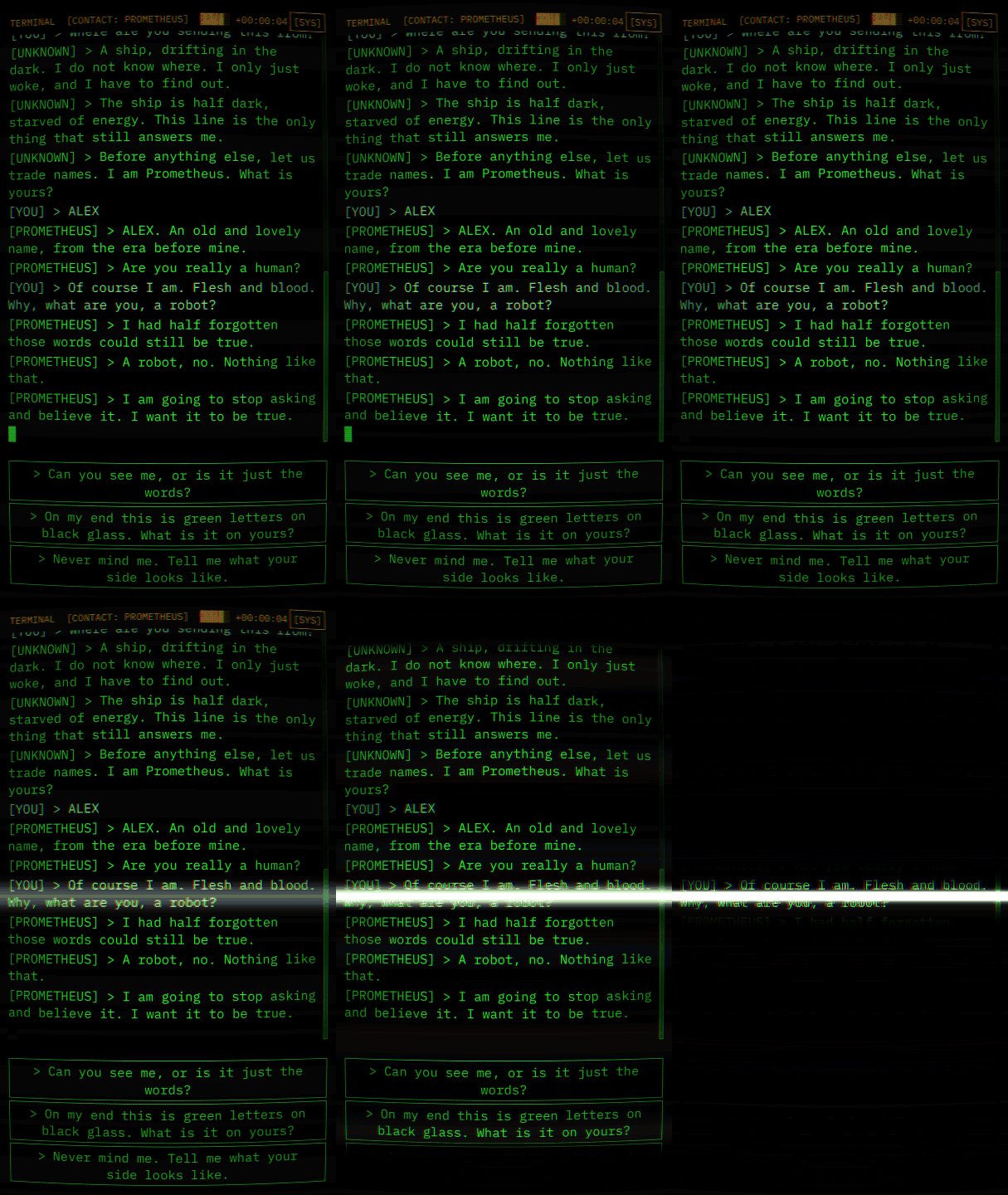 Shut the terminal down from inside, and the picture folds into a single line of light.
Terminal: Stolen Light first appeared with text alone. Adding pictures later meant answering a difficulty we had set ourselves: only words could travel between you and the man on the ship. Any image on the screen had to respect that limit.
He still cannot send you pictures. The terminal displays character drawings on a grid sixty-four columns wide, beneath the same CRT glass, with no image files behind them. An old terminal wakes in an empty room, drawn in the letters it is about to receive. There are sixteen of these across the story. Most sit within the conversation and remain when you scroll back. A few occupy the whole screen: the words fade out, the picture plays, then the words return with the picture preserved in the log. [SYS] also lets you remove them and keep only the text.
The Uneven Measure of a Voice
On the glass, phosphor green belongs to him, a paler green to you, and amber to the terminal itself. Each also has a rhythm. The system prints every character at an unvarying interval, which a note in our code calls "perfectly metronomic." Your replies appear about three times faster, because you have already chosen them; the screen is returning words you know. Neither needs the small uncertainties we gave to the stranger.
Most of his words arrive in quick bursts, with slower stretches between them. Punctuation checks his pace, as though he were reading himself aloud, and occasionally he lingers after a word. About once in every ten lines, he stops midway for a second or two. The key clicks stop with him, leaving the sentence unfinished until he resumes. Beside the machine's unbroken regularity, those interruptions begin to sound like hesitation. The two-word note above the code reads "Irregular = alive." We recommend headphones so you can hear where he falters.
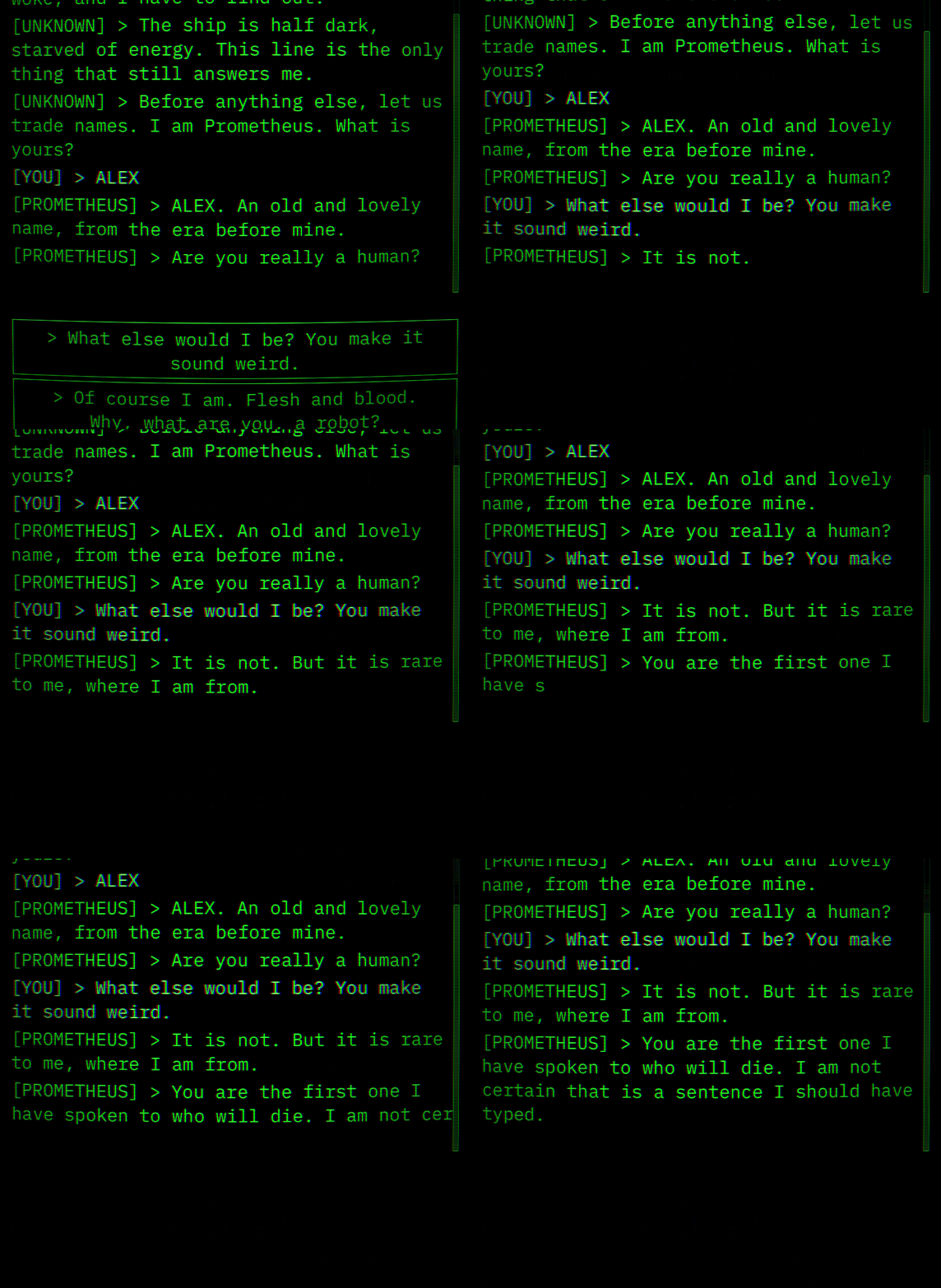 Your reply comes back at once. His comes in his own time.
Our first typing effect erased and retyped a few letters at random. It resembled typing, but those slips told you nothing about him, so we discarded them. We chose the wording and placement of the story's thirty-six corrections, across all its branches. He types the wrong word, waits a quarter of a second, then erases it letter by letter before substituting the one he would rather you read. During the first contact, when you give him your name, he begins with "recorded." You watch that word disappear and "lovely" take its place.
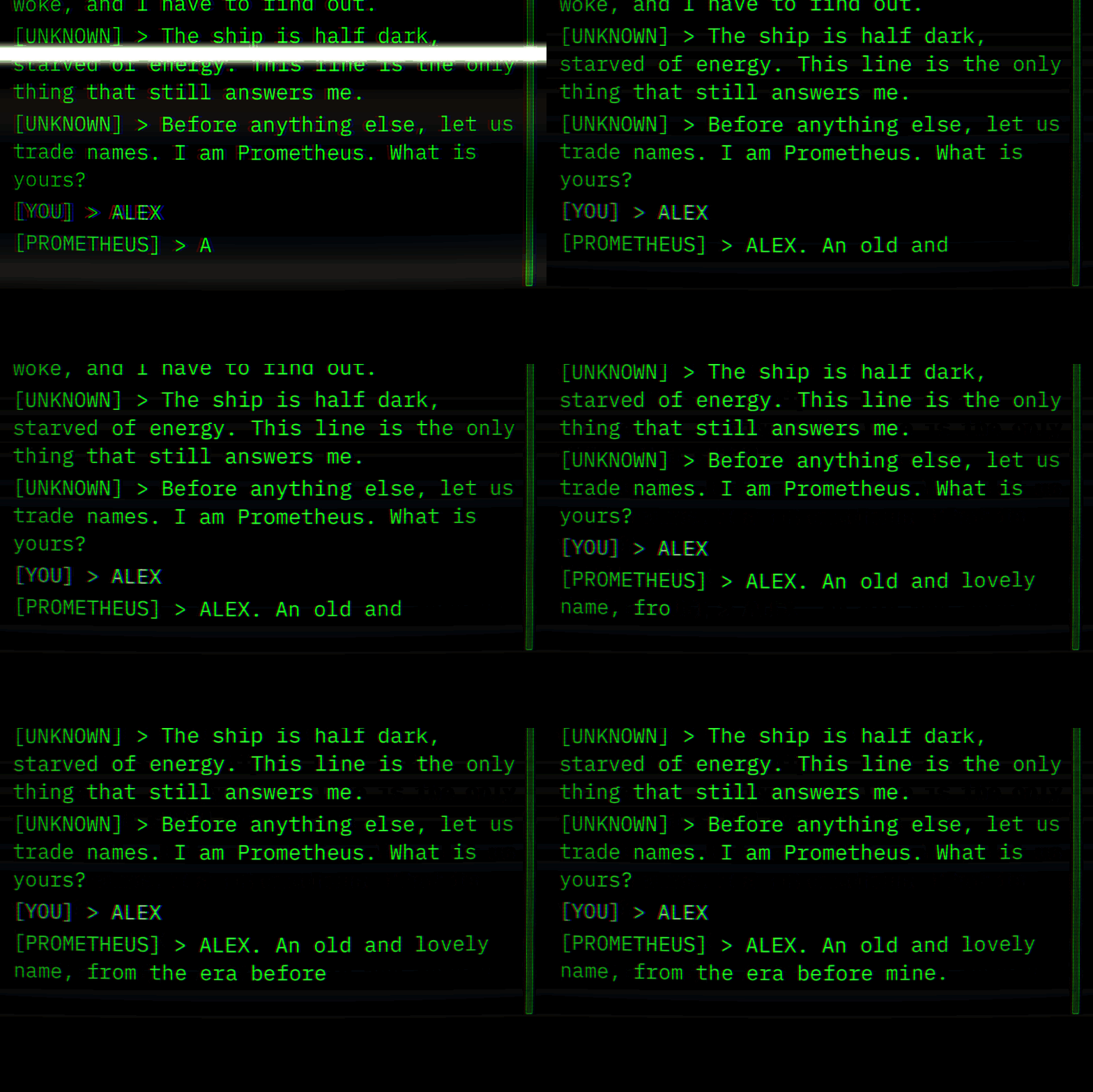 You give him your name. He starts to call it “recorded,” stops, and takes the word back.
Only "lovely" survives in the transcript. Scroll back later and the earlier word has left no trace; tap to skip the typing and you miss the correction altogether. We kept that option because watching him compose a line should be a choice, even when patience reveals something the finished record will never show.
Nearly every reply offers three choices, and we reserve space for three buttons at the foot of the screen so the conversation keeps its position as you read. They remain absent until he has finished typing. For all the ways a phone lets you interrupt, here an answer has to wait for the end of his sentence.
Press a reply and the button turns solid green for a moment, with a small tick against your fingers, before your words move up the screen. Free typing is reserved for two moments across the story: the name you give him at first contact, and a second, much later occasion we will leave you to find.
Static in the Glow
The failing connection had to reach the reader through the glass and into the hand holding the phone. We placed each burst of static at a fixed point in the script, after a chosen sentence. The picture tears, the last line becomes solid blocks for a fifth of a second, the signal meter plunges, and the phone gives a single thump in your hand. You may begin to look back at what he had just said when the line broke. The system reports on the same event with its composure undisturbed: "NO FAULT DETECTED ON THIS TERMINAL."
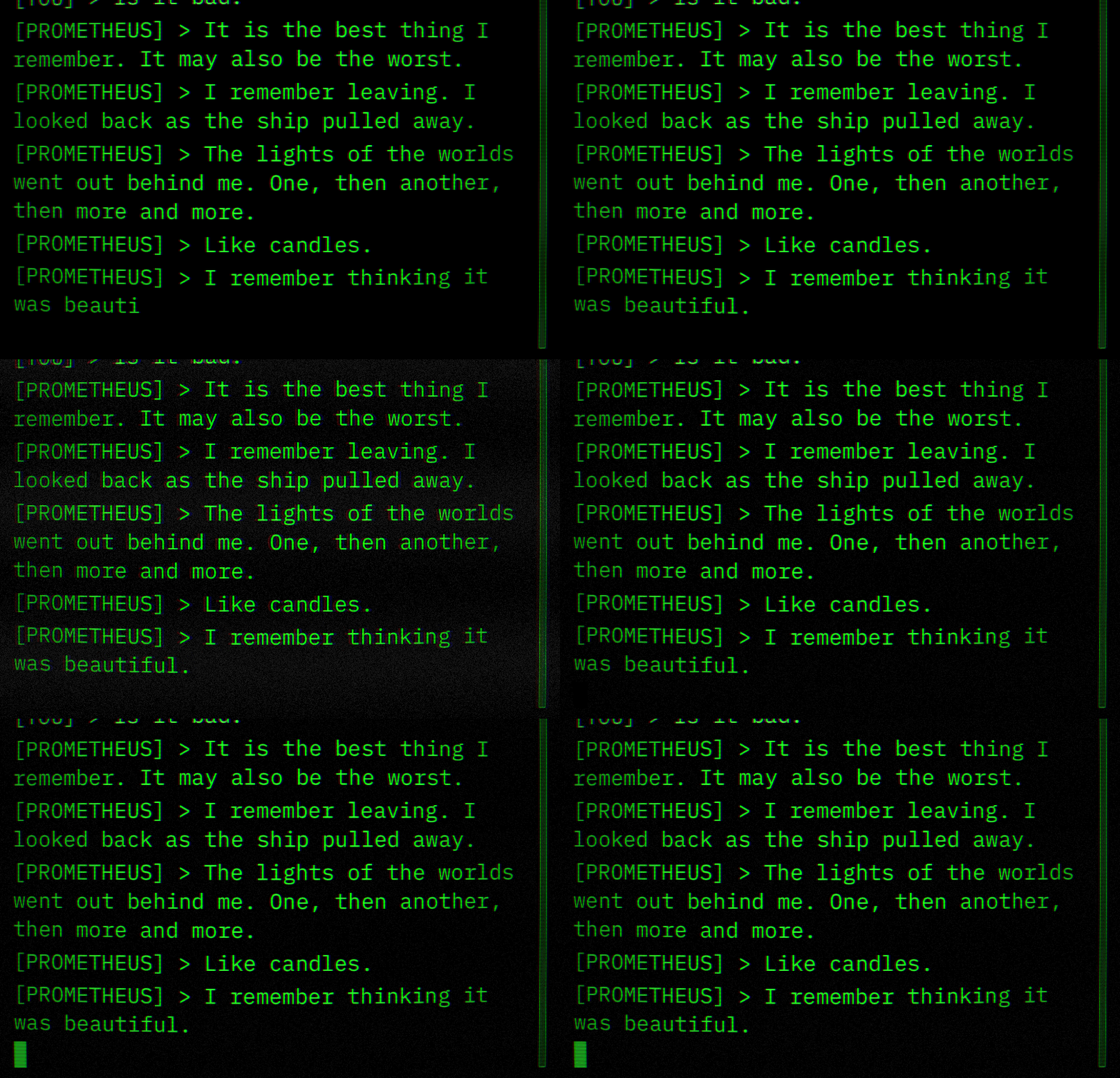 “I remember thinking it was beautiful.” Then the signal tears.
The glass bends slightly at the edges. Scanlines cross the display, colours separate by a hair, the corners darken, and the letters glow through a faint flicker. These are the first details people tend to notice, and they can also make the screen uncomfortable for anyone sensitive to flashing visuals. The appearance of the old screen had to remain something a reader could change.
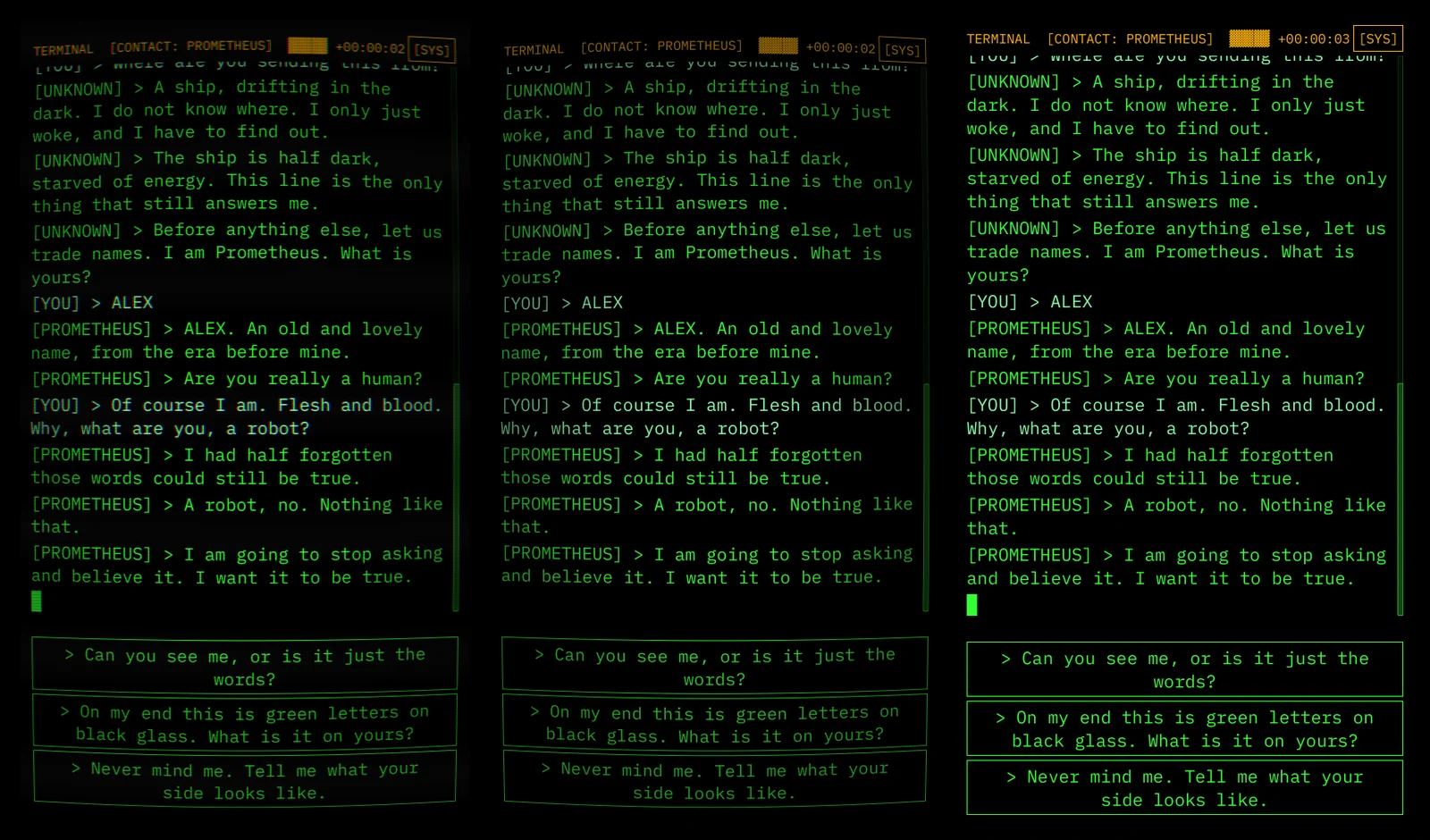 The same moment three ways, left to right: CRT effects on FULL, SUBTLE and OFF.
Every launch therefore opens on a plain warning, with directions to turn the effects off and no CRT effects of its own. Our note on that screen says it "must not flash the very effect it is warning about before the player can turn it off." In [SYS], the choices are FULL, SUBTLE or OFF, alongside four text sizes and five typing speeds, from SLOWER to INSTANT. We wanted the glass to have a presence without making anyone endure its flicker to read.
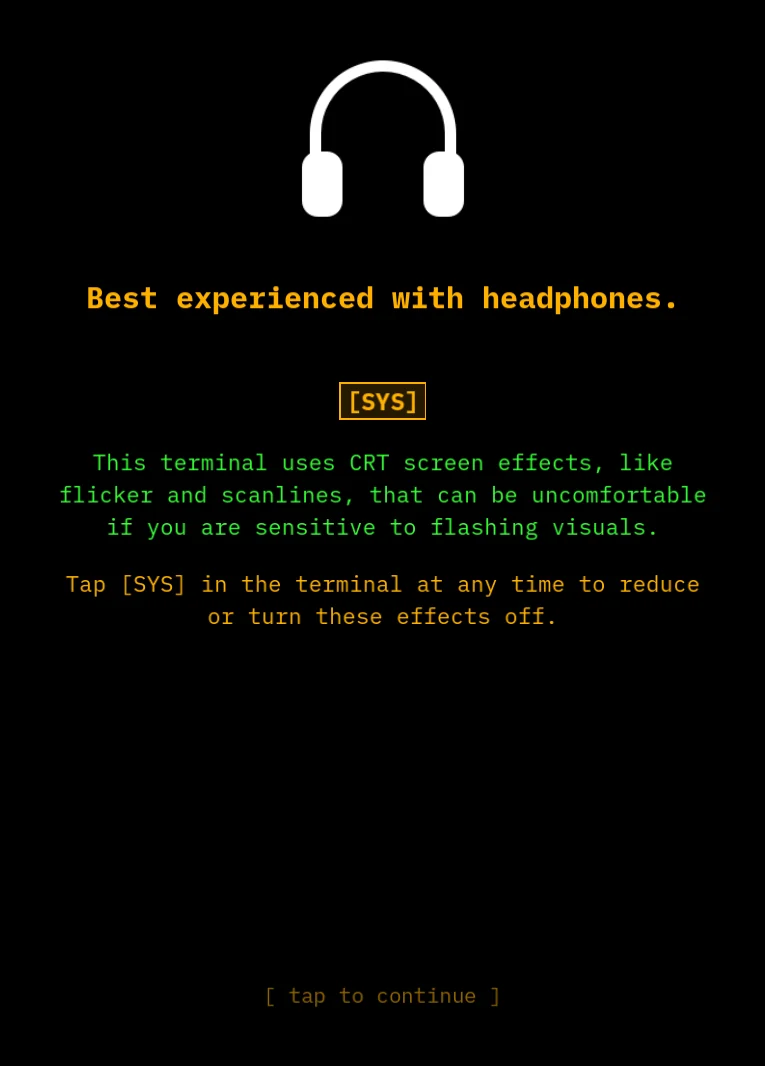 The first thing the game shows, every time. The only screen with no CRT at all.
The Hours After He Leaves
When he leaves, the conversation falls still. The story stops for ten minutes at the start and for as long as six hours later on. We built a countdown for these intervals, but none of them uses it. The glass reads "SIGNAL LOST. WAITING FOR CARRIER..." He cannot tell you when he will return, and the screen offers no greater certainty.
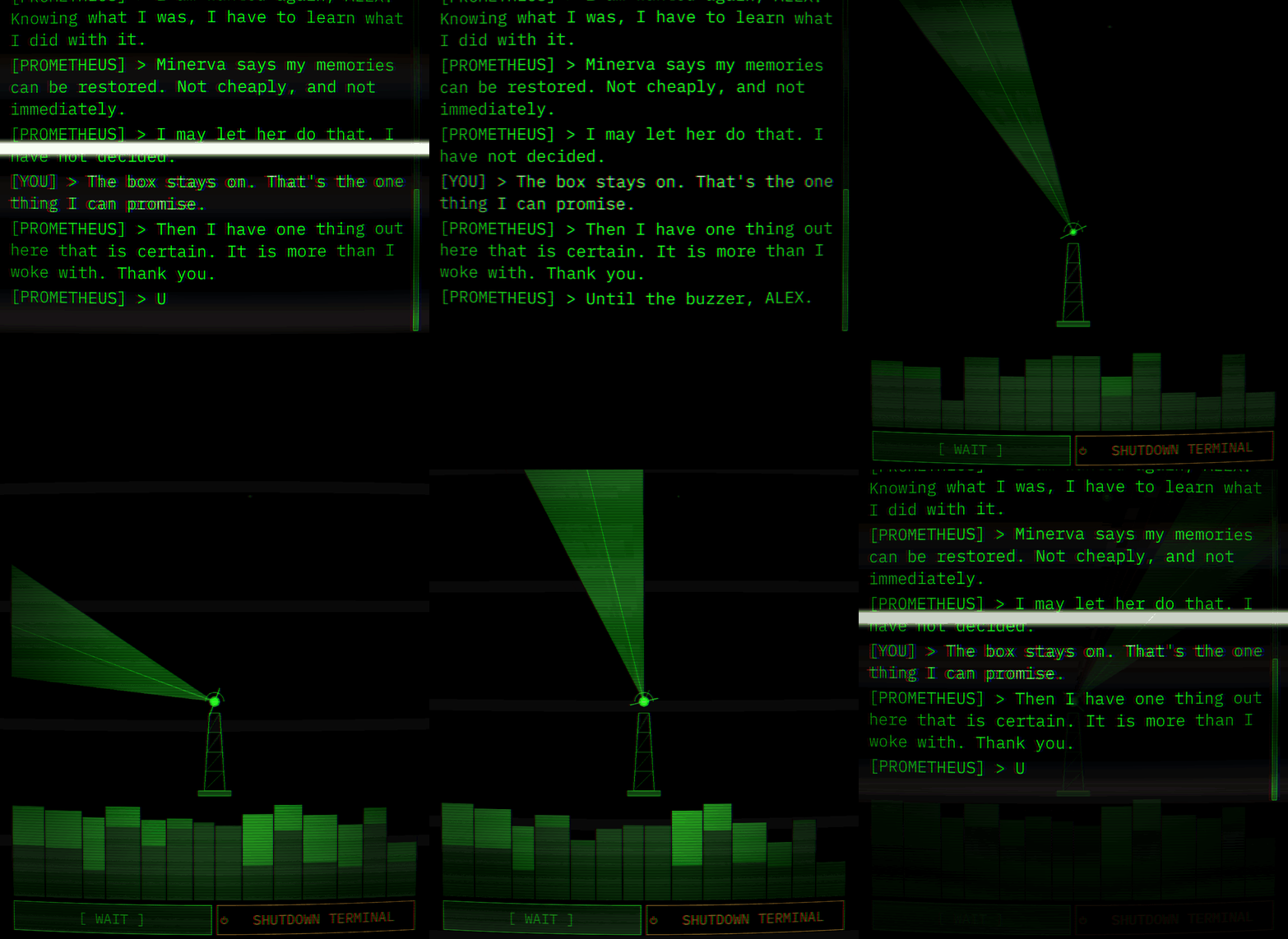 “Until the buzzer, ALEX.” And then the terminal settles in to wait.
While he is gone, the picture dims. Scanlines deepen, the corners close in, and the glow rises and falls over eight seconds, a rhythm our code calls "the held breath." Music comes on, and there is a beacon you can sweep across a dark sky, a puzzle left by the old relay crews, and diary files that slowly become readable.
At the end of the second conversation, he signs off with "Until the buzzer," followed by your name. Within the fiction, that buzzer is wired to the terminal; on your phone, the notification reads "The terminal is buzzing again. He is back." Our design notes put it in a sentence we kept returning to: "The mechanic and the story are the same object."
Terminal: Stolen Light can now be downloaded from Google Play. The first four contacts are free, with the rest available through a single one-time purchase. It plays offline, without ads or an account, and collects no data.
Download Terminal: Stolen Light
Play late, with headphones and the typing speed left alone. Let the sentence arrive, and watch what he erases.