September 18, 2026 · chara_bachtsevani

#devlog #interactive-fiction

Why We Gave The Red Tomorrow Fifteen Endings Instead of One

Once a year the wells come open, and the vapours rise from them the way mist lifts off dark water on a cold morning. What climbs out behind the mist comes fast, and it comes hungry for the living. Jonas has spent such a night fighting those risen things, as the men of the boglands have always done, and he comes home in the grey hours afterward to find his son's bed empty. The boy has been taken, carried off toward the heart of the realm, and the road that follows him there runs through a kingdom that has long since learned to look away.
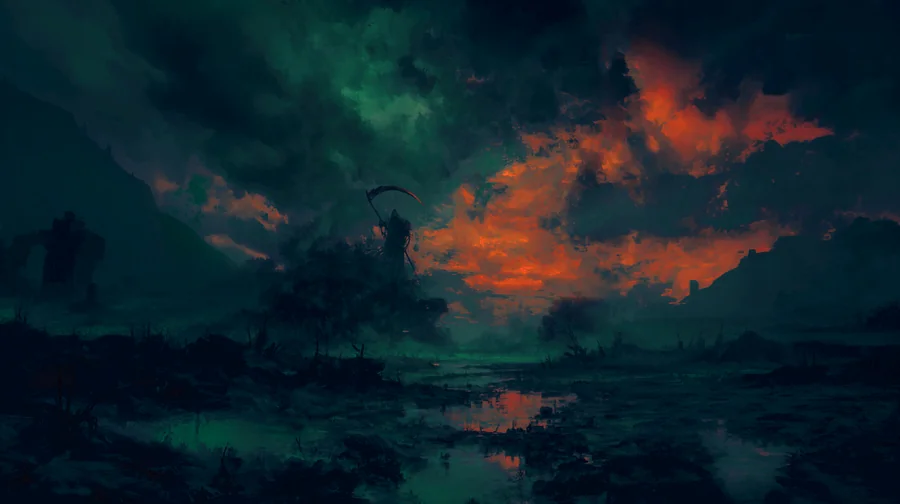
A drowned swamp of dead trees and black water under a red, burning sky. The wells, on the last night of the raid.

That is where The Red Tomorrow opens, and it opens there for everyone. It is an illustrated dark fantasy novel that plays like a choose-your-own-adventure game with multiple endings, a hundred and eighty-one chapters deep, in which the choices you make on Jonas's behalf are remembered long after you have forgotten making them. Where the road ends, however, is a different matter entirely, and for a long stretch of the writing we could not have told you either.

A Story Grown Rather Than Drawn

We never sat down with a number in mind and built fifteen doors for a reader to choose between. A story of this shape is grown rather than drafted, tended more than engineered, and we have come to think of the work as gardening rather than architecture: you put things in the ground, you watch what takes root and what withers, and you follow the growth where it insists on going rather than pruning it back into the diagram you sketched before planting.

What kept insisting, chapter after chapter, were consequences we had not accounted for. A decision made in the opening hours would still be standing thirty chapters later, unpaid, waiting for its reckoning like a debt that had merely gone quiet. By the time the story approached its final movement, the conclusions that could honestly follow from everything a reader might have done were not one, and were not some obliging round number either. They were fifteen.

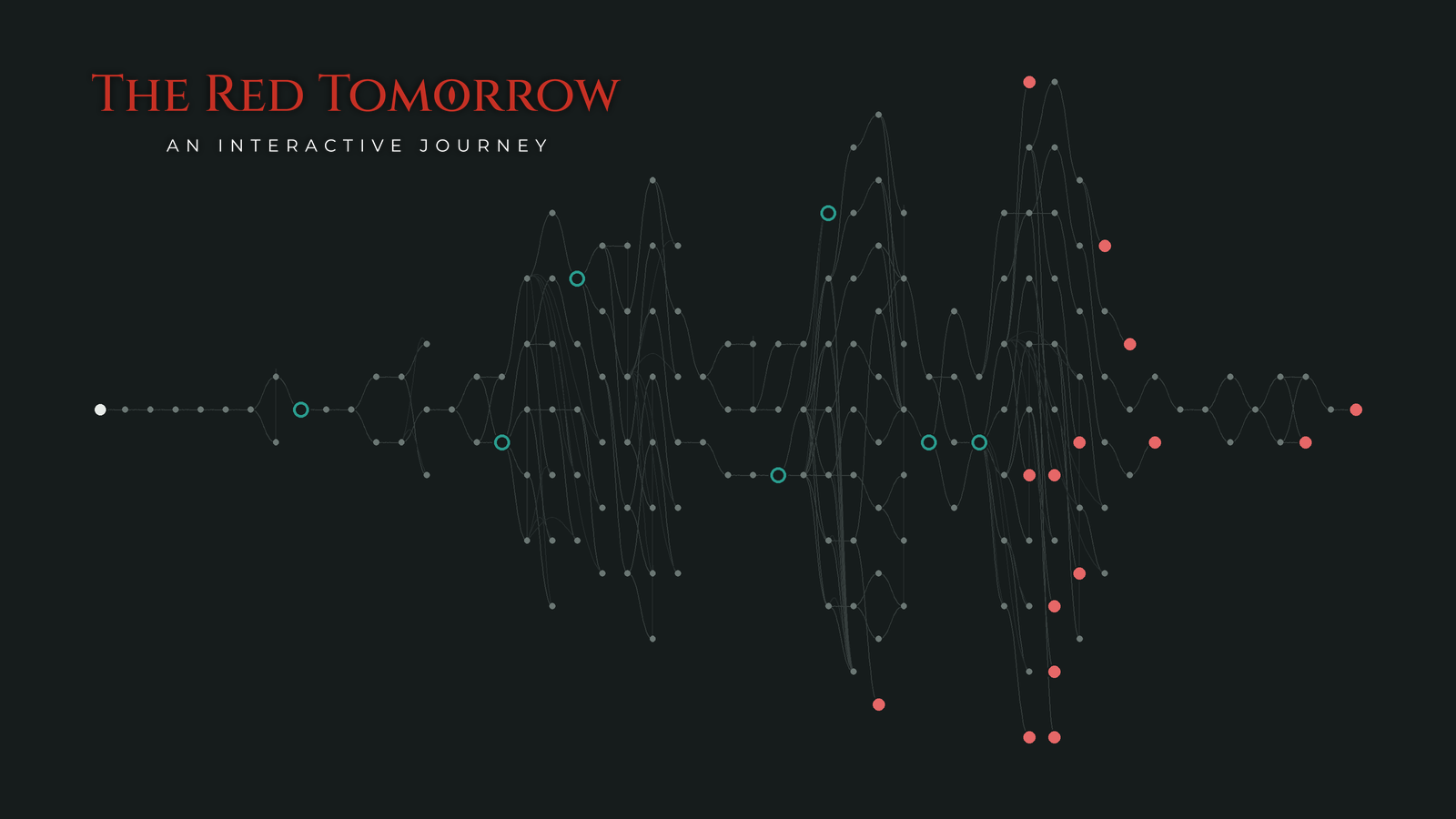
An animated map of the story’s chapters growing from the prologue on the left, with crossroads as teal rings and fifteen endings appearing as red dots at the far end. The whole story, chapter by chapter: 181 chapters, seven crossroads, and the fifteen endings it grew into.

What Fifteen Actually Means

Some of those fifteen stand at great distance from one another: different fates for Jonas, different prices paid and by whom. Others sit close together, kin rather than strangers, divided by nothing more than a handful of decisions taken chapters earlier and half-forgotten since. Change what you chose, and the ending shifts with it, the way a river finds an altogether different sea depending on which bank first turned it.

Fewer conclusions would have meant flattening outcomes that deserved to stay distinct, quietly informing a reader that their decisions weighed less than they had been led to believe. More would have meant manufacturing divergence for its own sake, doors built to swell a number rather than to answer a road that anyone had walked. Fifteen was what the work demanded once we stopped deciding in advance and let the consequences accumulate at their own pace, until they arrived at their own resting places without our help.

No Door Opens Early

None of those endings arrives cheaply, and none of them arrives soon. No conclusion in The Red Tomorrow can reach a reader before the thirtieth chapter, whatever they choose and however recklessly they choose it. An ending that lands before the story has earned it stops being a consequence and becomes an interruption wearing a consequence's clothes, and a reader who trips into one that early has been cheated rather than answered.
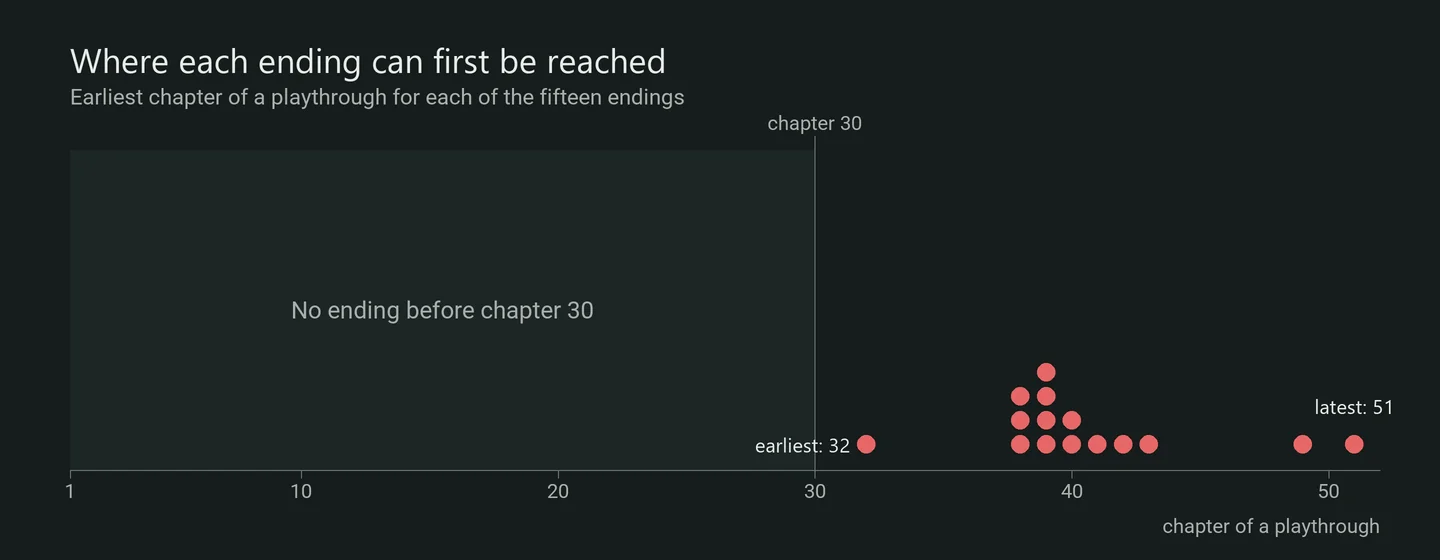
A chart of the fifteen endings by the earliest chapter each can be reached, all falling between chapters 32 and 51, with chapters 1 to 30 shaded and empty. No ending can be reached before chapter 30. The earliest is chapter 32, and most arrive between 38 and 43.

There is a second reason for the rule. The kingdom takes a long while to show a reader what it truly is: what the prophecy carved into the roadside stones is promising, and what the great houses keep beneath their roofs and their sigils. A conclusion arriving before the reader has felt the weight of that would land on ground too soft to hold it.

The Crossroads You Can Return To

A story this unwilling to forgive a decision needs some mercy folded into it somewhere, or nobody would ever dare the road they didn't take. So the game holds seven Crossroads in memory as you go, the major forks where a single decision reshaped everything downstream of it. Reach an ending, and you can return to one of those seven and walk the other way instead, without starting over from the first page. The path you turned away from stays open behind you, and finding out what was standing at the end of it asks nothing of you but the nerve to go back and look.

The game’s Crossroads screen listing seven saved forks, one of them held down, then a prompt asking to rewind time to The Old Crone. The seven Crossroads, held in memory. Press one, and time rewinds to that fork.

Fourteen, Then Fifteen

The number has already moved once. The Red Tomorrow held at fourteen endings until an update this past August, when new material we had written opened a fifteenth door the story had not possessed before. Readers who had already found all fourteen kept what they had earned; nobody who walked every road available to them lost anything for having walked it early.

Fourteen was the true shape of the story on the day we counted it. Fifteen is the true shape of it now.

Sixty-Four Thousand States, Walked in the Dark

A structure carrying this much memory can fail in ways no writer will ever catch by reading. Two hundred and seventy-four choices run through those hundred and eighty-one chapters, and forty-seven of them open, or refuse to open, purely because of something decided many pages earlier: a door standing ajar for one reader and sealed against another, both of them having walked the same story to arrive in front of it.

So before any change we make ever reaches a reader, a route checker walks the entire map on our behalf, confirming sixty-four thousand seven hundred and eight possible game states one at a time, verifying that all fifteen endings remain reachable and that no combination of choices can strand anyone in a corner the story never intended to leave them in. The branches split often across those chapters, but they do not sprawl outward forever. They fold back, again and again, into a handful of major crossings, which is the only reason a structure of this size remains a story rather than collapsing into a maze that not even its own writers could hold in their heads.

What Comes Next

Fifteen endings taught us how far past its first imagined shape a story can grow when you let it. There is another story in the workshop now: years in the writing, closing on its final chapters, and set to run nearly three times the length when it is done. We are not ready to say more about it yet. When we are, we will say it in our newsletter. If you would rather not learn about it secondhand, that is where to stand.

The Red Tomorrow is available to download now, and all fifteen roads through it are open, worn in by every reader who has chosen before you.


Download The Red Tomorrow · Join the Newsletter

One taken child, one road, and fifteen ways it can end. Take the first step and find out which one is waiting for you.

Why We Gave The Red Tomorrow Fifteen Endings Instead of One

Once a year the wells come open, and the vapours rise from them the way mist lifts off dark water on a cold morning. What climbs out behind the mist comes fast, and it comes hungry for the living. Jonas has spent such a night fighting those risen things, as the men of the boglands have always done, and he comes home in the grey hours afterward to find his son's bed empty. The boy has been taken, carried off toward the heart of the realm, and the road that follows him there runs through a kingdom that has long since learned to look away.

A drowned swamp of dead trees and black water under a red, burning sky. The wells, on the last night of the raid.

That is where The Red Tomorrow opens, and it opens there for everyone. It is an illustrated dark fantasy novel that plays like a choose-your-own-adventure game with multiple endings, a hundred and eighty-one chapters deep, in which the choices you make on Jonas's behalf are remembered long after you have forgotten making them. Where the road ends, however, is a different matter entirely, and for a long stretch of the writing we could not have told you either.

A Story Grown Rather Than Drawn

We never sat down with a number in mind and built fifteen doors for a reader to choose between. A story of this shape is grown rather than drafted, tended more than engineered, and we have come to think of the work as gardening rather than architecture: you put things in the ground, you watch what takes root and what withers, and you follow the growth where it insists on going rather than pruning it back into the diagram you sketched before planting.

What kept insisting, chapter after chapter, were consequences we had not accounted for. A decision made in the opening hours would still be standing thirty chapters later, unpaid, waiting for its reckoning like a debt that had merely gone quiet. By the time the story approached its final movement, the conclusions that could honestly follow from everything a reader might have done were not one, and were not some obliging round number either. They were fifteen.

An animated map of the story’s chapters growing from the prologue on the left, with crossroads as teal rings and fifteen endings appearing as red dots at the far end. The whole story, chapter by chapter: 181 chapters, seven crossroads, and the fifteen endings it grew into.

What Fifteen Actually Means

Some of those fifteen stand at great distance from one another: different fates for Jonas, different prices paid and by whom. Others sit close together, kin rather than strangers, divided by nothing more than a handful of decisions taken chapters earlier and half-forgotten since. Change what you chose, and the ending shifts with it, the way a river finds an altogether different sea depending on which bank first turned it.

Fewer conclusions would have meant flattening outcomes that deserved to stay distinct, quietly informing a reader that their decisions weighed less than they had been led to believe. More would have meant manufacturing divergence for its own sake, doors built to swell a number rather than to answer a road that anyone had walked. Fifteen was what the work demanded once we stopped deciding in advance and let the consequences accumulate at their own pace, until they arrived at their own resting places without our help.

No Door Opens Early

None of those endings arrives cheaply, and none of them arrives soon. No conclusion in The Red Tomorrow can reach a reader before the thirtieth chapter, whatever they choose and however recklessly they choose it. An ending that lands before the story has earned it stops being a consequence and becomes an interruption wearing a consequence's clothes, and a reader who trips into one that early has been cheated rather than answered.

A chart of the fifteen endings by the earliest chapter each can be reached, all falling between chapters 32 and 51, with chapters 1 to 30 shaded and empty. No ending can be reached before chapter 30. The earliest is chapter 32, and most arrive between 38 and 43.

There is a second reason for the rule. The kingdom takes a long while to show a reader what it truly is: what the prophecy carved into the roadside stones is promising, and what the great houses keep beneath their roofs and their sigils. A conclusion arriving before the reader has felt the weight of that would land on ground too soft to hold it.

The Crossroads You Can Return To

A story this unwilling to forgive a decision needs some mercy folded into it somewhere, or nobody would ever dare the road they didn't take. So the game holds seven Crossroads in memory as you go, the major forks where a single decision reshaped everything downstream of it. Reach an ending, and you can return to one of those seven and walk the other way instead, without starting over from the first page. The path you turned away from stays open behind you, and finding out what was standing at the end of it asks nothing of you but the nerve to go back and look.

The game’s Crossroads screen listing seven saved forks, one of them held down, then a prompt asking to rewind time to The Old Crone. The seven Crossroads, held in memory. Press one, and time rewinds to that fork.

Fourteen, Then Fifteen

The number has already moved once. The Red Tomorrow held at fourteen endings until an update this past August, when new material we had written opened a fifteenth door the story had not possessed before. Readers who had already found all fourteen kept what they had earned; nobody who walked every road available to them lost anything for having walked it early.

Fourteen was the true shape of the story on the day we counted it. Fifteen is the true shape of it now.

Sixty-Four Thousand States, Walked in the Dark

A structure carrying this much memory can fail in ways no writer will ever catch by reading. Two hundred and seventy-four choices run through those hundred and eighty-one chapters, and forty-seven of them open, or refuse to open, purely because of something decided many pages earlier: a door standing ajar for one reader and sealed against another, both of them having walked the same story to arrive in front of it.

So before any change we make ever reaches a reader, a route checker walks the entire map on our behalf, confirming sixty-four thousand seven hundred and eight possible game states one at a time, verifying that all fifteen endings remain reachable and that no combination of choices can strand anyone in a corner the story never intended to leave them in. The branches split often across those chapters, but they do not sprawl outward forever. They fold back, again and again, into a handful of major crossings, which is the only reason a structure of this size remains a story rather than collapsing into a maze that not even its own writers could hold in their heads.

What Comes Next

Fifteen endings taught us how far past its first imagined shape a story can grow when you let it. There is another story in the workshop now: years in the writing, closing on its final chapters, and set to run nearly three times the length when it is done. We are not ready to say more about it yet. When we are, we will say it in our newsletter. If you would rather not learn about it secondhand, that is where to stand.

The Red Tomorrow is available to download now, and all fifteen roads through it are open, worn in by every reader who has chosen before you.


Download The Red Tomorrow · Join the Newsletter

One taken child, one road, and fifteen ways it can end. Take the first step and find out which one is waiting for you.

Want to be told when the next story drops?

Θέλετε να μάθετε πρώτοι για την επόμενή μας ιστορία;

Quiet updates, no spam. Only when something worth sharing is ready.

Διακριτικά νέα, χωρίς ενοχλήσεις. Μόνο όταν έχουμε κάτι αξιόλογο να πούμε.

SubscribeΕγγραφή