
Fatherhood is near to godhood. Since the day my son was born, I could wrestle gods and demons alike if it meant he would live.
Morning in the boglands comes up the colour of standing water. Through it a man walks home with fresh rags wrapped over one side of his head. Beneath the cloth the bone has gone pale and translucent, nearer in colour to the things he spent the night killing than to anything that belongs on a living face, and the eye that sat above it is gone. He is still upright though, and so is every man who stood that line beside him. That is all that matters. Past his father's gravestone at the southern edge of the yard, his house is waiting for him, and the door is shut. Not how it was supposed to be…
While he was gone fighting in the swamps, the crown's men came up this same path, a sorcerer in white among them. Inside the house they found a boy bedridden, not once in his life able to walk to the door. They carried him out of it anyway. By the time his father crossed the yard, they were long gone.
This is the morning The Red Tomorrow is built around: our dark fantasy interactive novel, a hundred and eighty-one chapters, seventy illustrations and over a hundred thousand words, told from behind the one eye Jonas has left almost every step of the way.
Jonas is forty High Festivals old, a man who chose to live among the exiles of the boglands at the furthest edge of the kingdom, a sellsword before that, and the father of a boy named Hekion, who is twelve and has never walked a step in his life. Fifteen endings wait somewhere past this morning. All of them start here. A shut door. A man who has just lost half his face, only to learn that the loss bought his son nothing at all.
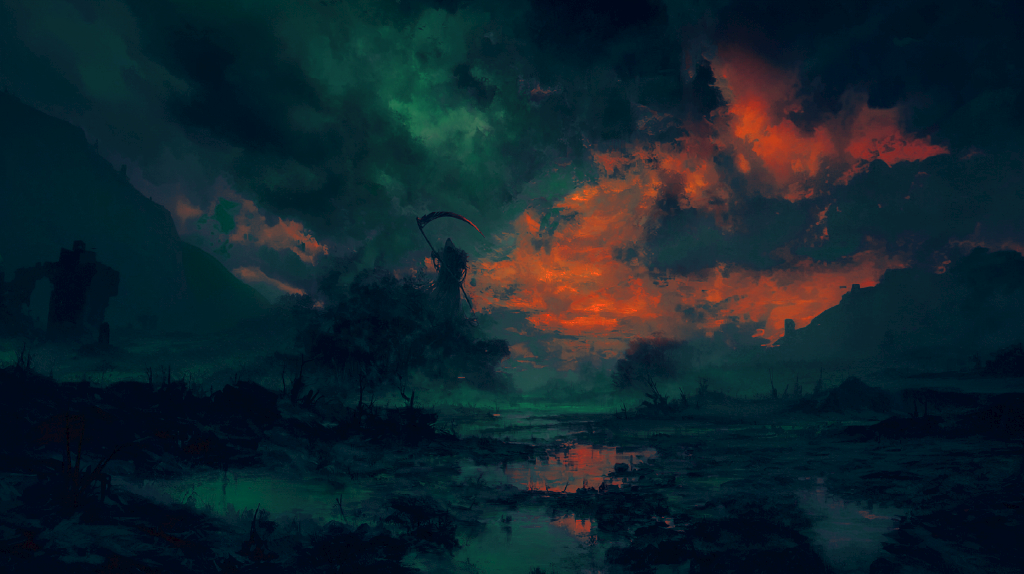 A raid season at the wells. The village meets it from the stone, never off it.
The Line He Cannot Leave
Once every raid season, for a handful of cursed nights, the wells in the bog come open and give back what has been waiting inside them. The village meets it the only way it ever has: from the stone, never off it, because the swamp is hungrier than anything that climbs out of the water and takes whoever trusts it with his weight. Jonas has held the front of that line alone ever since the season a wraith's touch turned the men standing before him into screams and blood. When the water finally settled he was the only one left on his feet. Nobody chose him for the job afterward. The burden simply landed on him the way weather lands on a roof, and he has held that stone every season since, right up to the night that finally costs him his face.
He keeps the wound bound in rags, so the village need not see how close he came, and he carries what is left of his face down every road the story sends him on from here. Strangers look, and then they keep looking. Later, in Morra, a witch who has not even seen beneath the rags tells him he already has a foot beyond the veil. In his case, she adds, half a skull. She is probably right…
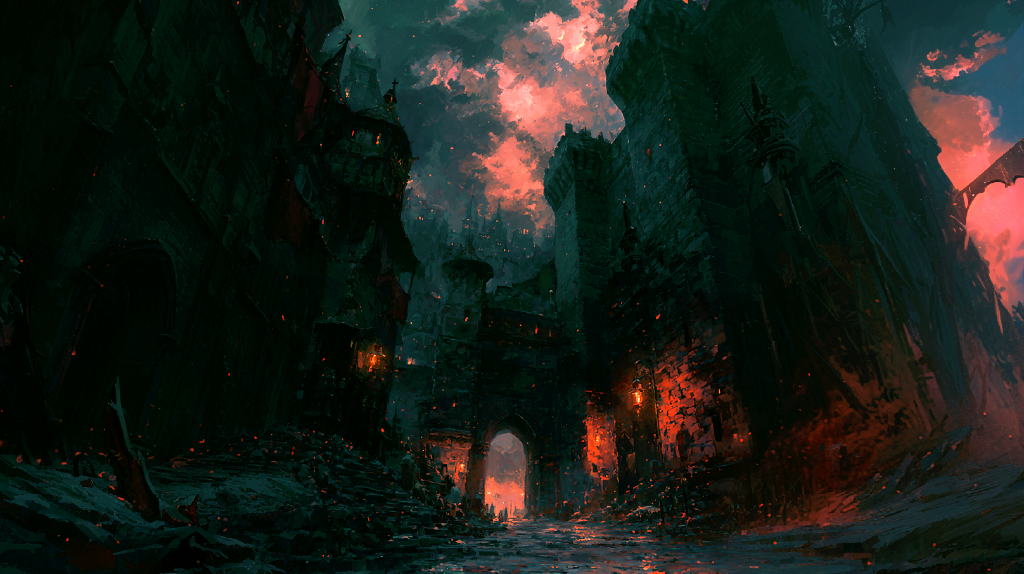 Morra, where a witch tells him he already has a foot beyond the veil.
The House He Comes Home To
None of this was handed to him. Nobody sentenced Jonas to the reeds, and that alone marks him out down there, since the boglands are where the kingdom empties whatever it would rather not look at, and most of the people around him were born into it, branded for the crimes of their fathers and grandfathers. He came on his own legs, and before that he sold his sword to whoever was paying for it. His own father served in the fleets of Simuth, ferrying warriors across the sea, and in his old age crossed half a kingdom to find the son he had lost, only to die in his sleep one night short of seeing him. Jonas dragged the stone into the yard and carved it with his own hands.
Every season before this one, the door he came home to stood open. Hekion has spent his whole life in a single bed, held there since infancy by a sickness in his marrow that no cure has ever touched and a witch's treatments only barely keep out of his mind. He has never once stood on his own legs. So Elaina would prop the door wide whenever Jonas was due back from the stone, and the boy would watch from his bed as his father came up the path, all the way from the tree line to the threshold.
Every High Festival, whatever little Jonas owned went toward the merchants' next stack of volumes. Histories, geographies, the memoirs of forgotten wanderers, and the illustrated ones above all. Stories to feed a hunger the boy's body would never let him satisfy any other way: whole kingdoms made of paper, handed to a child who cannot cross his own room to reach them.
What Was Waiting Behind the Door
A shut door, then, says everything a village full of people cannot yet find the words for. Then it opens on Elaina, her eyes red with tears that are days old, and behind her the bed Hekion has spent his whole life in stands empty. The crown's men came two nights ago, she tells him, with no word and no reason. When she begged, they struck her, and the bruises are not the worst of what they left behind.
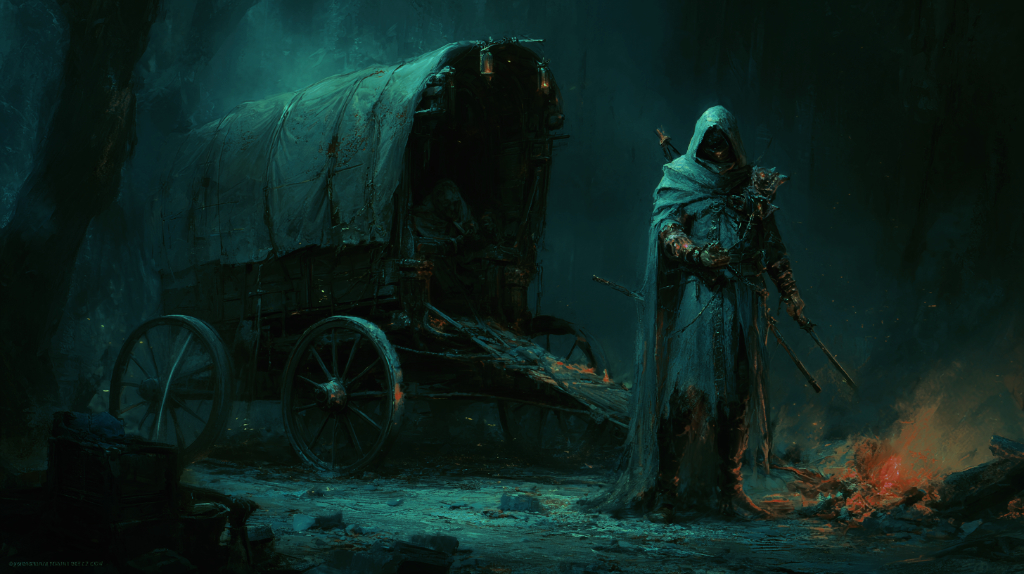 A sorcerer in white walked up the path with the crown's men.
Jonas holds her while she breaks. “I went away to slay the beasts of the other-world,” he thinks, “and forgot about the beasts that slither in this one.” Then the rag slips from his face, and the woman who bore his son cannot bring herself to look at him. He promises her anyway: he will bring their son home.
A Hatred with a God's Name on It
Beyond the marsh, the kingdom answers to the Father, a god nobody has ever laid eyes on, but who speaks through his prophets. The prophecy stones stand at every crossroads of the kingdom, wearing the dried blood of all the travellers who open their own palms to earn the prophet's blessing. Jonas spits on them instead and keeps walking. He has bled enough for this kingdom already.
That does not make him faithful to anything softer. When death is close enough to touch, his hand goes to Ruska's talismans, not to any god; he trusts what witches can do far more than witches themselves, the old crone alone excepted. Of the cultists who bow to the Old Gods and steal virgins for their altars, he thinks only: lunatics with borrowed holiness. The gods were never at fault, only the hands that wielded their names. And when a young sellsword on the road spits at the Father's name, Jonas finishes the thought for him. “When the world of men is ruled by good, evil, and all that festers between, why should I honour a god so clearly enthroned on the side of evil?”
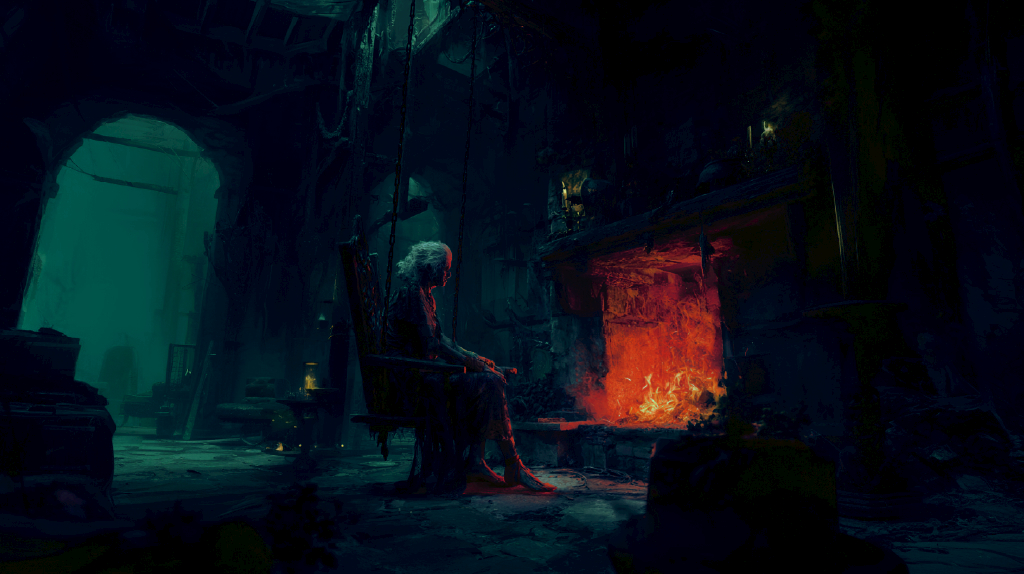 Ruska, whose talismans he trusts further than any god.
Everything After Is Yours
The story tells all of this in close third person, and the man at its centre is written whole, not left as a blank for you to fill. He is dry and sardonic with his men in the hour before a fight, telling a friend who would rather finish his supper than face the wells to rest easy, for if Jonas ever needs him his appetite will already be long gone. He will not speak of the wells once they are behind him. He loses his temper on occasion and curses himself afterward for having lost it. His grief he keeps on a chain, and the chain holds until, somewhere down the road, it does not.
What he does with all of that is not fated in advance. It is yours to decide, chapter by chapter, and the story holds you to whatever you choose, all the way out of the marsh and onto whatever road comes after it.
 Every road forks, and the story holds you to what you choose.
Then the road starts asking for payment. In chapter six he heaves the slab off his own father's grave and reaches into the dead sailor's belly for the gold hidden there, because the road ahead is long and nothing on it comes free. Ruska will not take his coin. The witch of Morra, though, if he seeks her out, takes something else, and a great deal more of it. Blood follows the coin: a raider, cultists, a witch caught in the smoke of her own working, whoever the road decides to put in front of him next. At the Narrow Pass he may turn away a woman whose sister the Conclave has taken, if you decide that a man already carrying one child's life has no room left in him for a second. Whatever you choose, none of it can end the story early, since no ending in The Red Tomorrow can reach you before the thirtieth chapter, and everything the kingdom has taken from him up to that point turns out to be only the opening price.
Why We Chose a Father, Not a Hero
Jonas began as a question about a map. We were deep in a session of Sacred Gold, the action role-playing game, when someone stopped to wonder what a whole life lived behind its eastern mountains would actually be like, past the point where anyone bothers to travel. The exiles of the bog walked out of that wondering fully formed, and everything else in this world grew outward from them.
 From the edge to the heart: the swamplands, the Narrow Pass, the Rainfields, Morra, the Shattered City.
We knew almost immediately that the man at the centre of it would be a father rather than another blade for hire, and that decision never once wavered afterward. A father who will overcome anything for his child moves us more than any sword or prophecy we could invent, and we would argue there is no stronger magic in fiction or out of it, because a child is woven so tightly into a family that losing one can tear the whole cloth for generations after. Grimdark is the register this studio writes in, though, so the kingdom itself feels none of that tenderness. It does not care how much Jonas loves the boy. It only ever counts what he is willing to hand over to get him back.
The Red Tomorrow is free to play, runs entirely offline, and is available to download right now. Jonas is standing at the edge of the marsh with his face in rags, a robbed grave at his back and his son somewhere ahead of him on a road neither of you has walked yet. What he becomes between here and there is yours to decide.
One ruined father, one stolen son, and a kingdom that will ask him for everything. Walk him to it.