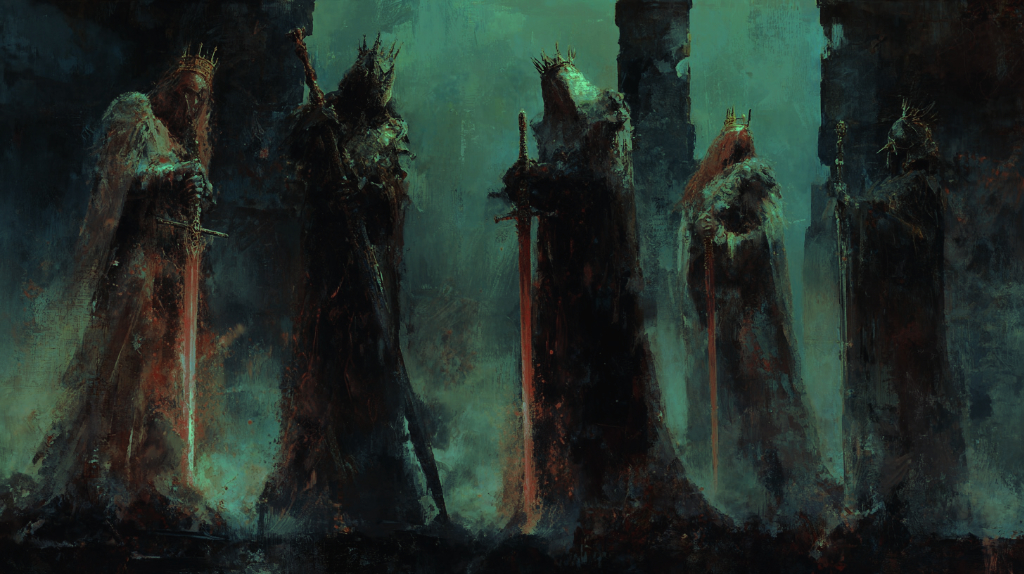
When the Night of Nights comes and the sun’s light fails, then the earth will awaken and the whispers of the damned gods will demise the souls of the faithful.
At every crossing of the King’s Road, that sentence is carved into stone, and the stone is never clean. Travelers open their own skin and let it run across the letters, the same offering their grandparents made at the same forks, paying for a blessing the old way, in the only coin that has ever truly satisfied a god.
This is the world of The Red Tomorrow, our dark fantasy interactive novel: over a hundred thousand words, a hundred and eighty-one illustrated chapters, and fifteen endings that answer to nothing but the choices you make along the way. You play Jonas, a man who survived the spectral raids only to come home and find his son already gone, taken by a mage into the heart of the very kingdom that has always kept men like him at its furthest, least forgiving edge. Before you follow him, it is worth kneeling first at the altar this kingdom actually prays to.
 The kingdom end to end: the Swamplands where it sends its exiles, the Narrow Pass, the Rainfields, Morra, and the Shattered City at the heart of it.
A Kingdom That Prays to a God Nobody Has Seen
The court calls it the Ascension, a word chosen with the particular grace of someone describing their own conquest as a gift. Beneath the word lies something far plainer: a god came from beyond the eastern deserts, borne in on the tongues of sorcerers and the prophets his own arrival summoned into being, and he took the kingdom’s faith the way a tide takes a shoreline, without asking and without needing to. He is called the Father now, and no living soul can claim to have looked upon his face, for he governs through absence rather than presence, through a murmur the faithful call the Whispering, a sound that settles into the marrow and reshapes belief the way water reshapes stone, slowly, and then completely. That same murmur quickens in the wombs of mortal women and leaves behind something no longer wholly human. Every demon in the kingdom’s streets, every prophet who reads its future, was born of that single, patient sound.
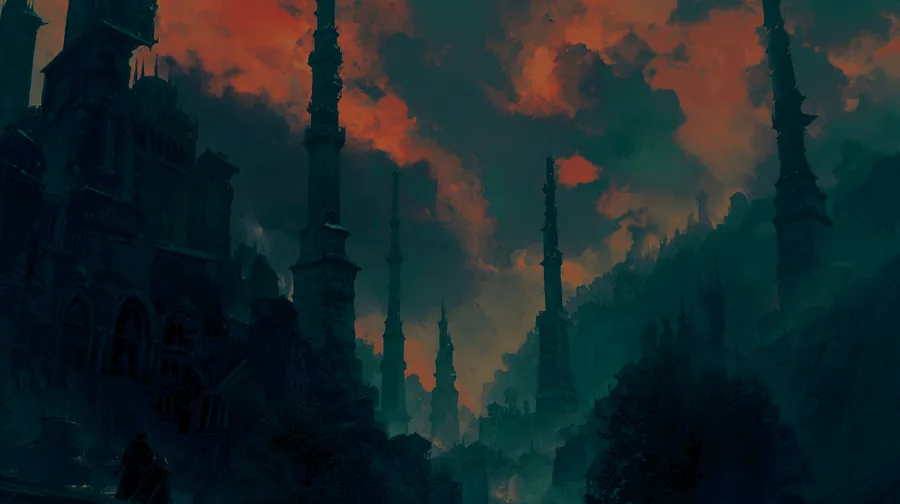 The Shattered City, where the temples rise higher than anything built before them.
None of this wears the face of catastrophe from within the palace walls. The temples rise higher than anything built before them. The court wants for nothing. It is simply the faith now, taught the way a child is taught to walk. The wrongness of it only reveals itself at the margins, in the places a kingdom sends what it would rather not look at directly.
Gods Who Became Something Stranger Than Dead
There were other gods once, and neither death nor departure claimed them. Something far stranger happened instead. Stripped of their worshippers, they did not fade so much as change their shape entirely, becoming not memory but material, the rawest and most potent substance left in the world, the very thing witches still reach toward long after the last knee bent willingly in their name.
Their trace still lingers for those who know where to look. Five swords are carved into the oldest gravestones in the realm, cut so long ago that even the Father’s own faithful hesitate to touch them. Oaths are still sworn on names the Church would rather see forgotten. Out at the kingdom’s edge, among the reeds and the drowned light, some still swear the old gods fight beside them yet. A faith dying by inches, perhaps, but not one that has finished dying.
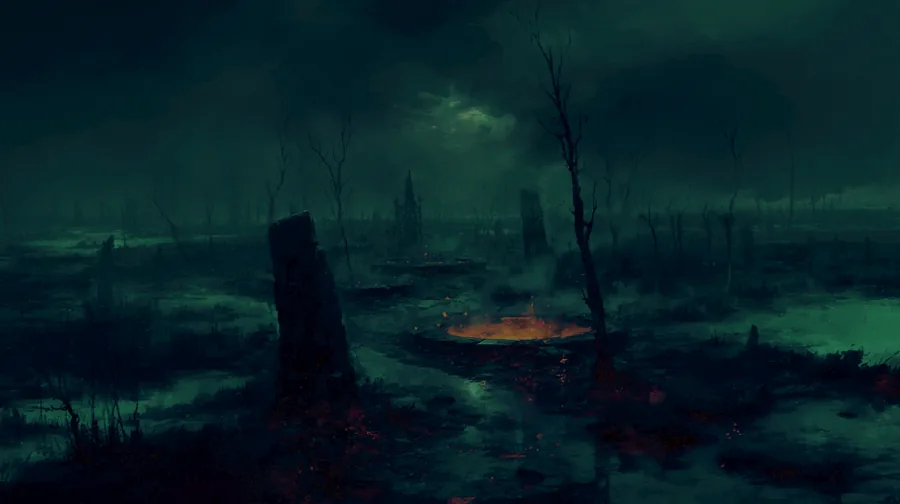 Out at the kingdom’s edge, among the reeds and the drowned light, where men still swear the old gods fight beside them.
A Family Tree Written by the Winners
The Church tells its own version of what became of them. Silent monks who serve the Father’s temples each carry five swords across their backs, one sword for every old god, and the teaching bound to those blades holds that the Five were never gods at all in their own right, only the Father’s children, born beneath him rather than before him.
So the Church teaches, at least.
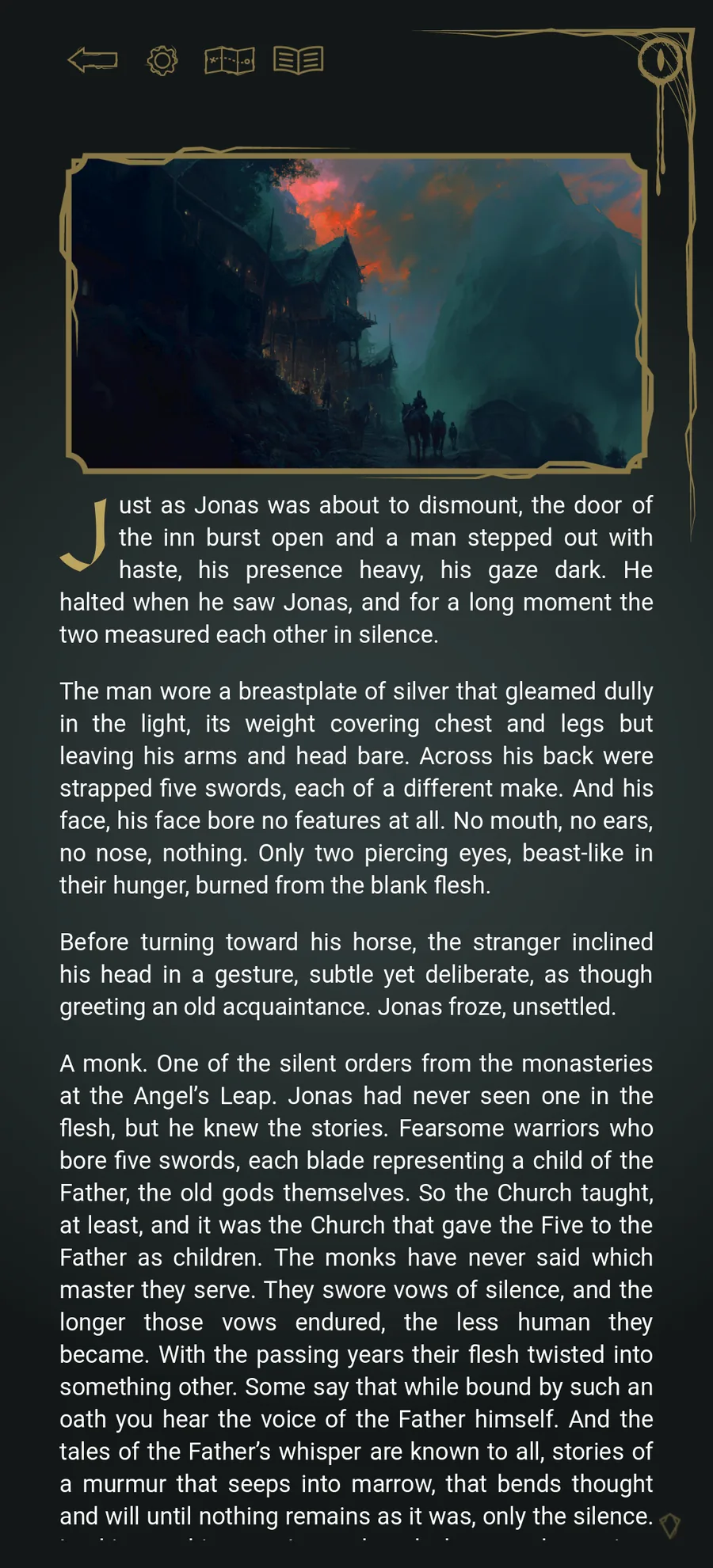 The game hedges it the same way: “So the Church taught, at least, and it was the Church that gave the Five to the Father as children.”
What was never destroyed was instead absorbed, demoted, folded gently into a bloodline that was never truly its own. The old gods were not erased from this kingdom’s memory. They were quietly renamed as sons and daughters of the very power that unseated them, a fate stranger, in its way, than simple ruin.
The Price a Witch Actually Pays
Where sorcery draws its power from words caged inside books, pages the witches swear are lined with the eyes of demons, witchcraft reaches instead toward the night, the moon, the beasts of the wild places, and whatever still stirs where the old gods once slept. And what a witch pays for what she knows is never coin. It is a grief surrendered. A bond formed and never undone. A piece of herself set down and never lifted again. The craft cannot pass from a mother to her daughter as blood does. It must be taken up new each time, at a cost only the witch herself will ever fully know, for witches are barren, and the gift dies with each who carries it unless another chooses to take up the burden fresh.
The commoner asks a witch for a love charm, a glimpse of the coming season, the small mercies that make a hard life bearable, and is grateful for the asking. The Church and the great houses answer the very same craft with a pyre. The hands that mix a kindness in one village would be bound and burned in the shadow of the palace, and nothing about those hands would have changed at all between one fate and the other, save who happened to be watching.
That is why most witches of the later generations dress their craft as alchemy, keeping shopfronts of steaming vials behind city walls, where folk will sooner trust a bottled draught than the raw art of blood and pain. The witches of the forests have never needed the disguise. And the eldest of their kind, the First and Second Generations, are far too powerful for the great houses ever to threaten.
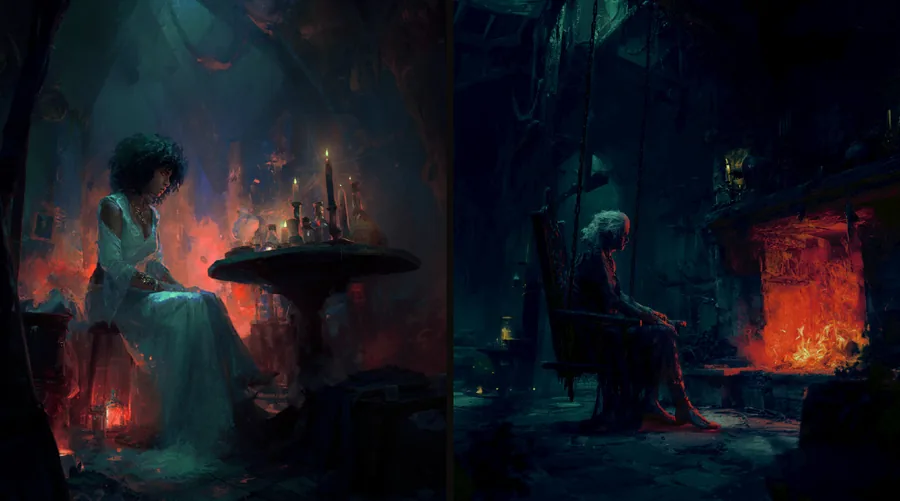 Behind city walls, a witch keeps a shopfront of steaming vials. In the forest, the old crone never needed the disguise.
The Ones Nobody Looks At Twice
The demons of this kingdom do not hide, and that is the truest horror of them. They are born, as anyone is born, from mortal wombs touched by the Father’s voice, human skin worn not as disguise but as birthright. The great houses bind them into service, each one branded with its house’s mark burned into the flesh, and a man might pass one on an open street, a sergeant’s sigil scorched into its forearm, while everyone around him continues on as though nothing at all had passed. No one hides them because no one need bother. To keep a demon bound is a mark of favour with the Father himself, and it happens, besides, to answer a far older question, for an army of demons overmatches an army of men, and only a handful trained in human sorcery can stand against what walks so openly among the crowds.
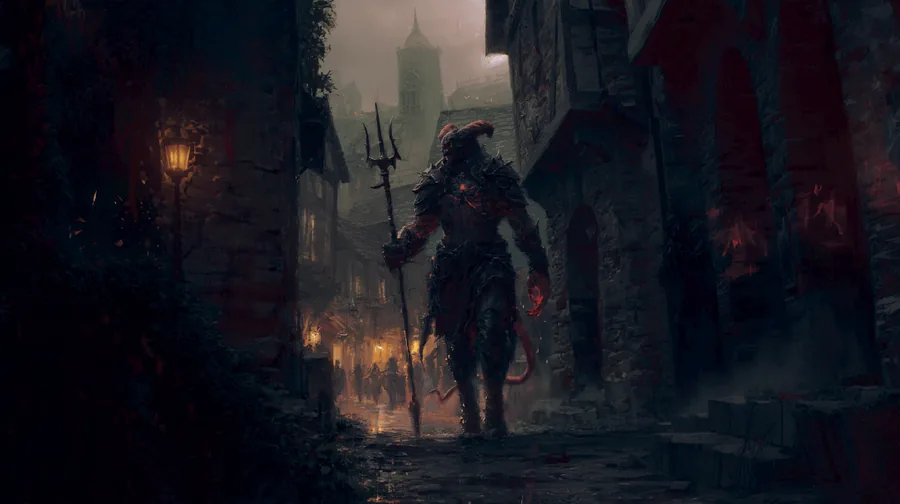 A demon on an open street, and the lanterns further down still lit.
Two Prophets, and a Kingdom Choosing Sides
Of the many strange sights the King’s Road offers a man walking it alone, none is stranger than a crossing where two stones have been raised instead of one. They stand side by side beneath the signposts, each cut in the same holy letters by hands equally certain of their god. Two Prophets speak for the Father in these years, demon-born the pair of them, and neither has ever conceded a single fork to the other.
What follows is a slow and bloody arithmetic. A traveler who stops at such a crossing must decide which of the two he will cut his palm for, and the stones remember. Year upon year, the letters of the favoured prophecy darken and thicken until they are more blood than stone, cut deeper each season by masons the winning Prophet can afford, while the rival stone beside it stands pale and thinly carved, its promise no less certain for having gone unwatered. Anyone who knows how to read the difference can stand at any crossroads in the realm and see exactly which of the two currently walks beside the king, and how far the other has fallen from favour, written in the offerings of every stranger who passed that way before him.
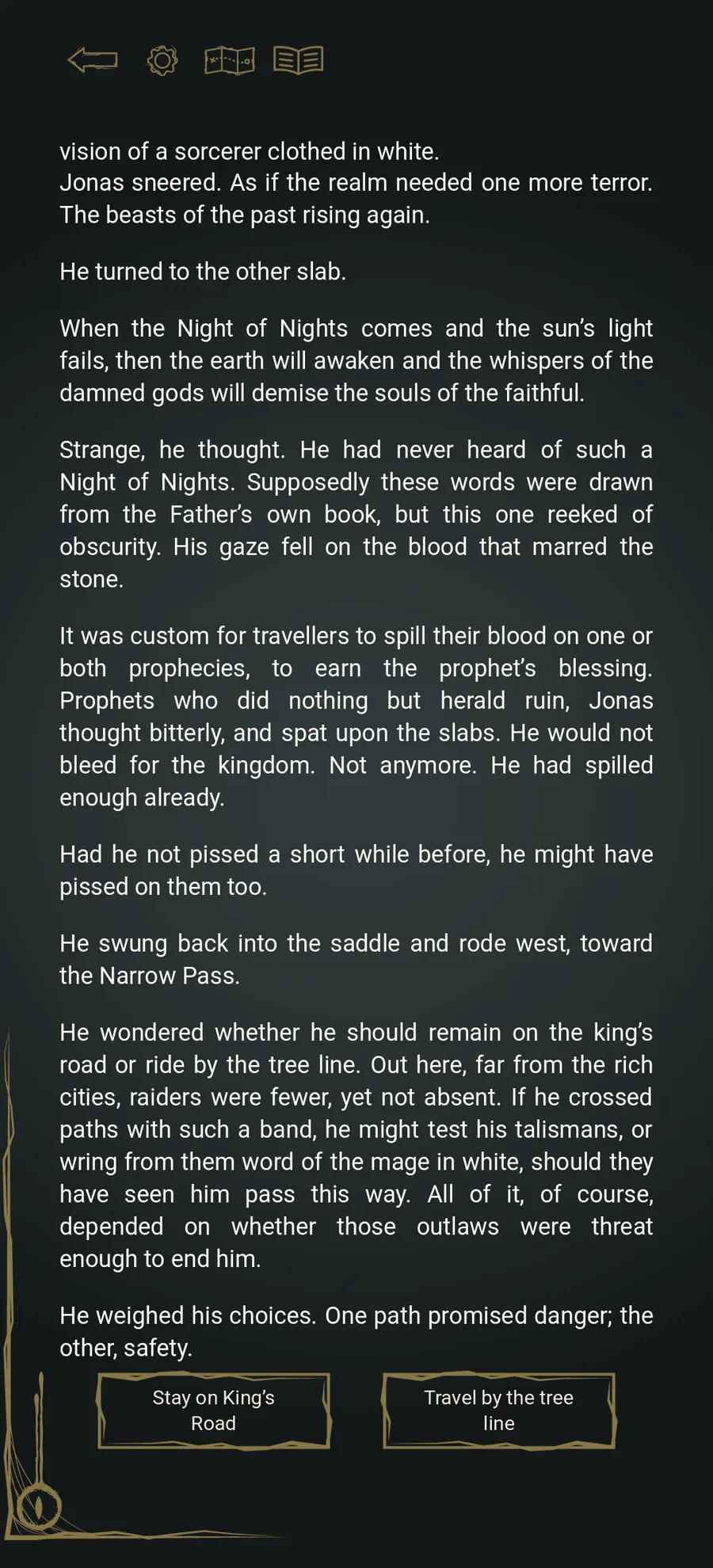 The second stone, in the game: the sentence this article opens with, and the custom of bleeding on one or both.
This is the kingdom Jonas is coming home to: a realm of rival gods and rival prophets, where even the stones at the roadside have already picked a side. What he chooses to do about it once he is standing there himself is not a question the roads get to answer for him. In The Red Tomorrow, that choice belongs to no one but you. Read it now, free to begin, and find out what the road asks of you.
 One crossroads, two roads: the tree line, or the King’s Road.