
At the crossroads, where the whispers of the Fates echo without end, paths converge and entwine. Here, the shadows of your choices linger and even in defeat the Fates grant a gift without promise, the chance to return.
Most stories forgive you. Turn back a page and the hero is standing exactly where you left him, untouched by what you nearly had him do. The Red Tomorrow is not built that way. It saves as you read, it keeps a single story at a time, and once a choice is made, the story carries it forward, sometimes for a single scene and sometimes for a hundred chapters, until the moment it decides to collect.
That would be a hard bargain to offer a reader with no way back at all. So the game offers seven.
The Red Tomorrow is our dark fantasy interactive novel: over a hundred thousand words, a hundred and eighty-one illustrated chapters, and fifteen endings shaped by the choices you make along the way. You play Jonas, a former sellsword living among the kingdom’s exiles in the eastern boglands, who comes home after a night of fighting the dead to find his son taken, carried west toward the heart of a kingdom that has never had any use for his kind. Every road after that is yours to choose. The seven Crossroads are how the game lets you choose again.
A Story That Keeps Its Receipts
Two hundred and seventy-four choices run through the story. Forty-seven of them only appear, or only stay hidden, because of something decided long before. Most of them are small, and that is the point: the story does not announce which decisions matter. It simply remembers them all.
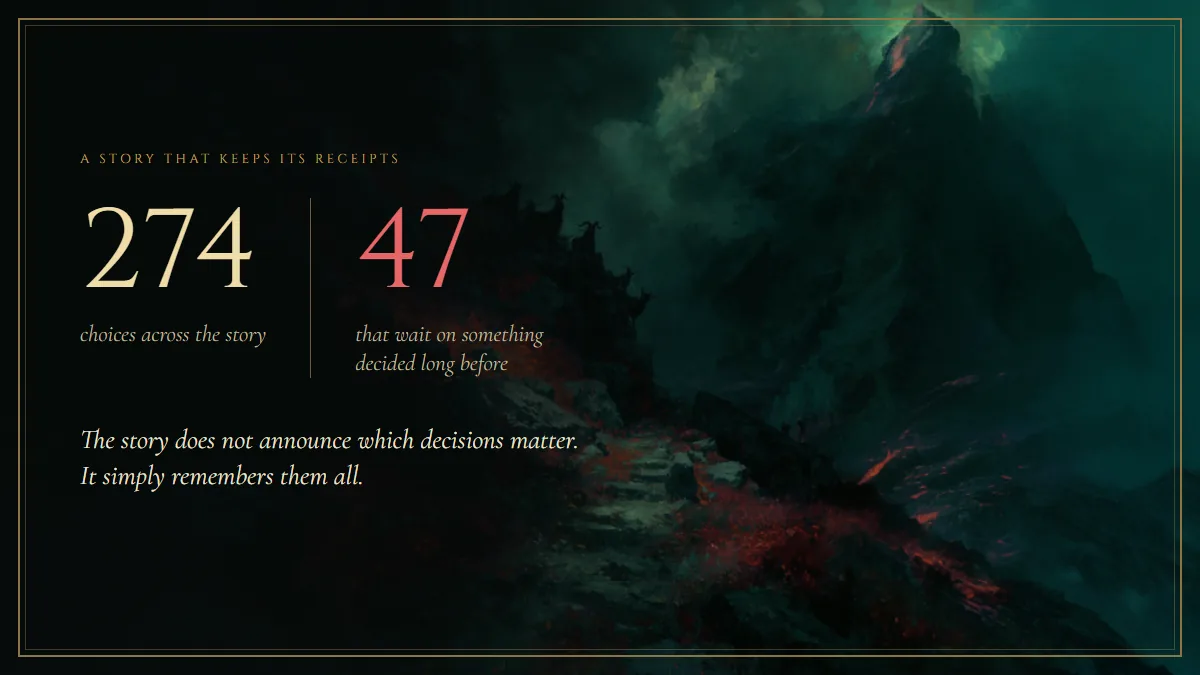 274 choices, and 47 that wait on something decided long before.
One of the first great forks comes early, in a witch’s hut deep in the forest, where an old crone offers Jonas talismans for the hunt and makes him choose which kind he will carry: warding pouches of Protection, beast teeth for Instinct, or metal sigils of Destruction. It feels like a choice about how to fight. It is also a choice about how Jonas will see the world for the rest of the book. Many chapters later, in a noble house’s tent outside a walled city, three readers who picked three different talismans stand in the same room and are told three different things about it. One talisman counts the guards. One reads the woman behind the desk for what she is. One feels sorcery close by when no mage is in sight. The scene is the same. What Jonas knows in it is not.
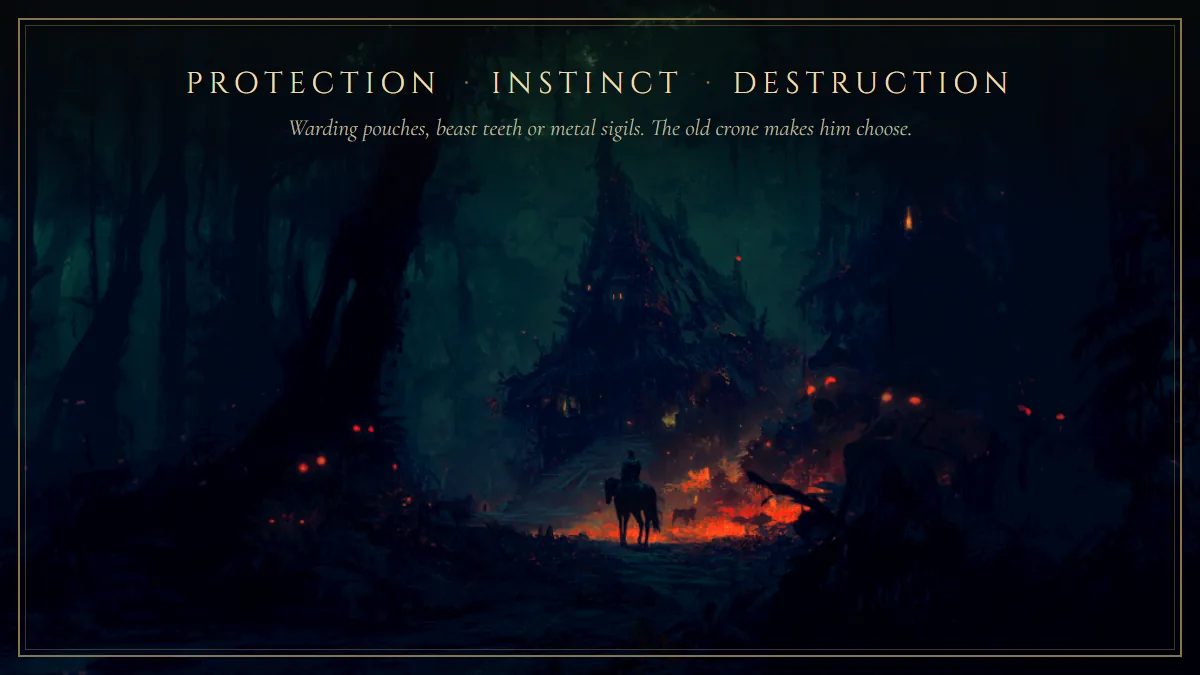 The witch’s hut in the forest, where the first great fork waits.
A story built like that needs somewhere to stand when you want to look at the road you didn’t take.
Seven Places the Story Holds Its Breath
As you read, the game marks seven moments. Each one is a place where the story genuinely forks, and the instant Jonas arrives at one, the game quietly keeps a copy of everything he is carrying: the decisions behind him, the people beside him, the coin in his purse. That copy is a Crossroad. Each one opens on the Crossroads screen the first time you reach it, and stays sealed until you do.
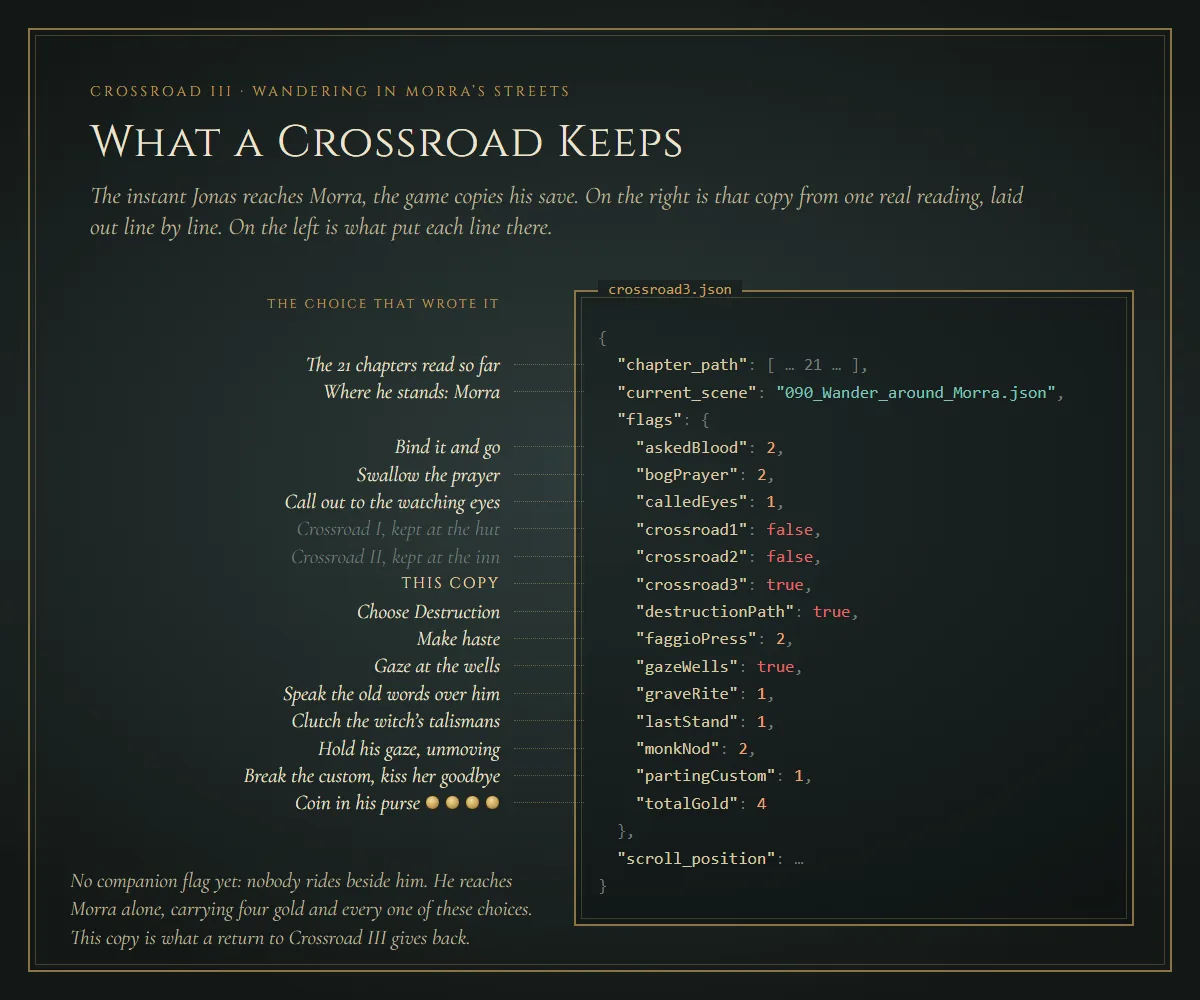 Crossroad III, opened up: the copy the game keeps, and the choices that wrote it.
These are the seven, by the names the game gives them:
The Old Crone. The witch’s hut, and the talisman choice: Protection, Instinct, or Destruction.
Inn of the Narrow Pass. A crowded inn at the mouth of the mountains. A lady across the room, a bounty poster on the wall, and the door back out to the road. One more conversation waits here, but only for a reader who went upstairs earlier that night.
Wandering in Morra’s Streets. A wealthy town in mourning, its temple hung with black. Ask at the inns, find the town’s witch, or put a coin in a guard’s palm.
At the Shattered Gate (Day One) and At the Shattered Gate (Day Three). The same gate, reached on different days, depending on how Jonas spent the road there. Six noble houses are handing out work outside the walls, and the question waiting at the gate is whether he takes it on alone.
The Inner Shattered Gates. Inside the outer walls, the guards turn on the friend who rode in beside him. Watching is one choice. Stepping in is the other.
The High Festivals. As many as five roads open here, and that number is not fixed. Some of those roads exist only because of a contract Jonas accepted days earlier, a wrong he heard about and did not forget, or a purse he kept heavier than it needed to be. Two readers can arrive at the same festival and find different doors in front of them.
No Single Road Passes All Seven
Not every reading reaches every Crossroad. The inn at the Narrow Pass keeps its Crossroad only for a reader who stays to listen. The Shattered Gate on Day One and the Shattered Gate on Day Three belong to different journeys. The Inner Gates keep a Crossroad only for a reader who did not come alone. A first reading might light up four of the seven and leave three sealed, and those sealed ones are not a failure. They are a list of roads that still exist.
 Seven Crossroads. A first reading might light four.
How Going Back Works
You can reach the Crossroads screen from the main menu at any time. When a story ends, the game offers it again, right beside the way back to the menu.
Choosing one is deliberate. You hold the Crossroad you want, the same long press the story uses for its choices, and the game asks you to confirm, in its own words: Rewinding time back to Crossroad 4. Are you sure you want to proceed? This action cannot be undone. It means it. Your current place in the story is replaced by the moment you saved, with everything Jonas was carrying at that moment and nothing he picked up after. From there, the fork is yours again.
 Rewinding from the High Festivals to Morra: what Jonas loses, what he keeps, and the fork that opens again.
A few things are worth knowing before you use one:
- Arriving again replaces the old copy. If you reach a Crossroad a second time, the newer arrival is the one the game keeps.
- A new story clears all seven. Starting over from the first page wipes the slate, Crossroads included.
- Your achievements stay with you. Whatever you have earned survives a return to any Crossroad, and survives a new story too.
Why Seven, and Not a Save Button
We could have let you save anywhere. We chose not to. A story where every page can be undone is a story where no page costs anything, and The Red Tomorrow is a grim book about a man paying, again and again, for what he chooses. Seven fixed Crossroads keep that weight where it belongs. The small choices between them stay yours to live with. The great forks stay open, so that the road you turned away from is never lost for good.
They also keep a long story readable. The branches split often across those hundred and eighty-one chapters, but they fold back, again and again, into a handful of major crossings. The Crossroads sit at exactly those crossings, which is why going back to one feels like standing at a real fork rather than reloading an arbitrary page.
Fifteen Endings, Seven Ways Back
None of the fifteen endings arrives before the thirtieth chapter, and none of them arrives cheaply. Reaching one is where the Crossroads matter most. The story is over, the game asks where you would like to go, and the answer can be a forest hut, a mountain inn, or a festival square. Jonas arrives carrying exactly what he carried the first time. You arrive knowing everything you have learned since.
 From each of the fifteen endings, a thread back to every Crossroad on the road there.
Before any change we make reaches a reader, a route checker walks the whole story on our behalf, sixty-six thousand four hundred and sixty-four possible game states, and confirms that every ending is still reachable and that no combination of choices strands anyone where the story never meant to leave them. The Crossroads are the reader’s half of that promise. Every ending exists, and you never have to start again from the first page to go looking for it.
Jonas does not get to take anything back. You do, seven times, at a price the game tells you plainly before you pay it. Everything between the Crossroads is still yours to live with.
The Red Tomorrow is free to begin. The Old Crone is waiting at the first fork, and the other six are further down the road.
Seven crossroads, fifteen endings, and one father who cannot go back. You can.