
Version 4.37 is out, and most of what it adds happens indoors.
At its centre is Taverns & Hubs, a new tool that builds a whole venue: the floor plan, up to three floors of it, and everyone and everything inside, from the barkeep to the room behind the cellar wall. Around it sits a long list of changes across the app. A few are large, like 1920s horror in every tool that has a genre choice and the full 78-card Tarot. Most are small, the kind you notice only because something that used to read slightly wrong now reads right. This post goes through all of it, tavern first.
4.37 at a Glance
- Taverns & Hubs: build a whole venue as a floor plan, up to three floors, 22 kinds across fantasy, sci-fi and the 1920s
- GM switch: hidden rooms, stashes and trouble stay off the map, the panels and Copy until you want them
- The Ledger and Tonight: a priced bill of fare, games of chance with full rules, and the evening hour by hour
- 1920s horror in every tool with a genre choice, and sci-fi in eight more tools
- The full 78-card Tarot, with more direct readings and the dice Oracle's Chaos, scenes and threads
- The Campaign Assembler is out of beta
- "Bring it to life" reaches the world-building tools, and the World Engine can open a chronicle's realm in the Realm Generator
- Rivers that run from a spring to the sea, and map names that keep clear of lines
- Bigger text up to 130%, and turning the phone keeps your place
- Twenty-eight race names replaced, and British spelling throughout
- Your saves open exactly as before
A Whole Venue, Floor by Floor

Taverns & Hubs lives in the Generators Hub. Press Generate and a floor plan appears under a name. Our first roll gave us Red Brannoc's Goose, a coaching inn at a crossroads: a common room and a kitchen on the ground floor, a round room in a tower off one corner, a cellar below and a row of guest rooms upstairs. A venue runs to three floors at most (cellar, ground and upstairs), and the buttons above the map step between them.
Each numbered pin is a spot you can tap. The bar told us that Wystan Moorcroft was pouring that night, a gale-souled jug-runner who wears a hood that is never lowered, even indoors. A booth gives you whoever is sitting in it. Every line carries its own lock and its own die, so you can keep a barkeep you like and reroll only the look, or keep the building and send in a new crowd. Generate rerolls whatever you haven't locked.
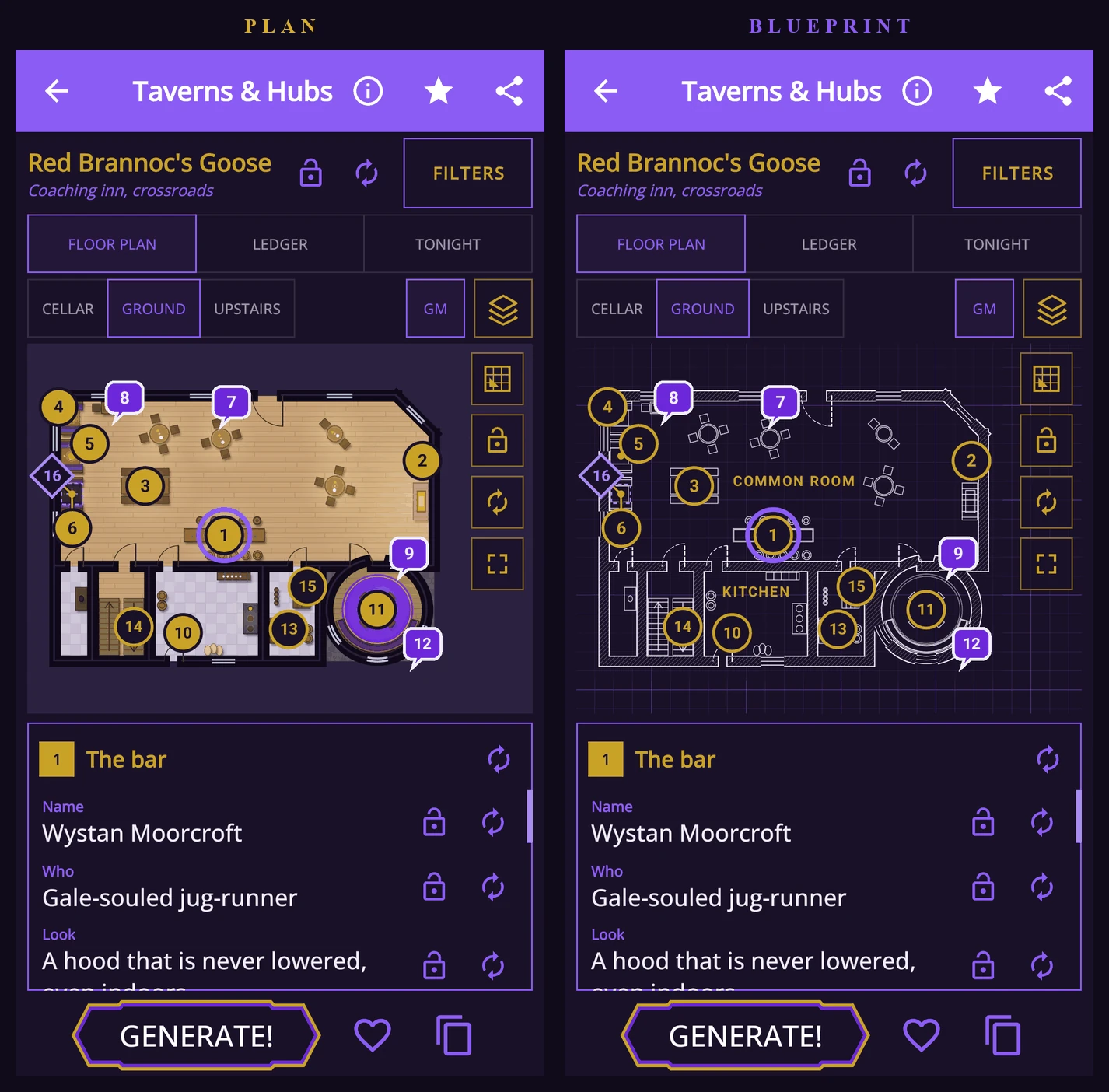 One ground floor, two styles: the plan on the left, the blueprint on the right. Pin 1 is the bar.
The map can be drawn two ways. The plan is the warm one, all floorboards, tables and fittings, and the blueprint is the same building in white lines on a dark grid, with the rooms named on it if you ask. One button beside the map flips between them. The Layers sheet decides which pins show (people, talk, places, the GM's secrets), pinch and drag move you around, and Fit puts the whole floor back on screen. Two more buttons settle the usual dilemma: lock the floor plan to keep the rooms and change the people, or draw a new floor plan that keeps who and what is in each spot.
Filters pin down as much as you care to, and anything left on Any gets rolled. Twenty-two kinds of place are spread across three genres. Fantasy has the tavern, coaching inn, mead hall, alehouse, teahouse, gambling den, fighting pit, adventurers' lodge and dockside dive. Sci-fi has the cantina, station lounge, orbital casino, colony mess hall, spacer bar and dock dive. The 1920s have the speakeasy, jazz club, hotel bar, gentlemen's club, waterfront dive, all-night diner and roadhouse. Past that you can set where it stands, its size and shape, how many floors it has, its wealth and mood, who drinks there, its tone, how near the trouble is to boiling over, and whether it has a stage, games of chance or anything for the GM to hide.
 Three floors of one inn: the cellar with its hidden room, the common room and kitchen, and the guest rooms upstairs.
The Switch That Keeps Your Secrets
Above the map sits a button marked GM, and it's the one we reach for most at a real table. Switched on, it shows the lot: the hidden room, the stash, the tunnel, the trouble running under the whole evening. Switched off, those pins leave the map and their lines leave the panels, and the phone can be turned round to face the players.
With GM on, the Goose's cellar has a hidden room tucked into one corner and a tunnel leading away from it. In the room, a purse of mixed coin is hidden in a boot, ready for a quick departure, and the people who use it are a band of retired adventurers planning one last expedition, and arguing about who has to carry the rope. With GM off, the players get the cellar, its barrels and its stores, and no hidden room on the map. Hidden rooms come in eight kinds, among them a smugglers' store, a forger's workshop, a tomb and a cult's meeting place.
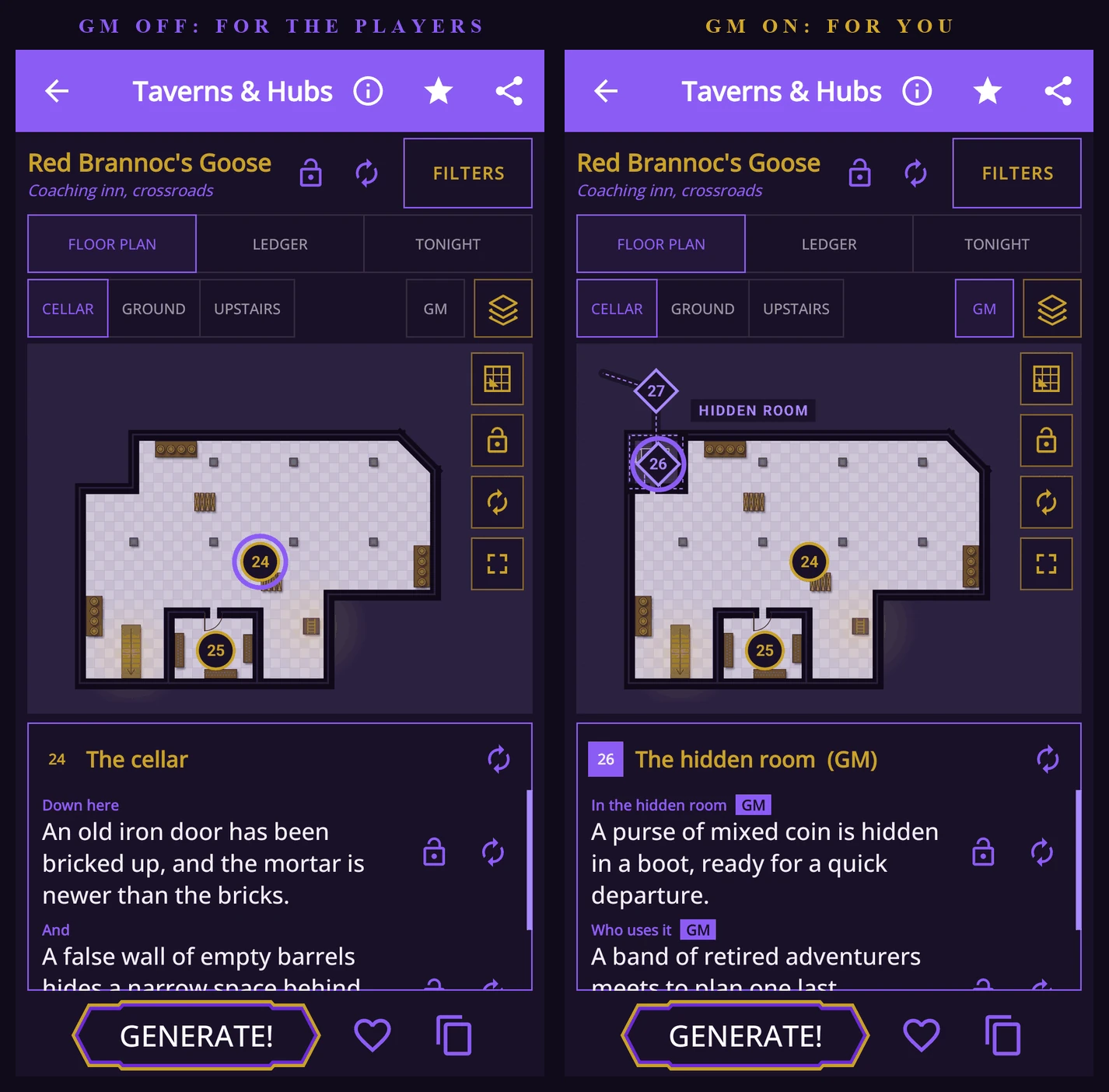 The same cellar twice. With GM on, the hidden room (26) and the tunnel (27) appear, and the panel tells you who uses it.
Copy obeys the same switch. With GM on it copies the venue as text, secrets included; with GM off it copies only what the players are meant to see.
The Ledger: What They Eat and What They Bet
The Ledger tab turns the venue into a single page to read before a session: the place, the owner, every spot, the bill of fare, the games and, if GM is on, the trouble. Nothing on it is frozen. Every line still locks and rerolls.
The bill of fare is a small generator of its own, and it starts with what the menu is written on. The Goose's is lettered down the handle of a wooden spoon the size of an oar. Drinks come first (a nightcap posset, a stirrup cup, Dame Wellcourt's Mulled Cider, stirred with a red-hot poker until it steams), then the food, a house special and one thing better avoided. You won't find a coin anywhere on it. Each item has a tier, bronze, silver or gold, and between one and five pips, and a legend under the menu says what a pip buys in this particular place. At the Goose a bronze pip is about a copper, the price of a carter's supper, and a gold one is for lords and the suddenly lucky. Whatever your game uses for money, the menu still works.
A venue with games of chance writes the rules out in full. The Lavender Tavern, a speakeasy in a big city, runs Dead Man's Deck: one card goes face down under an upturned glass, players draw in turn and bet on which card is under it, and anyone who names a card already drawn pays every player at the table. Tonight's twist is that any card touching the floor is out of the game for good. The dealer is a girl in pigtails and a party frock, and nobody can say whose daughter she is. Each game also lists its stakes, what's on the table and the table talk, plus one line only the GM sees: who is cheating.
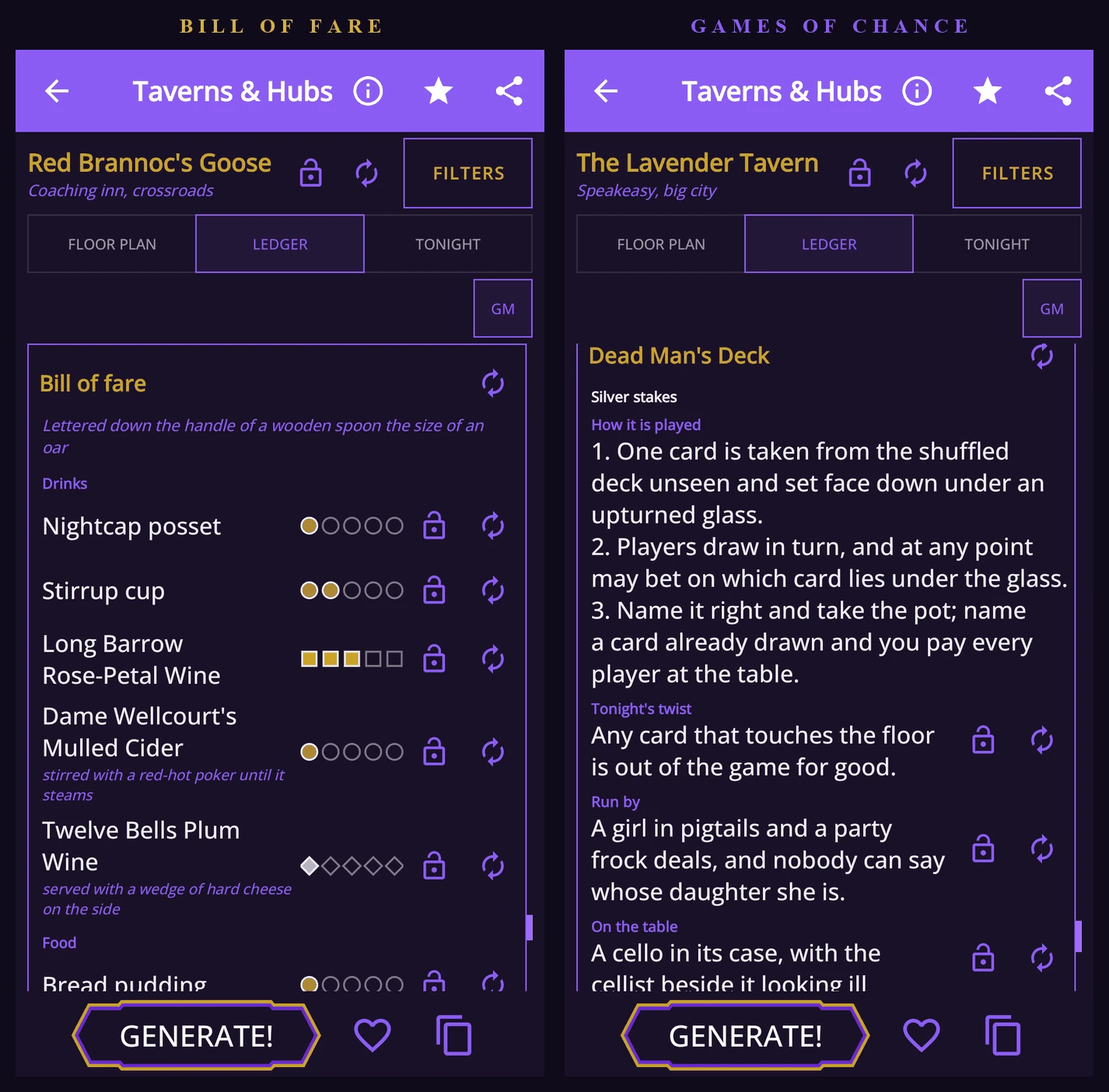 Left, the Goose's bill of fare, priced in pips: the circles are bronze, the diamonds silver, the squares gold. Right, the rules of the Lavender Tavern's card game.
Tonight, Hour by Hour
Tonight runs the evening from opening to closing time. A ribbon along the top gives the shape of the whole night, and beneath it each event has its hour and its room. At the Goose, half past six brings a stranger who sits down on the step outside and will not come in until called by name. By half past seven, two old enemies have recognised each other across the room and the talk around them has died. At half past eight, a spark lands in a sleeping drunk's beard, and the room cheers him awake.
New Evening rolls a different night in the same building. Send to Timeline hands the evening to the Timeline Maker, with a lane for each room and one for the trouble, where you can drag events to other hours, add your own and save it to Favourites.
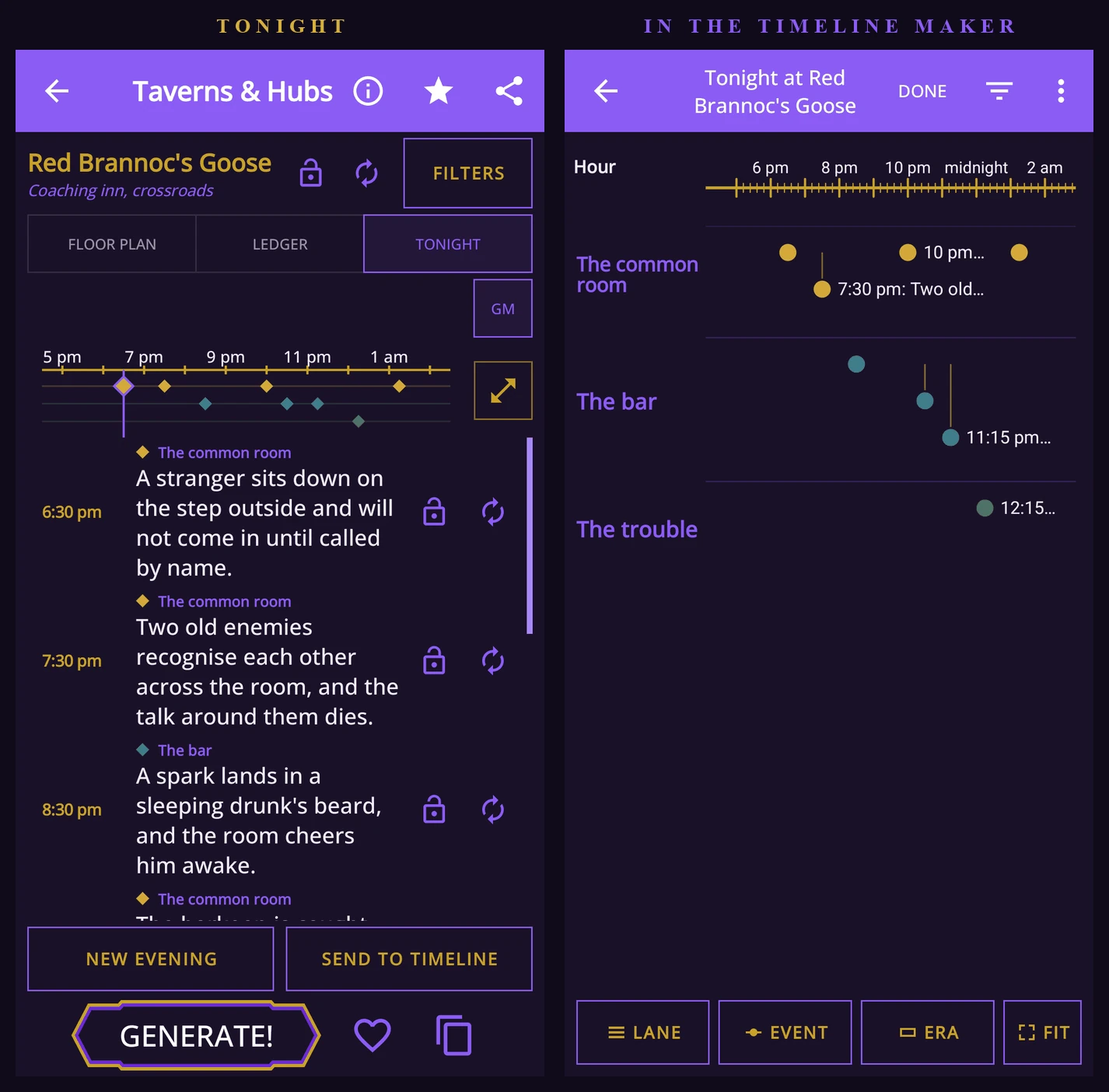 The evening at the Goose, hour by hour, and the same evening sent to the Timeline Maker.
Fantasy, Sci-Fi and the 1920s
The tool that built the Goose will just as happily build a cantina on a mining colony or a speakeasy on the waterfront. Floors take the genre's names (a sub-deck and an upper deck in sci-fi, a basement in the 1920s), and the writing follows. A 1920s bill of fare is engraved on a brass plate that hasn't been changed since 1919, and its house special is a free lunch with every second drink, if you can call it lunch. Under the Lavender Tavern, the trouble only the GM sees is that the cellar extension broke into an old colonial burying ground, and the owner is quietly selling off the grave goods.
Fantasy and sci-fi venues also borrow from the app's other generators. The job pinned to the notice board comes from Quest Hooks, the letter left in a guest's room from Found Notes, the pawned piece behind the bar from Magic Items, and the small creature living in the cellar from the Bestiary. The 1920s rooms are written for the 1920s alone, and the people in them come from the NPC generator's new 1920s horror register.
 Red Brannoc's Goose, Club Rat (a cantina in a core city) and Bones McAvoy's Grotto (a speakeasy on the waterfront).
Keep It and Bring It Back
A venue saved to Favourites reopens as it was, floor plan and people included, with every line still free to reroll. Attach one to the Campaign Board and it opens there as the same map, where other tools would attach text.
Every Genre Tool Now Writes Three Genres
Until now, some tools wrote fantasy and sci-fi and some wrote fantasy alone. As of 4.37, every tool with a genre choice writes fantasy, sci-fi and 1920s horror. The NPC generator gets a third option in its Filters, with period names, a background in place of a race, and roles, quirks, wants and secrets of the era. Its first 1920s roll for us was Delphine Hale, an engineer and the survivor of a shipwreck, who cannot abide silence and is trying to sleep one night through without the drowned bell.
Quest Hooks, Rumours, Encounters, the Bestiary, Found Notes, Omens, Mystery, Random Places, the dice Oracle, Magic Items, Dungeon Rooms, Five Room Dungeon, Adventures and Factions write the 1920s too, from a small American town's gossip to the house on the hill in five beats. Sci-fi grew alongside it. Random Places, Magic Items, Omens, Found Notes, Dungeon Rooms, Five Room Dungeon, Adventures and Factions write sci-fi for the first time, and every sci-fi table now matches its fantasy twin in size, with more than 5,700 new lines, each written and read by hand. A sci-fi Oracle session only ever offers you tools that write sci-fi. Realm, Faith, Dynasty, the History and World Engines and the Campaign Assembler remain fantasy tools.
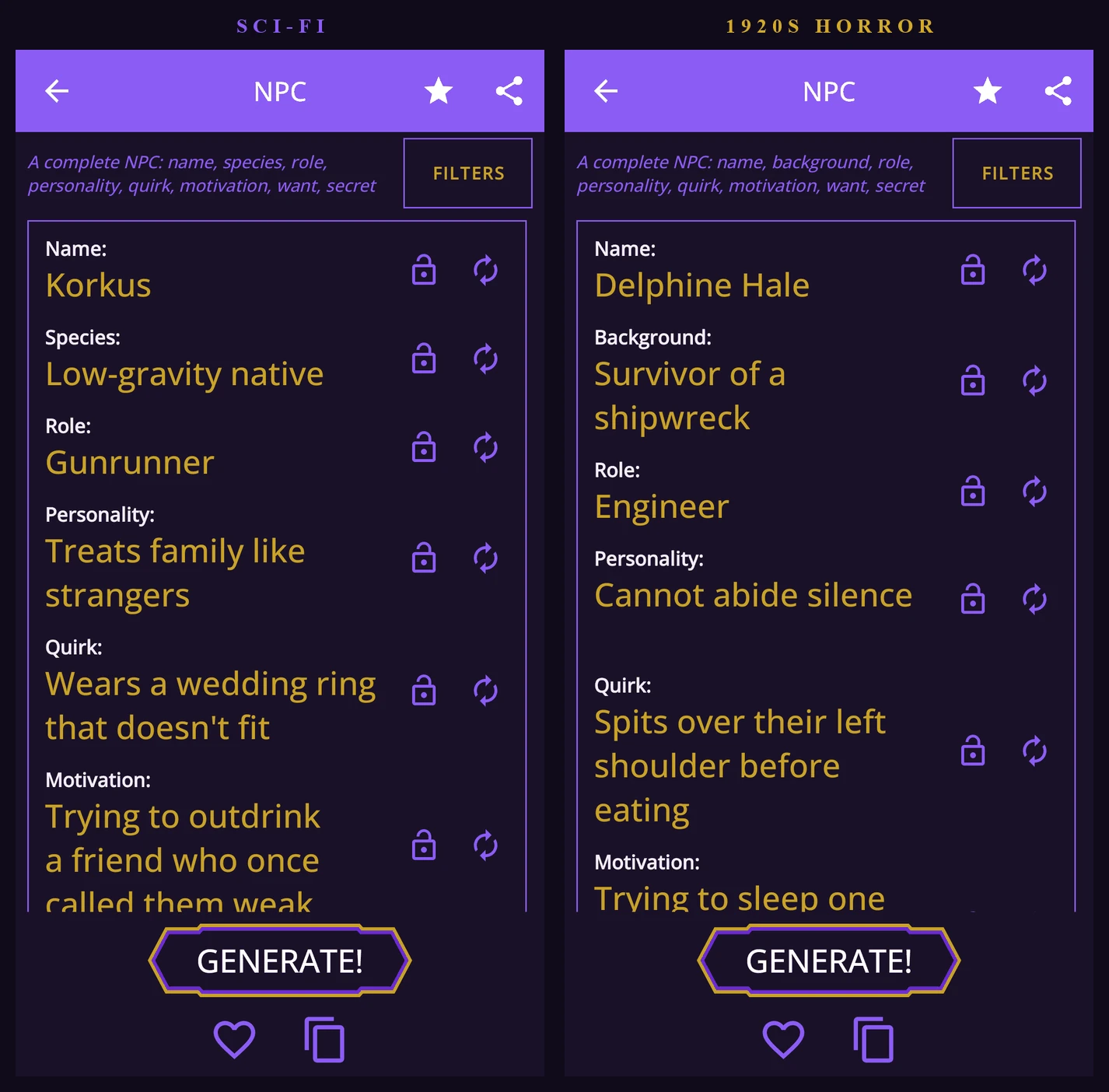 The NPC generator in sci-fi and in its new 1920s horror genre, where a background takes the place of a species.
The Whole Tarot
The Tarot Oracle Engine has its full deck at last: all 78 cards, the 56 Minor Arcana drawn in the Majors' style with meanings of their own. A Deck choice in the menu draws from everything, from the Majors alone or from the Minors alone. We asked whether we could trust the ferryman and drew the Four of Cups, the Ten of Pentacles and the King of Swords, which we took to mean probably, though it would be wise to count the change.
Readings answer more directly as well. A plain yes or no gives the card's meaning and nothing more, and an extra prompt appears only under "And:", "But:" or "Exceptionally:". Under every verdict, a line shows the sum behind it, the card's pull included, alongside the roll. Draw the same card twice in a session and it reads differently the second time. Twist speaks in the drawn card's own voice, and a Major drawn as a Figure reads as a person.
The Tarot also keeps the dice Oracle's books now. An exceptional answer can move Chaos (there's a switch for that in the menu), a scene you check ends in or out of control, an event can land on the people and threads of your dice Oracle campaign, and a Figure can join its NPCs.
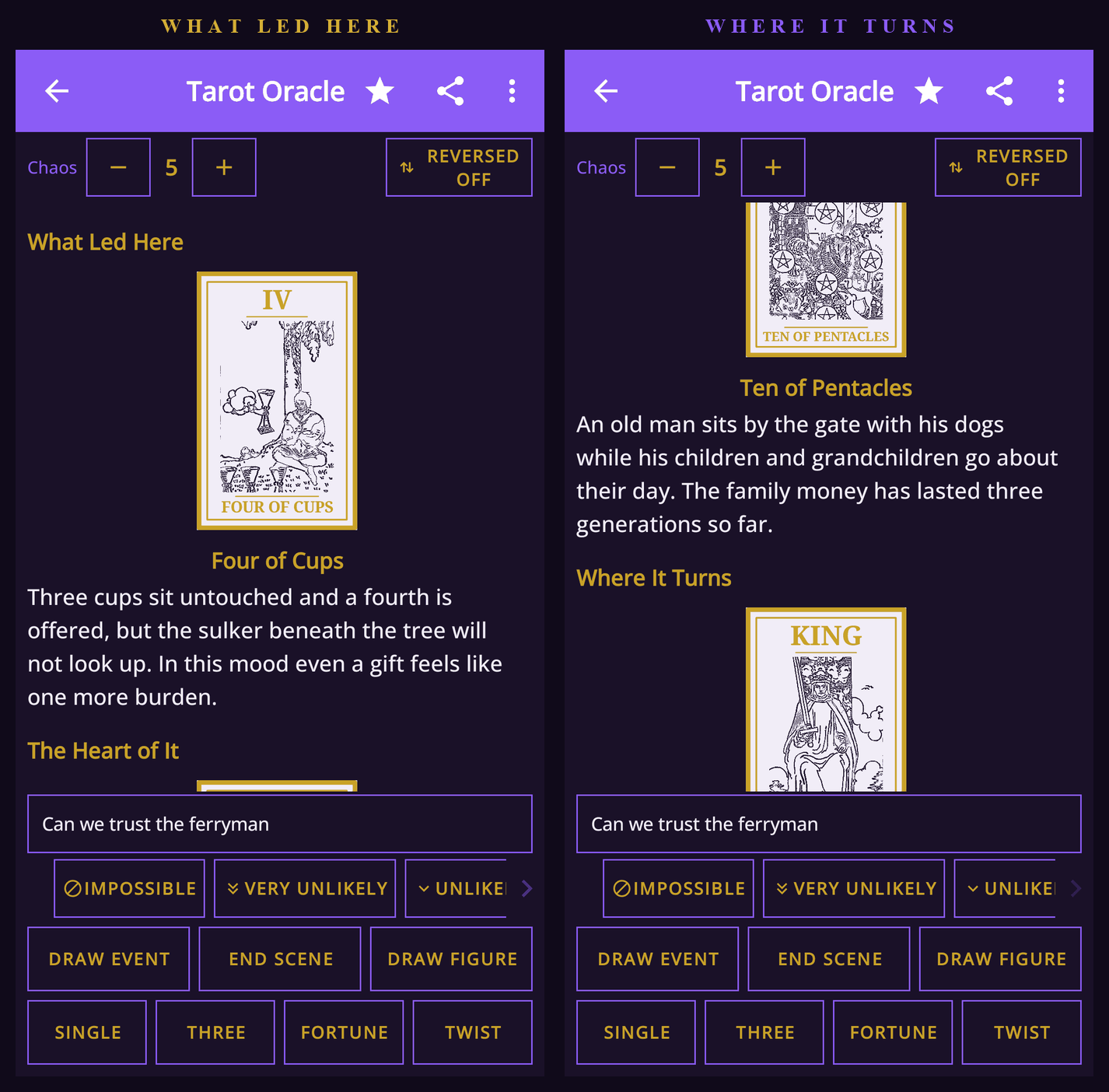 Three Minor Arcana in one spread: What Led Here, The Heart of It and Where It Turns.
The Campaign Assembler Leaves Beta
The Campaign Assembler has dropped its beta label. A pack takes its adventure's name, its NPCs come with a Want and a Secret, its quest has a Deadline, and a saved pack reopens in the Assembler for more changes. The Campaign Board reads packs properly now, and the PDF's title fits on its page.
The Oracle and the World Engine Reach Further
"Bring it to life" in the Oracle now reaches the world-building tools. Going on from a realm to its ruling house or its faith rolls them to suit that realm, and an adventure sent back to the Oracle brings its villain, lieutenant, ally and wildcard straight into your NPC list. Voyage jobs say where they're headed and pay the balance on arrival.
The World Engine gains "Open as Realm", which carries a chronicle's realm into the Realm Generator in the state the chronicle left it, so the story can carry on there. Chronicle timelines are easier to read, too: short titles with the full sentence kept as a note, reigns and factions drawn as bars, ages named for their reigns, and wars shown on both realms' lanes. That applies to chronicles saved from 4.37 onward.
Better Maps
The biggest change to the maps is the rivers. On the Fantasy Map and the Hex Map, a river now starts at a spring on high ground and runs downhill to the sea or a lake, picking up tributaries and widening towards its mouth as a single line. On the Hex Map it travels from hex to hex and stays off mountains and settlements. Names got the same attention: on the Treasure Map, the Town Map, the Star Chart, TOPO//SCAN, the Hex Map, the Sector Survey and the venue plans, every name keeps clear of lines and marks and sits beside what it names. Five Room Dungeon maps put each room number on a filled badge, sigil charges with holes in them, like the key and the coin, finally show the holes, and the full-screen map viewer has a Fit button.
None of this reaches back into maps you've already saved. They keep their rivers, names and labels as they were, and only maps made from 4.37 onward are drawn the new way.
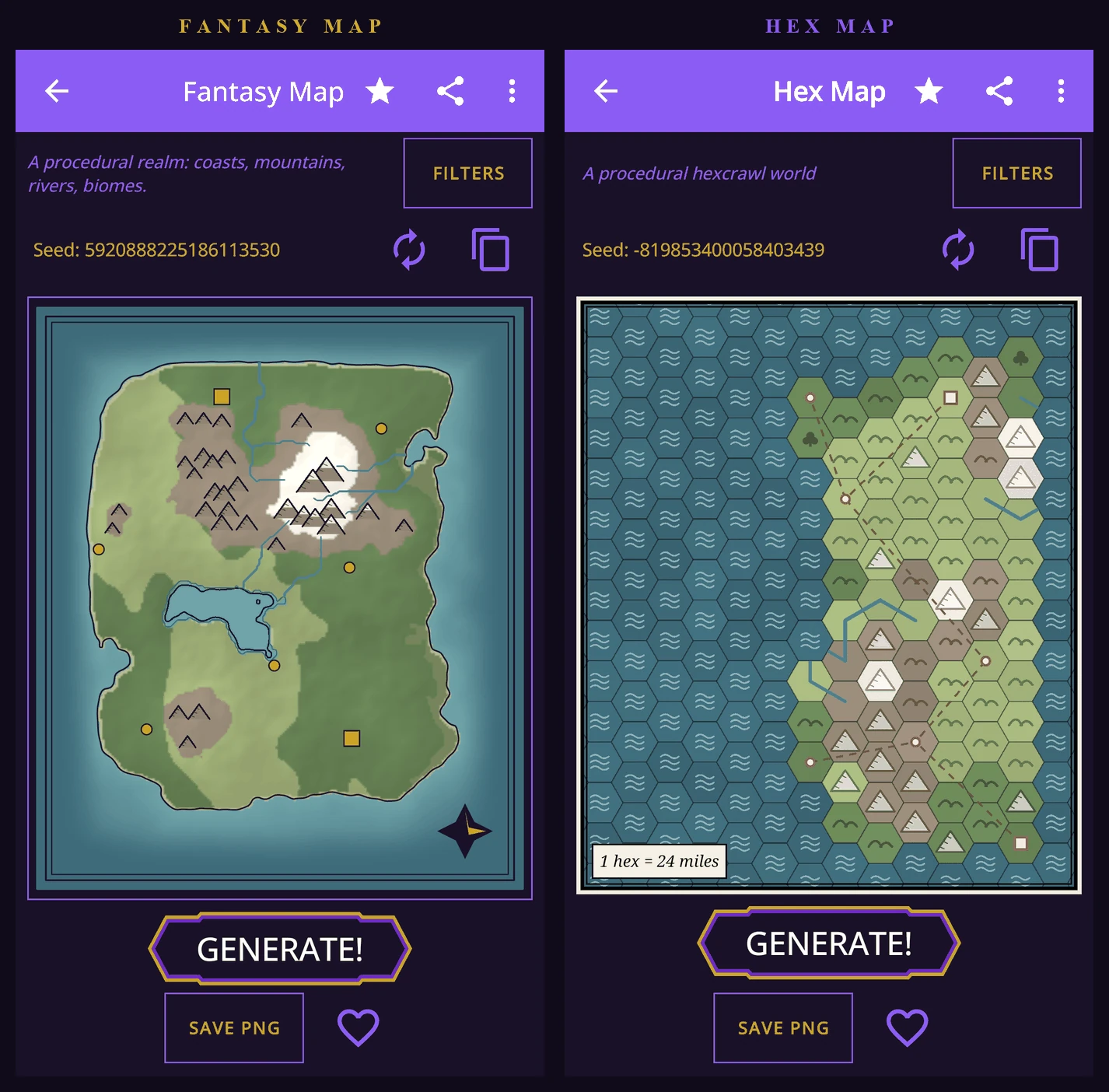 Rivers that start in the hills and end in the sea, on the Fantasy Map and the Hex Map.
Results That Fit Together
A good share of this update went into making separately rolled pieces agree with one another. Encounter stakes now suit the scene they're set in. A faith's worship suits its structure, so there are no more sun churches devoted to a god of locks. Rulers, heirs and founders draw from 150 names per gender rather than 26, and no given name turns up twice among one world's realms. House names in the name generator now run the whole alphabet, a creature's stats suit its description when you reroll them, and new faction crests keep rockets and satellites out of fantasy and the 1920s.
Bigger Text, and Turning the Phone
The app now follows your phone's font size up to 130%, with every screen still whole at that size. Turning the phone keeps everything where it was: results, locks, any open panel or popup, and the line you were reading.
A Few Names Have Changed
Twenty-eight NPC race names borrowed from other publishers' games have been replaced with names of our own, the Mothfolk, the Oathwrought and the Shellback among them. Saved NPCs keep the text they were saved with. Spelling across the app is now British (favourites, rumours, colour), again without touching anything you saved. And the UnifrakturMaguntia blackletter face has left the Settings list; if it's the one you use, it stays until you pick another.
Your Saves Are Safe
Every favourite, preset, note, campaign, map and setting you already have opens and looks the way it did before the update. Wherever a tool now writes or draws differently, the difference shows only in what you make next.
Version 4.37 is free on Google Play now. The stranger at the Goose is still out on the step, waiting to be called by name.
Download Fantasy World Generator
Twenty-two kinds of venue, up to three floors each, and one switch between what the players see and what only you know.