
Every tabletop table eventually goes quiet. Someone's schedule collapses under its own weight, a campaign cools for a month and never quite recovers its heat, and the story that mattered so much only a few weeks ago starts to feel like something you dreamed rather than played. An oracle exists for exactly that silence, and asks for nothing in return but your attention. It asks nothing of anyone else's calendar, nothing of a table that has to be booked or a friend group coordinated across three time zones. It only asks that you show up with a question, an honest guess at the odds, and the nerve to accept whatever the dice hand back.
The Empty Chair
Playing alone is not a diminished version of the hobby. It is a different shape of the same old craft, closer to writing a story alongside a co-author who refuses to tell you what happens next than to swapping a table of friends for silence. You still decide what your character does. You still live with what follows. The only real difference is that the chair across from you is empty, and an oracle fills it.
It travels well too, unlike almost anything else in this hobby: a train rattling through the dark, a waiting room under fluorescent light, the ten restless minutes before sleep, because the whole table now fits inside a pocket.
What an Oracle Actually Is
Here is the part worth being honest about: an oracle does not understand your question. It cannot weigh how clever or well-phrased it is, because underneath the mysticism it is a dice roll, nothing more. What makes it feel uncanny is what you bring to it, not what it brings to you.
You ask a plain yes or no question, and before the dice ever move, you choose a likelihood, sliding somewhere between Impossible and Near-certain depending on how probable a yes genuinely feels given what your character already knows. The oracle's only job is to hold you to that honesty once you've committed to it. Most answers come back as a clean yes or no. Some come back sharper: an “and” that pushes the answer further in the direction it was already leaning, a “but” that pulls against it, granting the yes while taking something back in the same breath, or softening the no with something you didn't see coming. And rarely, an Exceptional result, where the dice don't merely answer the question but lean their whole weight on it, an exceptional no landing with every bit as much force as an exceptional yes.
 Type the question, commit to the odds, then live with what comes back. This one landed on "Yes, but...".
The Dial That Decides How Wild Things Get
Sitting underneath every roll is the Chaos Factor, a dial running from one to nine. Push it high and the odds themselves start leaning toward yes, and random events start elbowing their way into scenes more often, uninvited and unbothered by your plans. Pull it low and the same world grows calmer, steadier, more willing to behave. You can turn it by hand whenever the story asks for it, upward once a scene is already spiraling and you want the story to match that momentum, downward again once you've wrestled some control back and want the ground to hold still under you for a while.
But the dial doesn't only move when you reach for it. Closing a scene shifts it a point on its own, one direction or the other depending on whether you ended that scene in control or out of it. An Exceptional answer nudges it too, settling the world further on a yes, unsettling it further on a no. Every one of these small movements writes its own line into the journal, so the number governing your whole story never changes under you without leaving a reason behind.
 Answer honestly and the dial listens, then writes down why.
The Shape of a Session
A session isn't simply a stream of questions with a story sifted out of them afterward. It has a shape, and the oracle hands you the places where that shape bends. Before you play a scene, you frame it: you say what you expect to happen, a small act of honesty carrying the same weight as setting your odds, because that expectation is then tested against the Chaos Factor before a word of the scene plays out. On a calm dial the scene usually holds and unfolds as pictured. On a wild one, it rarely gets the chance. Sometimes it arrives bent by a twist you have to reconcile with what you were expecting, and sometimes it's interrupted outright, a random event walking in and taking the scene over before you've even settled into it.
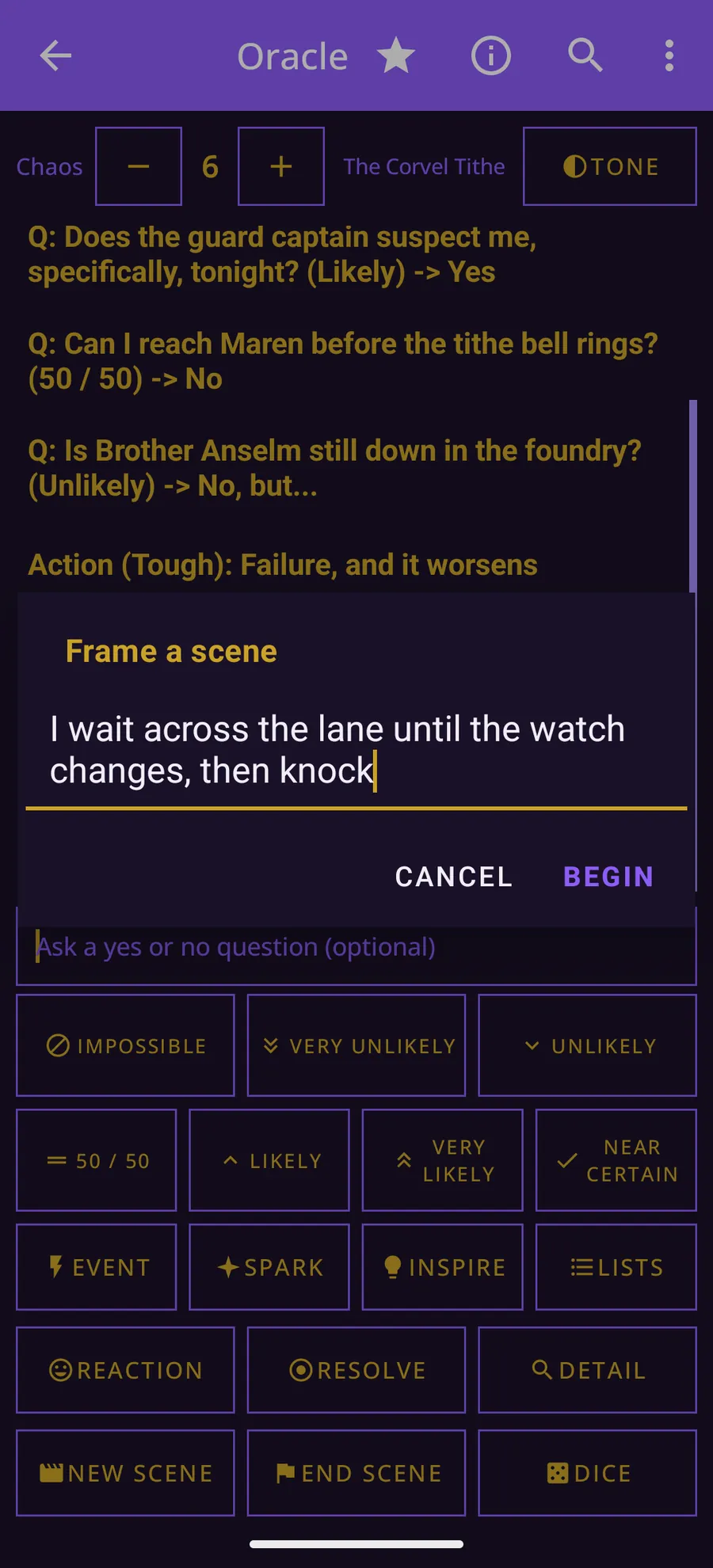 Say what you expect before you play it. The Chaos Factor decides whether you get it.
When the scene is done, you close it, and the oracle asks you a single honest question in return: were you in control as it ended, or not? Answer honestly and the dial listens. In control eases the world back down a notch. Out of control winds it tighter still. Either way, the number answers to something that happened in the fiction, not to you simply reaching over and turning it because you feel like it. Do that four or five times, frame and play and close, and you've had a session: a beginning, a shape all its own, and a place where it finally stopped.
Threads, NPCs, and the Events That Find Them
None of this happens in a vacuum. Alongside the oracle you keep two running lists: your open threads, the plot questions and goals still hanging unresolved, and your NPCs, the characters who have already stepped into the story. Add to both as you play, and the tool starts building on what you've already established rather than inventing strangers with no history behind them.
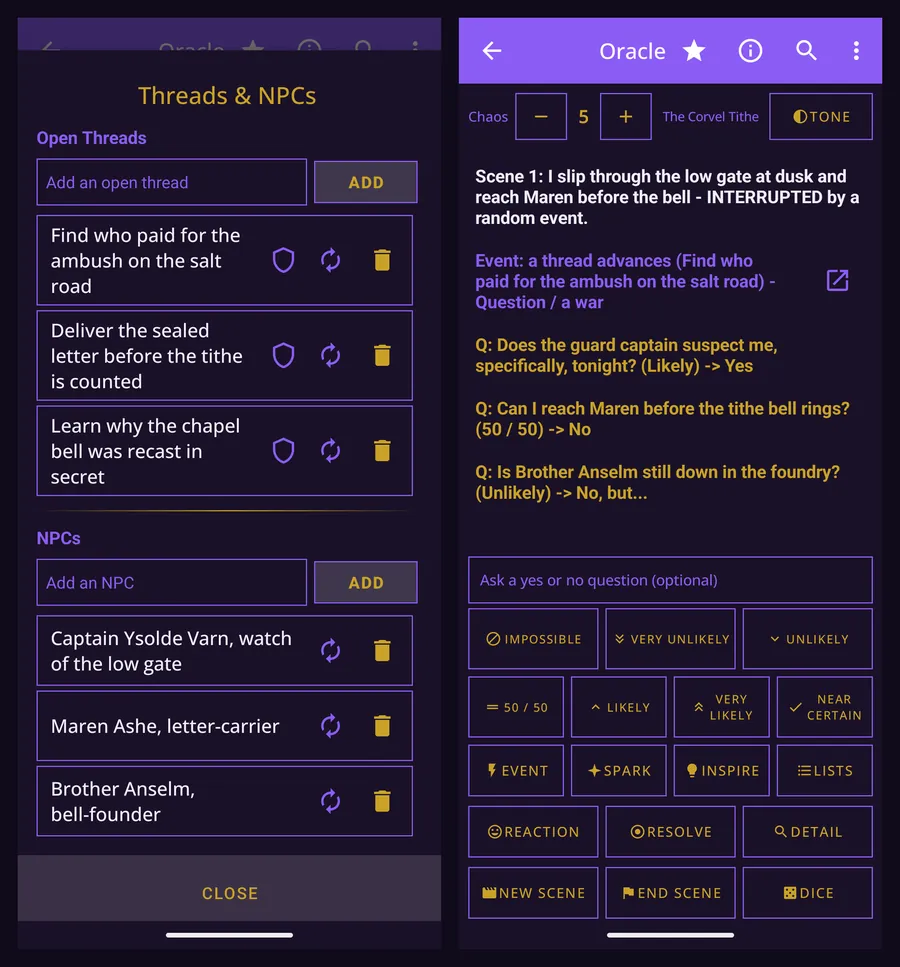 Keep the lists, and the events start finding them. That thread came back on its own.
That's what a Random Event draws from. Instead of a bare prompt from nowhere, it hands you a focus, an NPC acting on their own agenda, a thread advancing on its own terms, the wider world stirring somewhere off the page, paired with a meaning to read into whatever's happening. When you're simply stuck rather than waiting on an answer, a Spark hands you an action and a subject and leaves the meaning to you, and Inspiration opens a themed deck to pull from when the trouble is a whole angle of the scene rather than one detail: what it's about, how it looks, where it's happening, what's in the room, what it feels like, or where it might lead. Whenever something points you toward a concrete detail, a new face, an unfamiliar place, an omen worth reading, tap straight through to the matching generator and flesh it out on the spot. The oracle isn't one tool sitting apart from the rest of the kit. It's the current running underneath all of it.
The Art of Asking
Because the oracle cannot read intent, the real skill in solo play has nothing to do with phrasing a clever question. It has everything to do with setting honest odds. “Is there danger nearby” is a weak question not because the oracle would misunderstand it, but because it gives you nothing solid to base a likelihood on, and a shrug of a guess gives you a shrug of an answer. “Does the guard captain suspect me, specifically, tonight” works better because you can reason your way toward a number: you snapped at her yesterday, so that leans probable, not merely even.
The dice are only as honest as the odds you feed them. Call every uncertain moment near-certain because you want it to go your way, and you haven't invited the co-author to the table at all. You've just written the ending yourself and asked the dice to rubber-stamp it.
When a “but” lands on an answer you already wanted, resist waving it off as inconvenient. Escaping the ambush, but leaving your pack behind in the mud, can carry a session further than a clean yes ever could.
And not every question worth asking is a yes or no. Some are open, and for those the oracle hands you a detail instead of a verdict, a pair of words to read the scene through rather than an answer to obey. Some are attempts, where what you're asking isn't whether something happens but how well it goes, and there the answer climbs down a ladder from triumph, through success, through a success that costs you something, to a setback, down to a failure that makes things worse than before you asked, with the odds set favorable, even, or tough before a single die moves. And when a moment demands something go wrong, you can ask for the price outright: a resource spent for good, an ally hurt, someone you trusted turning on you. None of it needs a separate system bolted underneath. It's the same honesty as always, pointed at a different shape of uncertainty.
What the Oracle Keeps for You
A solo session sprawls in ways a full table never quite does, mostly because there's no one else's memory sitting beside you to catch what you'd otherwise forget. Everything here saves itself as you go, but the shape of that memory is yours to organize. Keep each campaign fully its own, with its own threads, NPCs, and history, so a face from one story never wanders uninvited into another. Each one carries its own genre and register too, fantasy or science fiction, tuned grim, mixed, or heroic, which quietly changes the words the oracle reaches for. A grim science-fiction campaign and a heroic fantasy one can sit side by side in the same app and never once sound like they came from the same throat. File a session's journal into folders of your own making, tucked into your Favorites for whenever you want to find your way back, or share it as plain text or markdown, or export it as a styled PDF: a parchment scroll, an illuminated tome, an adventure module, a royal decree, whichever shape suits the story you just told.
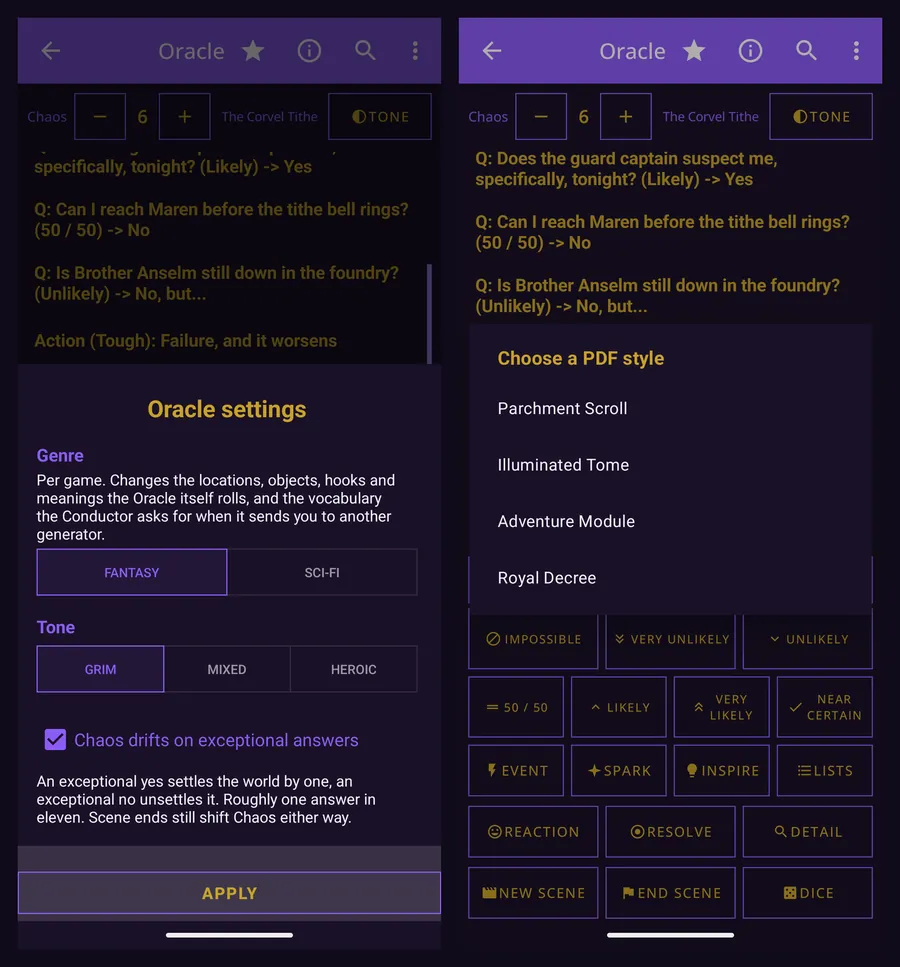 Each game keeps its own genre and register, and its journal leaves as a scroll, a tome, a module or a decree.
Begin Small, Begin Anywhere
Your first night alone does not need the weight of an entire kingdom behind it. Choose one small, specific uncertainty and nothing grander than that. Can she cross the market square without being recognized. Does the letter tucked in his coat say what he's afraid it says. Set your odds honestly, ask it, follow wherever the answer drags you, and let the next question grow naturally out of whatever you're left holding.
Fantasy World Generator's Oracle, alongside its threads, its NPCs, and its running journal, was built for this exact kind of quiet, solitary play: free, offline, and waiting whenever the rest of your table isn't.
Download Fantasy World Generator
Open the Oracle, and ask it your first question. See what it hands back, and let the story go wherever that answer wants to take it.