September 9, 2026 · chara_bachtsevani

#devlog #worldbuilding #tools

We Built a Free Name Generator That Grew Into a Worldbuilder's Toolkit

Fantasy World Generator began with one of the smallest problems imaginable: a blank text field and a cursor blinking patiently where a name was supposed to go. A tavern that existed only as an idea, still waiting for a word to make it real enough to walk into. A minor lord who existed in every sense except the one that actually mattered, the one you would call him by if he ever crossed your table. An entire village, half-built inside someone's skull at two in the morning, stalled dead because its builder could not decide what to call the innkeeper.

A Single Small Problem

We built a name generator first, and nothing grander than that. It let you blend cultures together the way an alchemist blends tinctures, never entirely certain what the mixture will yield until it settles and stops fighting you. You could choose how many fragments should braid together into something that rang like a real name instead of a random string of syllables, and pin down a rough length so the result never landed either clipped short or too unwieldy to say aloud at the table. It solved the one problem it had been built to solve, and for a while, we let ourselves believe that was the whole job finished.

The name generator's filter sheet with Nordic and Elfish selected and fragments set to 3, followed by two pages of generated names. Where it started. Pick the cultures to blend, choose how many fragments braid together, and roll.

The Moment It Stopped Being Small

What we had not accounted for was how fast one solved problem drags the next one out from behind it, blinking in the light. A named innkeeper needs a face, a temperament, something he wants badly and something he is hiding, quite possibly from himself. A named village needs a history: who founded it, what nearly wiped it off the map, what old grudge is still simmering under the floorboards a century later, waiting for the wrong person to disturb it. Every answer the tool handed us seemed to crack open a door onto some further, unnamed thing standing just behind it, and we kept walking through, one door after another, further than we had ever planned to go.
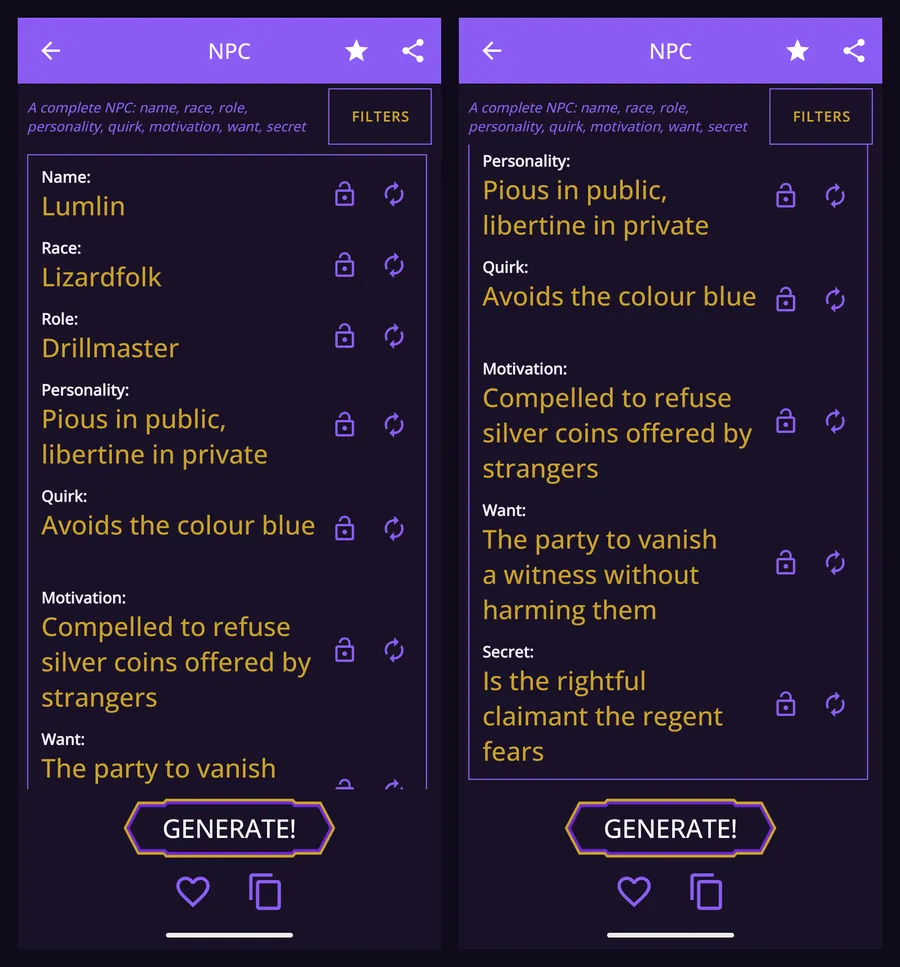
A generated NPC showing name, race, role, personality and quirk, scrolled to reveal a Want and a Secret. Every NPC arrives with something they want badly and something they are hiding.

So the generator grew the way a path through unfamiliar country tends to grow: one clearing revealing the next, with no map drawn in advance and no real sense of where the treeline finally ended. NPCs arrived not as names bolted onto a role, but as small, whole people, the kind you could believe had a life running somewhere off the page even in the moments you were not looking directly at them. A bestiary followed close behind, built from the conviction that a monster ought to feel like something that had actually lived and hunted and nearly died once already, rather than a stat block assembled hastily for a single throwaway encounter. Maps came next, unrolling one after another: continents rendered like something pulled from an old expedition's back pocket, cities with walls and rivers and districts that made honest sense to walk through, dungeons keyed room by room with a hazard crouched waiting in the dark of at least one of them.
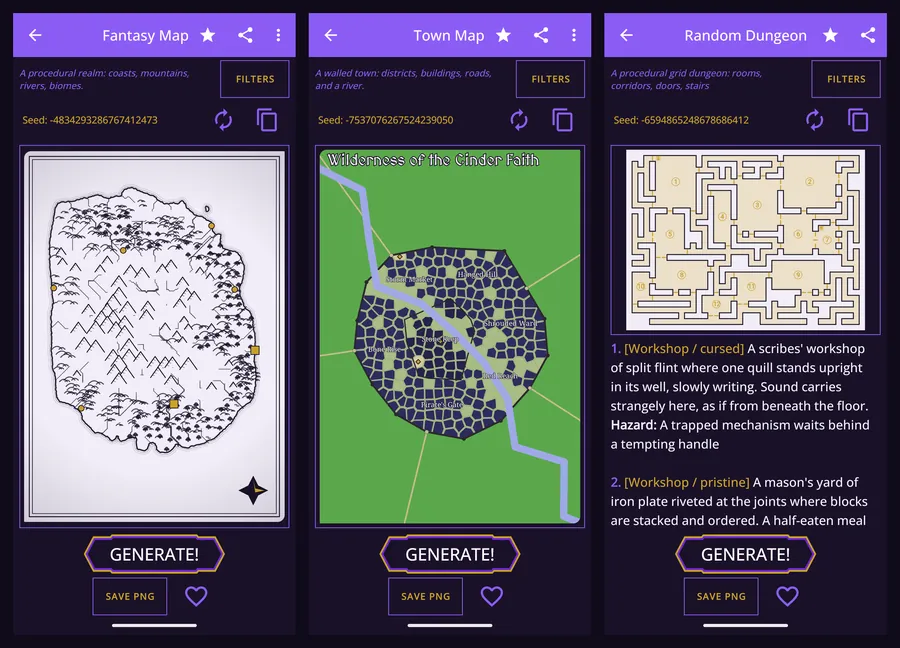
Three phone screens side by side: a procedural continent map, a walled town map with named districts, and a grid dungeon with a numbered room key. Continents, walled towns with districts you can walk, and dungeons keyed room by room, hazards included.

What Lives Inside It Now

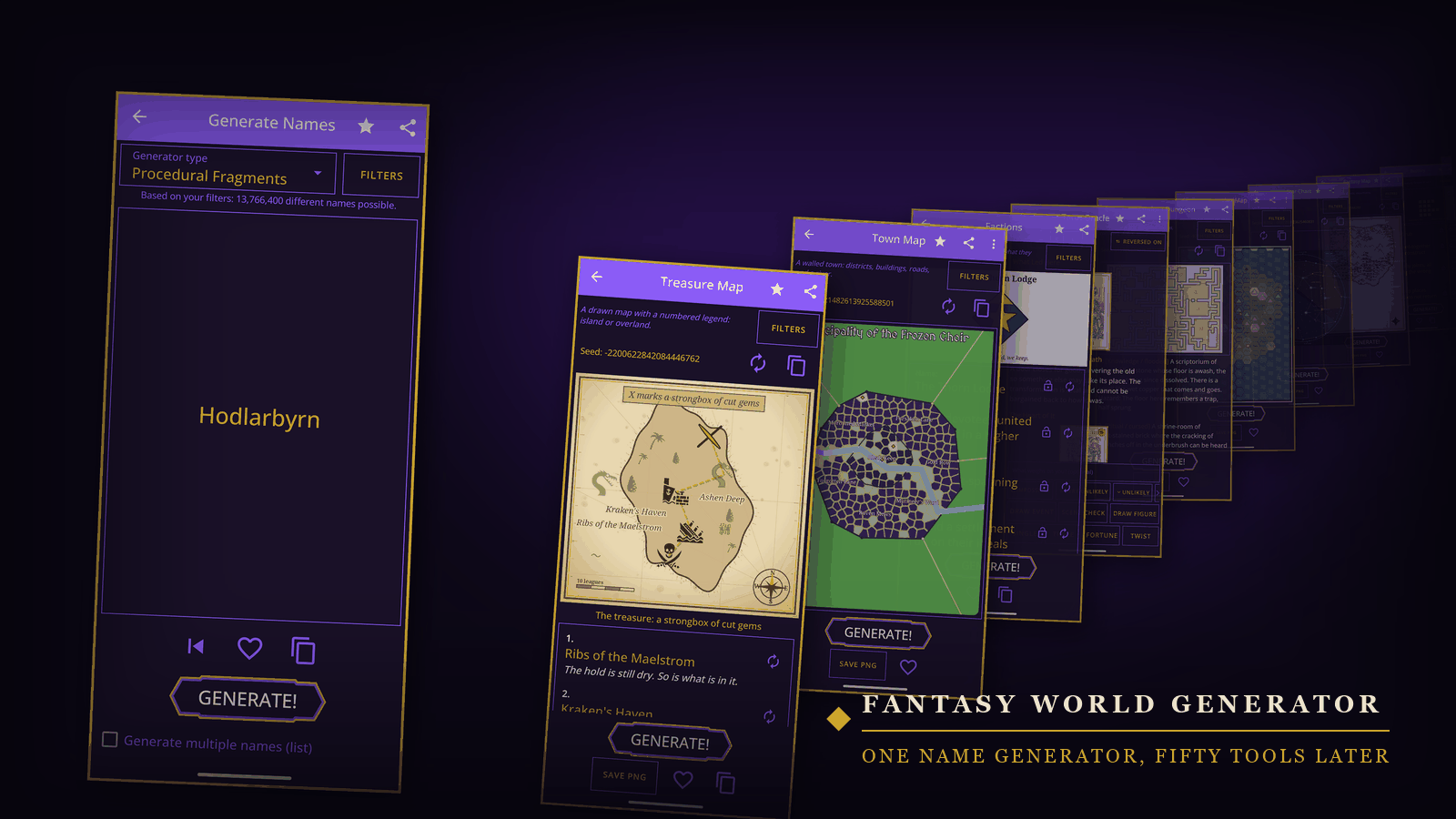
We stopped counting with any precision somewhere past the thirtieth tool, though the number now sits close to fifty and shows no sign of slowing down. Name generators alone span a dozen cultures and more. There is a full bestiary now, procedural continents and town maps and star charts for the science-fiction side of the toolkit, along with quest hooks, tavern rumors, and unsolved mysteries built to be dropped straight into a session with no preparation required at all.
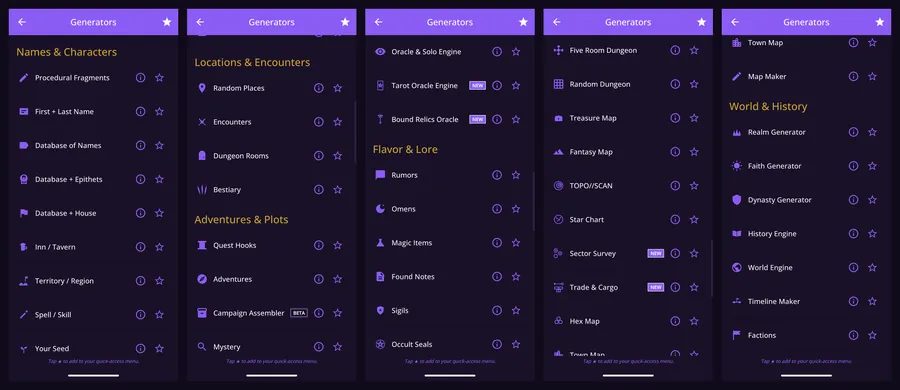
Five consecutive screens of the app's generator list, covering names, locations, adventures, lore, maps and world history. The whole shelf, in five screens.

The tool we still find genuinely strange to watch in motion is the History Engine. Hand it a single seed, and it rolls out a realm, a faith, and a ruling house from nothing, then lives out their shared history decade by decade: golden ages, plagues, schisms, the slow accumulation of small grudges that eventually curdles into a war nobody quite remembers the original reason for anymore. Watching centuries assemble themselves out of one small starting point has never entirely stopped feeling, even to us, like a small and slightly disreputable kind of magic, even now that we understand precisely how the gears turn underneath it.

The History Engine rolling out a realm's timeline decade by decade as CONTINUE is pressed. One seed, then five decades: a treasury scandal, a famine, a conspiracy, a golden age, an assassin.

None of it asks for an account. None of it requires a connection to anything at all. It was built, from that first stalled name onward, to work just as well on a phone with no signal at a table with no game master as it does anywhere else in the world.

An Oracle, Not an Author

The tool we are proudest of might also be the least visible one: the Oracle system, built for the specific and slightly lonely problem of wanting to play when no one else is sitting at the table. It answers the questions a game master would ordinarily answer, weighing how likely a yes really ought to be, complicating a clean answer with an unexpected twist right when the moment calls for one, reading a Tarot spread the way an old hand at the table might, if that old hand kept a private, slightly eerie sense of what the cards actually meant underneath the printed descriptions. It never writes your story for you. It only ever answers what you put to it, and leaves every ounce of the telling in your hands, where it belongs.

Still Growing

We never set out to build a kit with dozens of tools crowded inside it, and we do not imagine ourselves finished now, not by a long way. Fantasy World Generator remains free, remains offline, and remains, in the fullest sense of the word, unfinished: every module we add tends to reveal two more we had not thought of yet, in exactly the same way that first stalled name once did, all those clearings ago.

If you have ever needed a name, a monster carrying a history behind its scars, a kingdom nursing a thousand-year grudge, or an entire session conjured out of nothing but a single seed and an oracle's patience, it is sitting there now, free to open, one tap away from whatever you find yourself needing next.


Download Fantasy World Generator

Free and offline from the very first name onward. See how far one small clearing can grow.

We Built a Free Name Generator That Grew Into a Worldbuilder's Toolkit

Fantasy World Generator began with one of the smallest problems imaginable: a blank text field and a cursor blinking patiently where a name was supposed to go. A tavern that existed only as an idea, still waiting for a word to make it real enough to walk into. A minor lord who existed in every sense except the one that actually mattered, the one you would call him by if he ever crossed your table. An entire village, half-built inside someone's skull at two in the morning, stalled dead because its builder could not decide what to call the innkeeper.

A Single Small Problem

We built a name generator first, and nothing grander than that. It let you blend cultures together the way an alchemist blends tinctures, never entirely certain what the mixture will yield until it settles and stops fighting you. You could choose how many fragments should braid together into something that rang like a real name instead of a random string of syllables, and pin down a rough length so the result never landed either clipped short or too unwieldy to say aloud at the table. It solved the one problem it had been built to solve, and for a while, we let ourselves believe that was the whole job finished.

The name generator's filter sheet with Nordic and Elfish selected and fragments set to 3, followed by two pages of generated names. Where it started. Pick the cultures to blend, choose how many fragments braid together, and roll.

The Moment It Stopped Being Small

What we had not accounted for was how fast one solved problem drags the next one out from behind it, blinking in the light. A named innkeeper needs a face, a temperament, something he wants badly and something he is hiding, quite possibly from himself. A named village needs a history: who founded it, what nearly wiped it off the map, what old grudge is still simmering under the floorboards a century later, waiting for the wrong person to disturb it. Every answer the tool handed us seemed to crack open a door onto some further, unnamed thing standing just behind it, and we kept walking through, one door after another, further than we had ever planned to go.

A generated NPC showing name, race, role, personality and quirk, scrolled to reveal a Want and a Secret. Every NPC arrives with something they want badly and something they are hiding.

So the generator grew the way a path through unfamiliar country tends to grow: one clearing revealing the next, with no map drawn in advance and no real sense of where the treeline finally ended. NPCs arrived not as names bolted onto a role, but as small, whole people, the kind you could believe had a life running somewhere off the page even in the moments you were not looking directly at them. A bestiary followed close behind, built from the conviction that a monster ought to feel like something that had actually lived and hunted and nearly died once already, rather than a stat block assembled hastily for a single throwaway encounter. Maps came next, unrolling one after another: continents rendered like something pulled from an old expedition's back pocket, cities with walls and rivers and districts that made honest sense to walk through, dungeons keyed room by room with a hazard crouched waiting in the dark of at least one of them.

Three phone screens side by side: a procedural continent map, a walled town map with named districts, and a grid dungeon with a numbered room key. Continents, walled towns with districts you can walk, and dungeons keyed room by room, hazards included.

What Lives Inside It Now

We stopped counting with any precision somewhere past the thirtieth tool, though the number now sits close to fifty and shows no sign of slowing down. Name generators alone span a dozen cultures and more. There is a full bestiary now, procedural continents and town maps and star charts for the science-fiction side of the toolkit, along with quest hooks, tavern rumors, and unsolved mysteries built to be dropped straight into a session with no preparation required at all.

Five consecutive screens of the app's generator list, covering names, locations, adventures, lore, maps and world history. The whole shelf, in five screens.

The tool we still find genuinely strange to watch in motion is the History Engine. Hand it a single seed, and it rolls out a realm, a faith, and a ruling house from nothing, then lives out their shared history decade by decade: golden ages, plagues, schisms, the slow accumulation of small grudges that eventually curdles into a war nobody quite remembers the original reason for anymore. Watching centuries assemble themselves out of one small starting point has never entirely stopped feeling, even to us, like a small and slightly disreputable kind of magic, even now that we understand precisely how the gears turn underneath it.

The History Engine rolling out a realm's timeline decade by decade as CONTINUE is pressed. One seed, then five decades: a treasury scandal, a famine, a conspiracy, a golden age, an assassin.

None of it asks for an account. None of it requires a connection to anything at all. It was built, from that first stalled name onward, to work just as well on a phone with no signal at a table with no game master as it does anywhere else in the world.

An Oracle, Not an Author

The tool we are proudest of might also be the least visible one: the Oracle system, built for the specific and slightly lonely problem of wanting to play when no one else is sitting at the table. It answers the questions a game master would ordinarily answer, weighing how likely a yes really ought to be, complicating a clean answer with an unexpected twist right when the moment calls for one, reading a Tarot spread the way an old hand at the table might, if that old hand kept a private, slightly eerie sense of what the cards actually meant underneath the printed descriptions. It never writes your story for you. It only ever answers what you put to it, and leaves every ounce of the telling in your hands, where it belongs.

Still Growing

We never set out to build a kit with dozens of tools crowded inside it, and we do not imagine ourselves finished now, not by a long way. Fantasy World Generator remains free, remains offline, and remains, in the fullest sense of the word, unfinished: every module we add tends to reveal two more we had not thought of yet, in exactly the same way that first stalled name once did, all those clearings ago.

If you have ever needed a name, a monster carrying a history behind its scars, a kingdom nursing a thousand-year grudge, or an entire session conjured out of nothing but a single seed and an oracle's patience, it is sitting there now, free to open, one tap away from whatever you find yourself needing next.


Download Fantasy World Generator

Free and offline from the very first name onward. See how far one small clearing can grow.

Want to be told when the next story drops?

Θέλετε να μάθετε πρώτοι για την επόμενή μας ιστορία;

Quiet updates, no spam. Only when something worth sharing is ready.

Διακριτικά νέα, χωρίς ενοχλήσεις. Μόνο όταν έχουμε κάτι αξιόλογο να πούμε.

SubscribeΕγγραφή