October 24, 2026 · CHARIS BACHTSEVANI

#devlog #mystery #tools #announcement

Who Was Where, and When: Mystery and Everything Else in 4.38

Version 4.38 is out, and this time there is a body upstairs.

At its centre is Mystery, rebuilt. It used to hand you a crime as a page of text. Now it hands you the building where it happened: every floor, everyone who was in it, and where each of them spent the night. Around it sit a few smaller changes, among them a short tour the first time you open Mystery, Taverns & Hubs or the Campaign Board, and a handful of things that read slightly wrong before and read right now. This post goes through all of it, starting with the case.

4.38 at a Glance

  • Mystery, rebuilt: a crime set in a whole building, drawn floor by floor, with the clues and the suspects pinned where they are.
  • 36 buildings, three genres: from a crossroads inn to an orbital hotel to a sleeper train, in fantasy, sci-fi and 1920s horror.
  • The case file: every person in the house, with who they are, what they are to the victim, their room, manner, look and mark.
  • The night: the evening hour by hour, ready to send to the Timeline Maker.
  • GM switch: who did it, what each clue proves and where things were hidden, for your eyes only.
  • Dice and locks: every worded line rerolls or stays, and locked lines carry into the next case.
  • Keep the building: lock the floor plan, and Generate writes a new crime into the same house under the same name.
  • Favourites and the Campaign Board: a saved case comes back with its floor plan, wherever you open it.
  • A first-run tour: Mystery, Taverns & Hubs and the Campaign Board step you through their screens, using the screen itself.
  • Smaller fixes: timeline lanes, viewer buttons, a scroll bar where one was missing, and "an Oval shield".
  • Your saves: every Mystery you saved before opens exactly as it did.

One House, One Night

Mystery lives in the Generators Hub, where it wears a NEW badge for now. Press Generate and you get a case: a title, a building, a crime and a floor plan with numbered pins. Our first roll for this post was The Late Guest, a murder at Lockridge Grange, a manor house "beside a lake where the family has drowned two of its own". It has four floors, from the attic down to the cellar, and the arrows beside the floor's name step through them.
Lockridge Grange in Mystery, shown floor by floor: the attic, the upper floor, the ground floor with its garden, and the cellar, each with its numbered pins. Lockridge Grange from the attic down: four floors, one night.

Each pin is something you can tap. Pin 1 is the victim, here the body servant Hywel Quillon, found dead in "Bedroom 7, by the bed". The other round pins are the suspects, where the investigators find them, and the clues, where they lie. The speech-bubble pins hold what somebody overheard. Clue 7 sits on the upper floor, at the door of bedroom 2: "A spit-turner saw the shadow of Zillah Lockridge cross the light under the door of bedroom 2 at ten past eleven."

Filters set as much as you like and roll the rest: the genre, one of the twelve buildings it has, a small, medium or large cast, the crime and the tone. Murder, theft and disappearance turn up in every genre, poisoning in fantasy and the 1920s, and sabotage in sci-fi. A grounded case keeps every method and every sight explainable. A strange one lets the uncanny in, a sight nobody can account for, and keeps what it really was for the GM. Mixed rolls either.

The Case File

The second tab turns the case into a page to read before the session. It opens on the case itself: the incident, the place, the occasion that brought everyone together, the atmosphere and the reason the investigators are the ones asking questions. At Lockridge Grange, "A scream from bedroom 7 at ten past midnight brings the household running", the occasion is "The family's annual gathering", and "The gravel drive crunches loudly under every wheel."
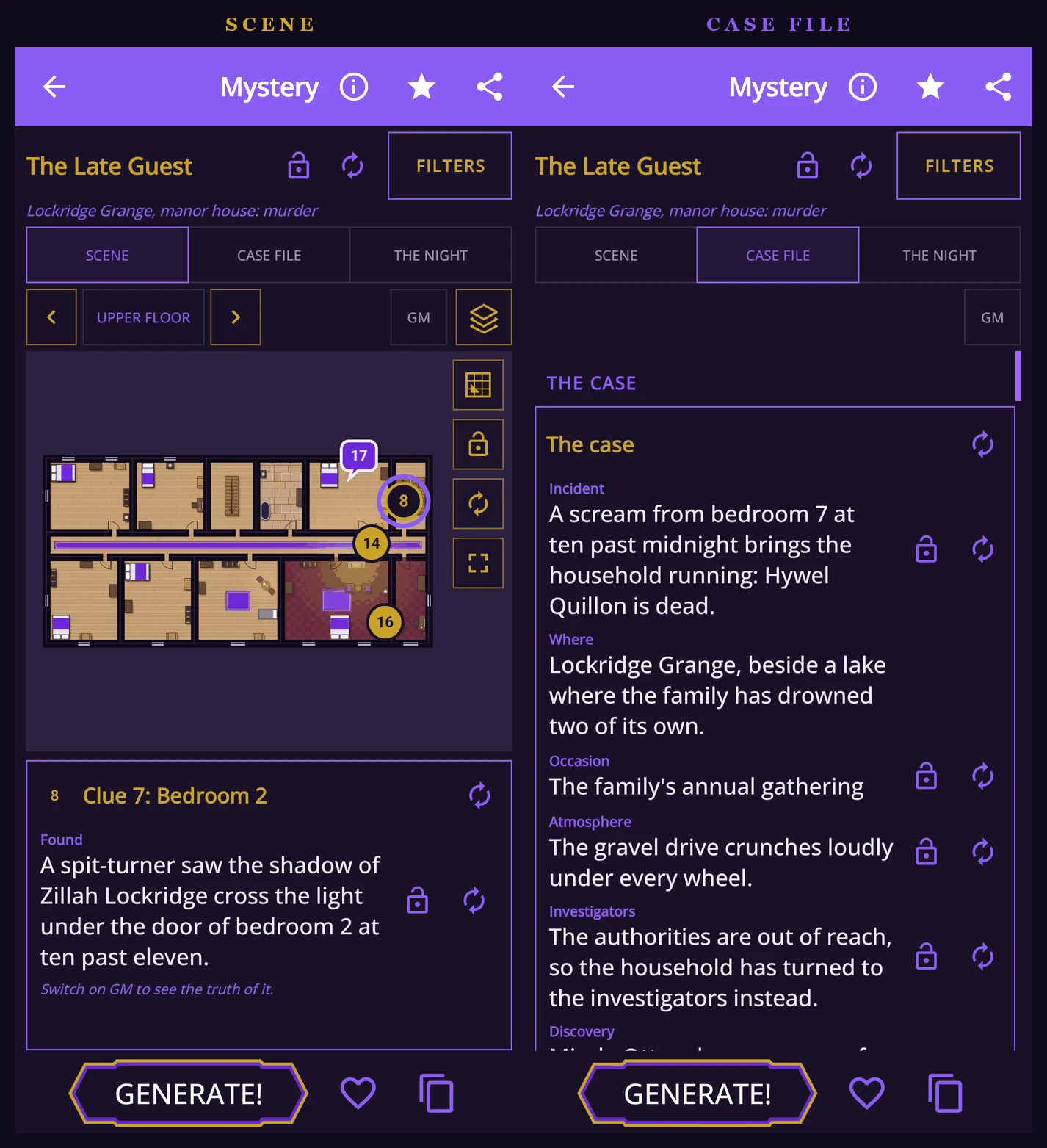
The upper floor of Lockridge Grange with the card for clue 7 open, beside the Case file tab opening on the incident, the place, the occasion and the atmosphere. The scene and the case file. Pin 8 is the spot where the spit-turner saw the shadow.

After the case come the victim and everyone else in the house. Each has who they are, what they are to the victim, their room, their manner, their look and a mark you can describe across the table. Then the clues, room by room, and with GM on, who did it, how and why.

Every case can be solved. The clues, the people and the night hold together, and the culprit's account of the evening breaks against something your players can find.

The Night, Hour by Hour

The Night tab lays the evening out as a ribbon of hours over a list. With GM off it holds what everybody knows. At Lockridge Grange, "Everyone gathers in the dining room" at 7 pm, Hywel Quillon "Goes to bedroom 7" at 10:46, and at 12:10 "Mirela Ottery has a message for Hywel Quillon and carries it to bedroom 7 in person."

With GM on it holds the rest: where each person really spent the evening, and the culprit's route to the scene and back. At eight o'clock Hywel Quillon was in "Bedroom 4, reading one letter over yet again", and Brivet Hollier was in "Bedroom 5, mending a torn hem by candlelight."
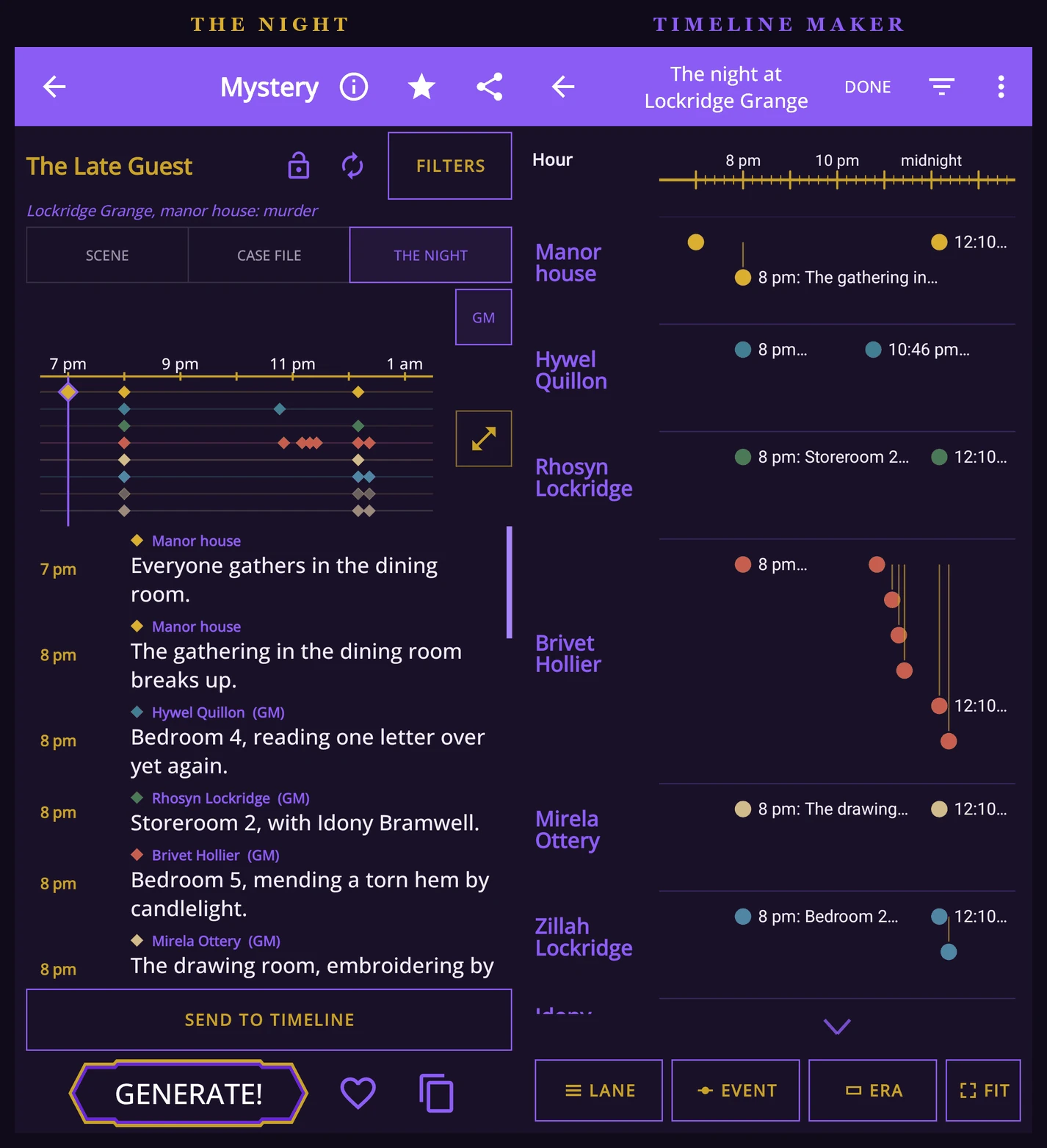
The Night tab of Lockridge Grange with GM on, its ribbon of hours above the list, beside the same night opened in the Timeline Maker with one lane for each person. The night with GM on, and the same night in the Timeline Maker.

Send to Timeline opens the night in the Timeline Maker as a timeline of its own, with a lane for each person, ready to keep, change or show.

The Switch That Keeps the Truth

As in Taverns & Hubs, the GM button decides what the screen shows. Switched off, the phone can be turned round to face the players. Switched on, the case shows its hand. Each clue says what it proves, the victim's card gives the hour of death, the night fills in, and new pins appear where the culprit hid things. In the attic at Lockridge Grange, pin 10 only exists with GM on: "The torn pillowcase, balled tight, is pushed at the back of the wardrobe." Its card names who put it there.
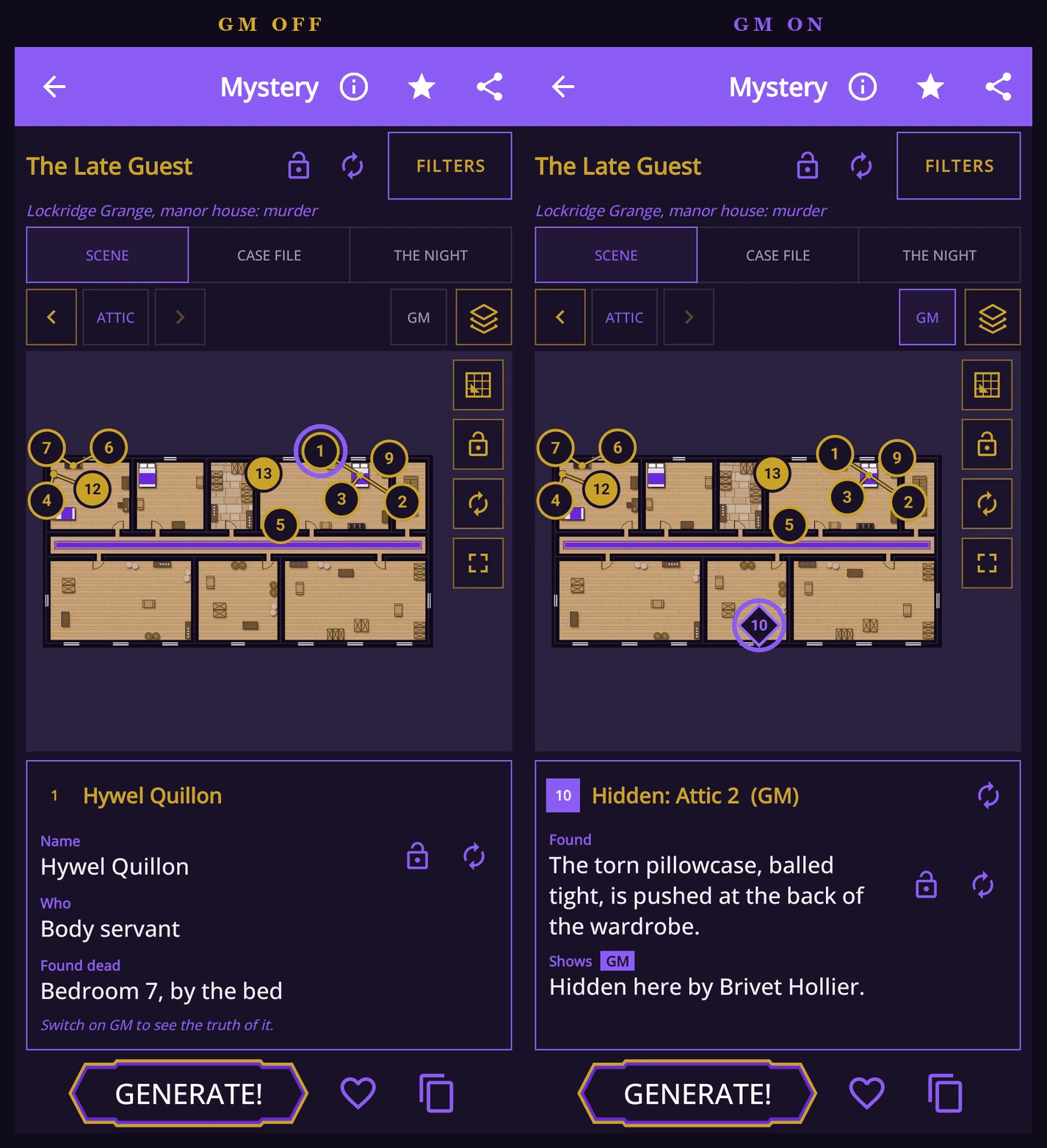
The attic of Lockridge Grange with the GM switch off, showing the victim's card, and with it on, showing the hidden pin 10 in the storeroom and its card. The same attic twice. With GM on, pin 10 appears in the storeroom.

The Layers button sits next to it. It chooses which pins show (clues, suspects, what was overheard) and whether the map is a warm floor plan or a blueprint with the rooms named. Copy follows the switch too: with GM on it copies the whole case as text, and with GM off only what the players should hear.

Fantasy, Sci-Fi and the 1920s

Each genre has twelve buildings of its own. Fantasy has the inn at a crossroads, the castle, the royal palace, the manor house, the abbey, the wizard's tower, the river barge, the guildhall, the hunting lodge, the temple, the bathhouse and the theatre. Sci-fi has the passenger liner, the research station, the orbital hotel, the mining outpost, the corporate retreat, the diplomatic embassy, a generation ship's deck, the medical frigate, the arcology penthouse, the prison barge, the terraforming relay and the salvage tug. The 1920s have the house on the hill, the sleeper train, the sanatorium, the lakeside hotel, the museum after hours, the country church and rectory, the university library, the ocean liner, the lighthouse and keeper's house, the mill-town mansion, the seance parlour and the hunting club in the woods.
Three cases in turn: The Late Guest at Lockridge Grange, a fantasy manor house; Static on the Line aboard The Vireo Halo, a sci-fi orbital hotel; and Bootleg and Brimstone on The Ames Special, a 1920s sleeper train. One case in each genre: a manor house, an orbital hotel and a sleeper train.

The people change with the building. Aboard The Vireo Halo, an orbital hotel, the victim was the hotel owner's spouse, found in "The security office, by the console". On The Ames Special, a sleeper train, a doctor called to a consultation lost a bag of morphine from "Compartment 2, near the bunk".

Keep What You Like

Every worded line in a case has its own die and its own lock. The die words the line again and leaves the facts behind it alone. The lock keeps it, and a locked line carries into the next case wherever it still holds there, filled in with the new names: a title you like, an atmosphere, a hook, a suspect's look or manner.

The floor plan has a lock of its own. With it on, Generate keeps the building, its rooms and the place's name, and writes a whole new crime into it. At Bramblecote Park a disappearance gave way to a theft and then to two different murders in three presses, each with a new cast in the same rooms. Where the place is named after the family that owns it, the family keeps its name: new people, same house. The button under the lock draws a new floor plan of the same kind of building when you want different rooms.
Four cases generated one after another at Bramblecote Park with the floor plan locked: The Last Toast, Wax and Wine, Smoke Without Fire and The Long Night, all on the same ground floor. Bramblecote Park with its floor plan locked: four cases, one house.

Save It, Pin It, Run It

A saved case opens in Favourites as itself: its floor plan and pins, the card beside them, and the case file and GM switch a tap away. Open in the generator brings it back to Mystery to change, and saving the changed copy leaves the original as it was. On the Campaign Board, a case can be attached to a node or pinned to the plan's Quick access drawer, and it opens in the same viewer, floor plan and all.
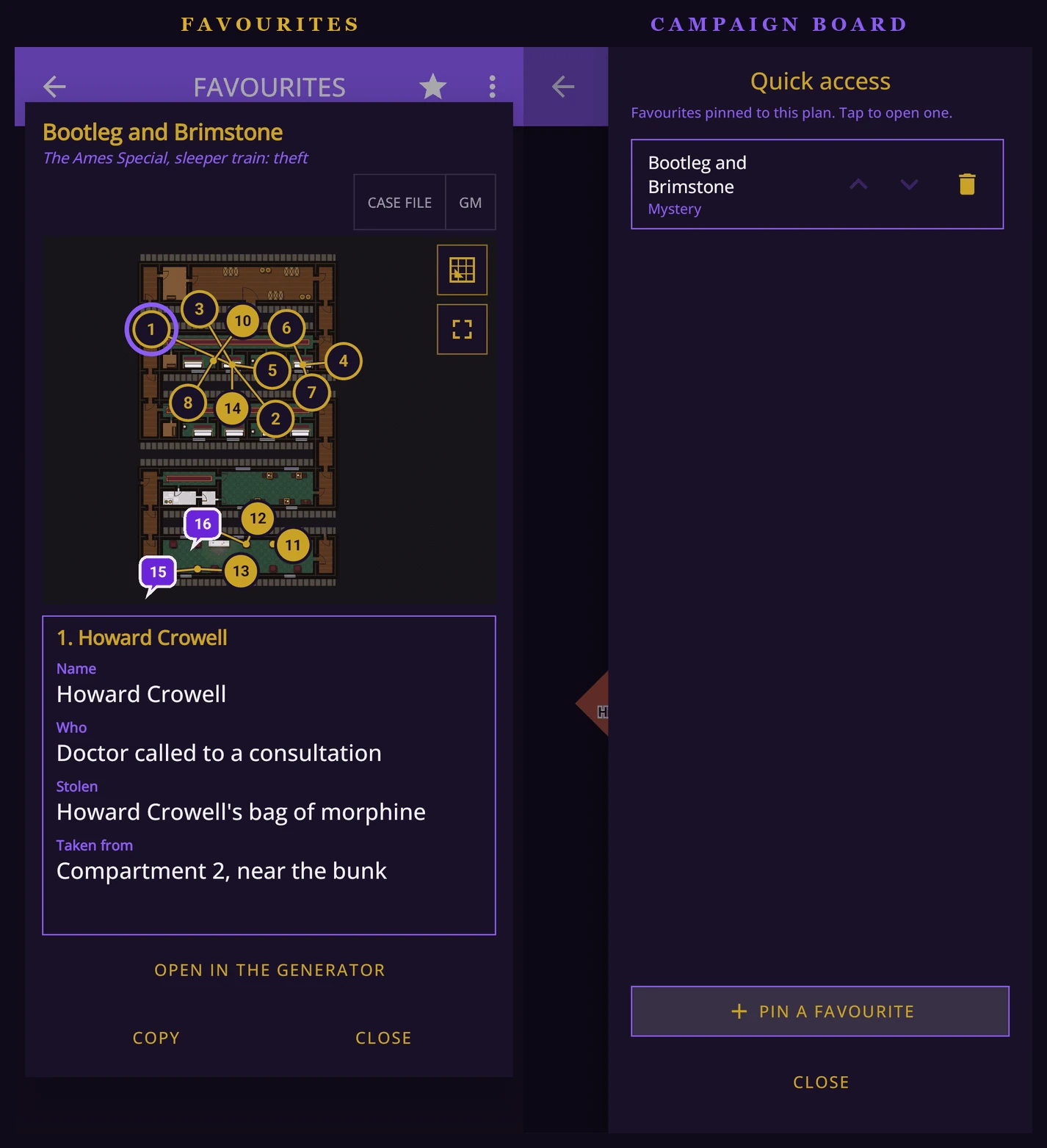
The saved case Bootleg and Brimstone open in Favourites with its floor plan and the victim's card, beside the Campaign Board's Quick access drawer with the same case pinned to the plan. A saved case in Favourites, and the same case pinned to a plan on the Campaign Board.

A Tour on the First Visit

The first time you open Mystery, Taverns & Hubs or the Campaign Board, a short tour steps through the screen with Skip, Back and Next. Each step shows the part of the screen it describes, cut from the screen as it is at that moment, with your own case, venue or board in it. The (i) at the top plays it again whenever you want it.
Mystery's tour, step by step: Make a case, Scene, The night, GM and Keep it, each step showing its part of the screen above a short explanation. Mystery's tour. Each step shows its own part of the screen.

Smaller Things

  • The Timeline Maker keeps a lane's name at its own size while the lane scrolls partly out of view. On a narrow phone its filter moves into the menu, so the timeline's name shows whole at the largest text.
  • In the viewer for a saved venue or case, Open in the generator gets a row of its own where it would otherwise wrap.
  • A Layers sheet shows its scroll bar when there is more below, so the hint under the switches is easy to find with the phone on its side.
  • With the Campaign Board's Quick access drawer open, the toolbar dims along with the board, and the drawer's picker talks about pinning to the plan.
  • Map pins in Taverns & Hubs keep clear of the buttons over a short map.
  • Delete all in Favourites has moved into the menu, which leaves the screen's title room at the largest text.
  • Emblems from the Sigils generator read "an Oval shield" and "an Eye charge" where they used to say "a".

Your Saves Are Safe

Every Mystery you saved before this update opens exactly as it did. Emblems you saved keep the wording they were saved with, and everything else you have (favourites, presets, notes, campaigns, maps and settings) opens and looks the way it did before. Wherever a tool now writes differently, the difference shows only in what you make next.

Version 4.38 is free on Google Play now. At Lockridge Grange the household is still waiting in the corridor outside bedroom 7, for somebody to ask the right question.


Download Fantasy World Generator

Thirty-six buildings, three genres, and a night that holds together however hard the players lean on it.

Who Was Where, and When: Mystery and Everything Else in 4.38

Version 4.38 is out, and this time there is a body upstairs.

At its centre is Mystery, rebuilt. It used to hand you a crime as a page of text. Now it hands you the building where it happened: every floor, everyone who was in it, and where each of them spent the night. Around it sit a few smaller changes, among them a short tour the first time you open Mystery, Taverns & Hubs or the Campaign Board, and a handful of things that read slightly wrong before and read right now. This post goes through all of it, starting with the case.

4.38 at a Glance

  • Mystery, rebuilt: a crime set in a whole building, drawn floor by floor, with the clues and the suspects pinned where they are.
  • 36 buildings, three genres: from a crossroads inn to an orbital hotel to a sleeper train, in fantasy, sci-fi and 1920s horror.
  • The case file: every person in the house, with who they are, what they are to the victim, their room, manner, look and mark.
  • The night: the evening hour by hour, ready to send to the Timeline Maker.
  • GM switch: who did it, what each clue proves and where things were hidden, for your eyes only.
  • Dice and locks: every worded line rerolls or stays, and locked lines carry into the next case.
  • Keep the building: lock the floor plan, and Generate writes a new crime into the same house under the same name.
  • Favourites and the Campaign Board: a saved case comes back with its floor plan, wherever you open it.
  • A first-run tour: Mystery, Taverns & Hubs and the Campaign Board step you through their screens, using the screen itself.
  • Smaller fixes: timeline lanes, viewer buttons, a scroll bar where one was missing, and "an Oval shield".
  • Your saves: every Mystery you saved before opens exactly as it did.

One House, One Night

Mystery lives in the Generators Hub, where it wears a NEW badge for now. Press Generate and you get a case: a title, a building, a crime and a floor plan with numbered pins. Our first roll for this post was The Late Guest, a murder at Lockridge Grange, a manor house "beside a lake where the family has drowned two of its own". It has four floors, from the attic down to the cellar, and the arrows beside the floor's name step through them.

Lockridge Grange in Mystery, shown floor by floor: the attic, the upper floor, the ground floor with its garden, and the cellar, each with its numbered pins. Lockridge Grange from the attic down: four floors, one night.

Each pin is something you can tap. Pin 1 is the victim, here the body servant Hywel Quillon, found dead in "Bedroom 7, by the bed". The other round pins are the suspects, where the investigators find them, and the clues, where they lie. The speech-bubble pins hold what somebody overheard. Clue 7 sits on the upper floor, at the door of bedroom 2: "A spit-turner saw the shadow of Zillah Lockridge cross the light under the door of bedroom 2 at ten past eleven."

Filters set as much as you like and roll the rest: the genre, one of the twelve buildings it has, a small, medium or large cast, the crime and the tone. Murder, theft and disappearance turn up in every genre, poisoning in fantasy and the 1920s, and sabotage in sci-fi. A grounded case keeps every method and every sight explainable. A strange one lets the uncanny in, a sight nobody can account for, and keeps what it really was for the GM. Mixed rolls either.

The Case File

The second tab turns the case into a page to read before the session. It opens on the case itself: the incident, the place, the occasion that brought everyone together, the atmosphere and the reason the investigators are the ones asking questions. At Lockridge Grange, "A scream from bedroom 7 at ten past midnight brings the household running", the occasion is "The family's annual gathering", and "The gravel drive crunches loudly under every wheel."

The upper floor of Lockridge Grange with the card for clue 7 open, beside the Case file tab opening on the incident, the place, the occasion and the atmosphere. The scene and the case file. Pin 8 is the spot where the spit-turner saw the shadow.

After the case come the victim and everyone else in the house. Each has who they are, what they are to the victim, their room, their manner, their look and a mark you can describe across the table. Then the clues, room by room, and with GM on, who did it, how and why.

Every case can be solved. The clues, the people and the night hold together, and the culprit's account of the evening breaks against something your players can find.

The Night, Hour by Hour

The Night tab lays the evening out as a ribbon of hours over a list. With GM off it holds what everybody knows. At Lockridge Grange, "Everyone gathers in the dining room" at 7 pm, Hywel Quillon "Goes to bedroom 7" at 10:46, and at 12:10 "Mirela Ottery has a message for Hywel Quillon and carries it to bedroom 7 in person."

With GM on it holds the rest: where each person really spent the evening, and the culprit's route to the scene and back. At eight o'clock Hywel Quillon was in "Bedroom 4, reading one letter over yet again", and Brivet Hollier was in "Bedroom 5, mending a torn hem by candlelight."

The Night tab of Lockridge Grange with GM on, its ribbon of hours above the list, beside the same night opened in the Timeline Maker with one lane for each person. The night with GM on, and the same night in the Timeline Maker.

Send to Timeline opens the night in the Timeline Maker as a timeline of its own, with a lane for each person, ready to keep, change or show.

The Switch That Keeps the Truth

As in Taverns & Hubs, the GM button decides what the screen shows. Switched off, the phone can be turned round to face the players. Switched on, the case shows its hand. Each clue says what it proves, the victim's card gives the hour of death, the night fills in, and new pins appear where the culprit hid things. In the attic at Lockridge Grange, pin 10 only exists with GM on: "The torn pillowcase, balled tight, is pushed at the back of the wardrobe." Its card names who put it there.

The attic of Lockridge Grange with the GM switch off, showing the victim's card, and with it on, showing the hidden pin 10 in the storeroom and its card. The same attic twice. With GM on, pin 10 appears in the storeroom.

The Layers button sits next to it. It chooses which pins show (clues, suspects, what was overheard) and whether the map is a warm floor plan or a blueprint with the rooms named. Copy follows the switch too: with GM on it copies the whole case as text, and with GM off only what the players should hear.

Fantasy, Sci-Fi and the 1920s

Each genre has twelve buildings of its own. Fantasy has the inn at a crossroads, the castle, the royal palace, the manor house, the abbey, the wizard's tower, the river barge, the guildhall, the hunting lodge, the temple, the bathhouse and the theatre. Sci-fi has the passenger liner, the research station, the orbital hotel, the mining outpost, the corporate retreat, the diplomatic embassy, a generation ship's deck, the medical frigate, the arcology penthouse, the prison barge, the terraforming relay and the salvage tug. The 1920s have the house on the hill, the sleeper train, the sanatorium, the lakeside hotel, the museum after hours, the country church and rectory, the university library, the ocean liner, the lighthouse and keeper's house, the mill-town mansion, the seance parlour and the hunting club in the woods.

Three cases in turn: The Late Guest at Lockridge Grange, a fantasy manor house; Static on the Line aboard The Vireo Halo, a sci-fi orbital hotel; and Bootleg and Brimstone on The Ames Special, a 1920s sleeper train. One case in each genre: a manor house, an orbital hotel and a sleeper train.

The people change with the building. Aboard The Vireo Halo, an orbital hotel, the victim was the hotel owner's spouse, found in "The security office, by the console". On The Ames Special, a sleeper train, a doctor called to a consultation lost a bag of morphine from "Compartment 2, near the bunk".

Keep What You Like

Every worded line in a case has its own die and its own lock. The die words the line again and leaves the facts behind it alone. The lock keeps it, and a locked line carries into the next case wherever it still holds there, filled in with the new names: a title you like, an atmosphere, a hook, a suspect's look or manner.

The floor plan has a lock of its own. With it on, Generate keeps the building, its rooms and the place's name, and writes a whole new crime into it. At Bramblecote Park a disappearance gave way to a theft and then to two different murders in three presses, each with a new cast in the same rooms. Where the place is named after the family that owns it, the family keeps its name: new people, same house. The button under the lock draws a new floor plan of the same kind of building when you want different rooms.

Four cases generated one after another at Bramblecote Park with the floor plan locked: The Last Toast, Wax and Wine, Smoke Without Fire and The Long Night, all on the same ground floor. Bramblecote Park with its floor plan locked: four cases, one house.

Save It, Pin It, Run It

A saved case opens in Favourites as itself: its floor plan and pins, the card beside them, and the case file and GM switch a tap away. Open in the generator brings it back to Mystery to change, and saving the changed copy leaves the original as it was. On the Campaign Board, a case can be attached to a node or pinned to the plan's Quick access drawer, and it opens in the same viewer, floor plan and all.

The saved case Bootleg and Brimstone open in Favourites with its floor plan and the victim's card, beside the Campaign Board's Quick access drawer with the same case pinned to the plan. A saved case in Favourites, and the same case pinned to a plan on the Campaign Board.

A Tour on the First Visit

The first time you open Mystery, Taverns & Hubs or the Campaign Board, a short tour steps through the screen with Skip, Back and Next. Each step shows the part of the screen it describes, cut from the screen as it is at that moment, with your own case, venue or board in it. The (i) at the top plays it again whenever you want it.

Mystery's tour, step by step: Make a case, Scene, The night, GM and Keep it, each step showing its part of the screen above a short explanation. Mystery's tour. Each step shows its own part of the screen.

Smaller Things

  • The Timeline Maker keeps a lane's name at its own size while the lane scrolls partly out of view. On a narrow phone its filter moves into the menu, so the timeline's name shows whole at the largest text.
  • In the viewer for a saved venue or case, Open in the generator gets a row of its own where it would otherwise wrap.
  • A Layers sheet shows its scroll bar when there is more below, so the hint under the switches is easy to find with the phone on its side.
  • With the Campaign Board's Quick access drawer open, the toolbar dims along with the board, and the drawer's picker talks about pinning to the plan.
  • Map pins in Taverns & Hubs keep clear of the buttons over a short map.
  • Delete all in Favourites has moved into the menu, which leaves the screen's title room at the largest text.
  • Emblems from the Sigils generator read "an Oval shield" and "an Eye charge" where they used to say "a".

Your Saves Are Safe

Every Mystery you saved before this update opens exactly as it did. Emblems you saved keep the wording they were saved with, and everything else you have (favourites, presets, notes, campaigns, maps and settings) opens and looks the way it did before. Wherever a tool now writes differently, the difference shows only in what you make next.

Version 4.38 is free on Google Play now. At Lockridge Grange the household is still waiting in the corridor outside bedroom 7, for somebody to ask the right question.


Download Fantasy World Generator

Thirty-six buildings, three genres, and a night that holds together however hard the players lean on it.

Want to be told when the next story drops?

Θέλετε να μάθετε πρώτοι για την επόμενή μας ιστορία;

Quiet updates, no spam. Only when something worth sharing is ready.

Διακριτικά νέα, χωρίς ενοχλήσεις. Μόνο όταν έχουμε κάτι αξιόλογο να πούμε.

SubscribeΕγγραφή