A knife ended King Corwin, and Queen Brynn ascended over a court suddenly full of suspects.
Queen Brynn was struck down by unknown hands, and Queen Elspeth claimed the throne asking no questions.
The court of House Mournwell became a nest of spies, and friends watched friends.
Those three lines closed out a hundred and twenty years of invented history the first time we ever ran the seed that produced them. Six monarchs sat that throne across those twelve decades. Three were murdered. Nobody at this studio wrote that. Nobody decided House Mournwell would bleed itself dry from the inside, sentence by sentence, reign by reign. It happened because a set of numbers did what we'd told them to do, decade after decade, until they'd assembled a tragedy on their own that none of us had planned. That's the entire reason the History Engine exists, and it's the reason we still open it some evenings for no better purpose than seeing what it's built this time.
The Numbers Underneath
Before the murders and the coincidences, it's worth laying out what's running beneath this tool, because the mechanism itself is the interesting part. Every generated world sits on a dashboard of seventeen numbers, each running zero to a hundred. Seven track the realm itself: military strength, wealth, stability, faith, knowledge, corruption, expansionism. Five track its dominant religion: unity, militancy, zeal, tolerance, its own wealth. Five more track the ruling house: legitimacy, prestige, fertility, intrigue, martial skill. Above that dashboard sit twenty-three possible events, drawn from war and plague and famine and golden ages on the realm side, schism and crusade and inquisition on the faith side, royal marriages and court intrigue and mad rulers on the dynasty side.
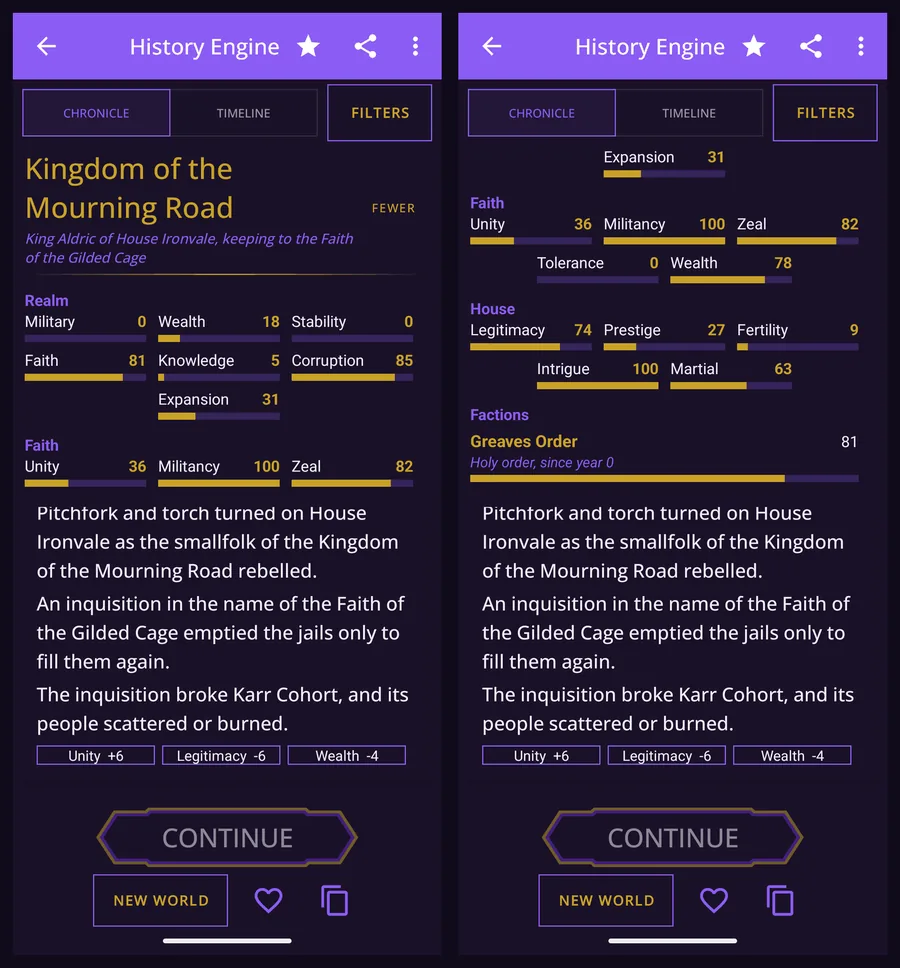 All seventeen dials at the end of a real 120-year run: seven for the realm, five for its faith, five for the ruling house. Intrigue sits at 100 and stability at 0, and legitimacy is still 74.
None of these numbers sit still, and that's the whole trick of the thing. A revolt grows likelier the moment stability starts to slip, the way a crowd grows likelier to turn the longer it's kept waiting. A crusade gathers its own momentum as militancy rises, the way a rumor picks up conviction the more people repeat it. One or two of these pressures win out in most decades, and whichever wins doesn't just happen and vanish, it leaves the dials changed for good, so a war lost this decade becomes an empty treasury the next, an empty treasury becomes a hungry season after that, and a hungry season becomes a crowd at the gates before anyone's had time to recover. Westrun's court fell into this kind of undertow precisely. One murder left the court more suspicious of itself than it had been the decade before, that suspicion made the next round of scheming easier to justify, and the scheming made whichever ruler sat the throne that much easier to remove by force rather than by time. Nobody adjusted the current to make that happen. It was simply the shape the current took once it started flowing downhill, decade after decade, never once given a reason to flow back up.
The strangest part of Westrun's chronicle, once we went looking, was that House Mournwell's legitimacy never wavered. It closed at seventy-nine out of a hundred, practically pristine, every succession procedurally spotless and universally acknowledged right up until each monarch was murdered anyway. The paperwork, as it were, was flawless.
 One chronicle, decade by decade: the founding, the first murder, a war that bled the treasury white, a famine, the revolt the decade after it, and the end of the run. Stability falls from 58 to 0; legitimacy never drops below 74.
An event that just fired has its own odds cut to a quarter of normal afterward, and to half the decade after that, so plagues don't return every single decade purely from repetition, and the engine keeps its own last eight lines in mind so it almost never hands you the same sentence twice running. On a decade when nothing wins the lottery at all, you get a single line instead, drawn from a small set of three, one of which has become a house favorite: a quiet decade passed in Westrun; the chronicles record little of note.
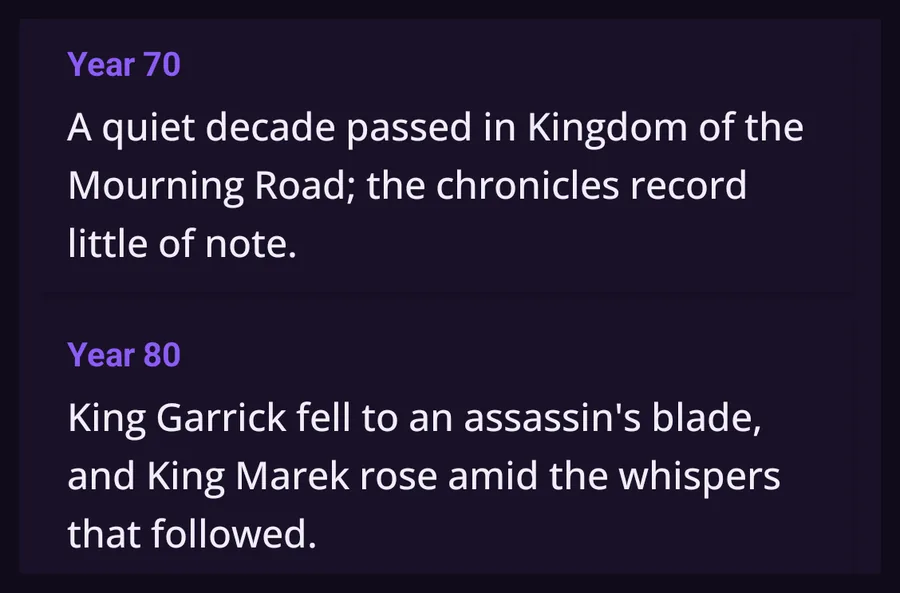 The house favorite as it appears in the app, and the decade that broke the quiet.
A Realm Built From Three Smaller Ones
The History Engine isn't one generator so much as three smaller ones handed a single shared clock. Fantasy World Generator already has standalone tools for rolling a realm, a faith, and a ruling house on their own, and the History Engine calls all three internally: a single master seed splits into three sub-seeds, each tool rolls its own part, and their combined stats populate the seventeen dials before the first decade ever starts.
Above even that sits something larger, the World Engine, which runs two to four realms at once on one shared timeline and passes events between them: wars, royal marriages, missionaries crossing a border. Roughly half of all decades in a multi-realm run produce one of these. A realm that loses a war to its neighbor limps visibly through the decades that follow, because the war itself knocked its numbers down before the clock kept moving.
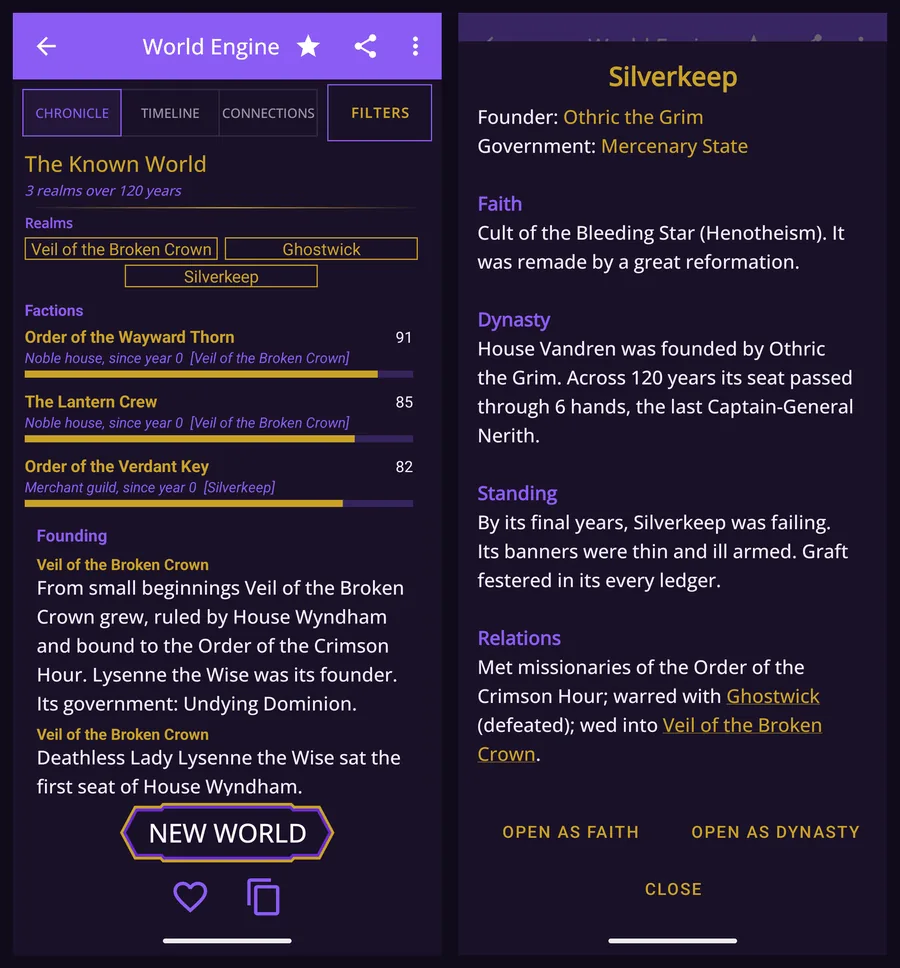 A three-realm world from one seed, and the page of the realm that lost: Silverkeep met missionaries, was defeated by Ghostwick, married into the Veil of the Broken Crown, and ends the run failing.
What Didn't Work the First Time
An early version of the faith system had a problem that only looked obvious in hindsight: schisms grow more likely as a religion's unity falls, and every schism lowers unity further. Once unity bottomed out early in a run, the faith simply kept fracturing forever, one new breakaway sect every single decade for the rest of the simulation. Twelve decades, twelve sects, absurd on its face. The fix had each existing splinter sect suppress the odds of the next one forming, the same way real faiths tend to fracture hard once and then calcify rather than shattering indefinitely.
A smaller, uglier bug lived inside the narration templates themselves. Faith names in this system already arrive as complete phrases, Faith of the Endless Road, Church of the Pale Flame, but the templates assumed otherwise, so the app happily produced lines like “the priests of the faith of Faith of the Endless Road were never busier.” The realm side had its own version, “the people of Barony of the Hollow Sun.” Both now pass through a small helper that checks whether a name already carries its own article before a sentence commits to one. Not glamorous, but it's the entire difference between prose and nonsense.
The decision we went back and forth on longest was whether succession should just be another entry in the event table. It would have been the tidier answer. We pulled it out instead and made it its own step, resolved every decade before the event table even runs, because a ruler dying isn't something that merely might happen to a realm, it's closer to the clock the realm runs on in the first place. Every decade the engine ages the current ruler, rolls against a death chance that climbs with reign length and with how poisoned the court has grown, and resolves what follows: a peaceful handover, a disputed claim, an assassination, an interregnum with no heir, or another house seizing the throne outright. The event table sits on top of that heartbeat rather than inside it, and we're still fairly confident that was the right call.
The Coincidence We Didn't Write
Not everything strange this tool produces traces back to a feedback loop we can point at afterward. In one multi-realm run, two realms rolled from independent sub-seeds happened to found their ruling houses under the same name, House Vaughn, ruling two separate realms, Redridge and Sunfield, with nothing in the code at the time connecting either roll. Fifty years into that shared timeline, the two realms went to war with each other. Sunfield won. Forty years further on, House Vaughn was thrown out of Redridge by an upstart house called Vossheim. Read back as a chronicle, it plays like the story of one family that split generations ago, turned on its own bloodline, and eventually lost half of everything it once held. The engine holds no concept of family or irony or any of that. It only rolled the same surname twice and let the ordinary math do what it always does. It is also a coincidence the engine will no longer hand you. A house shared by two realms read as one family with two founders, and it quietly blocked every royal marriage between them, so every realm in a run now founds a house of its own.
A Record, Not a Draft
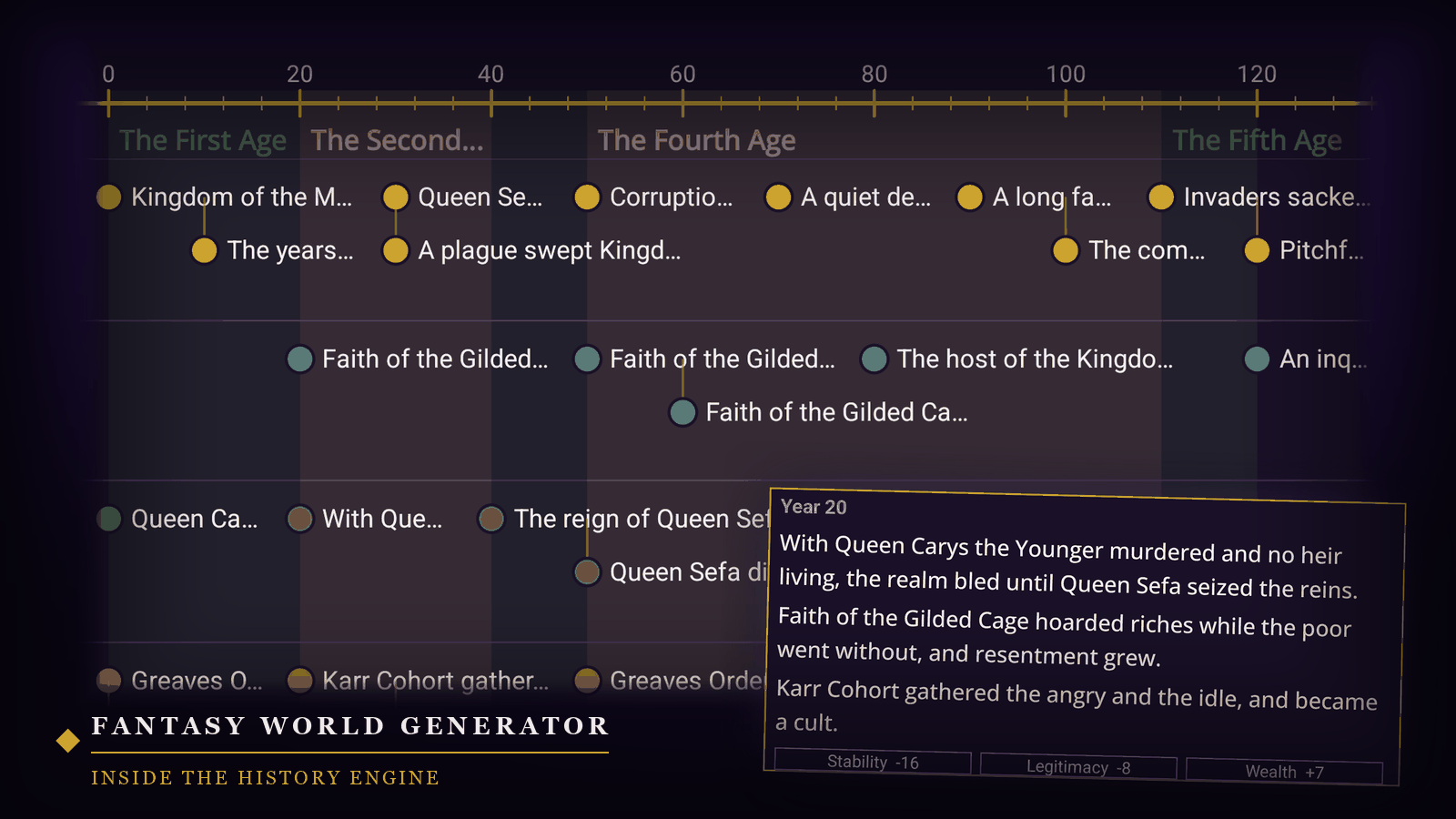
Any chronicle the History Engine produces can be flipped, with a single toggle, into a visual timeline: four parallel lanes, the realm's history in gold, the faith's in sea blue, the dynasty's in green, the factions' in red. Behind them sit shaded bands marking off the run's ages, and those bands take their boundaries not from every crowned head but from the founding and from the dynasty's own real turning points, a succession, a marriage, a scandal at court, cutting the whole span into no more than five of them. What you get, at a glance, is the shape of the eras rather than a ledger entry for every ruler who ever sat the throne.
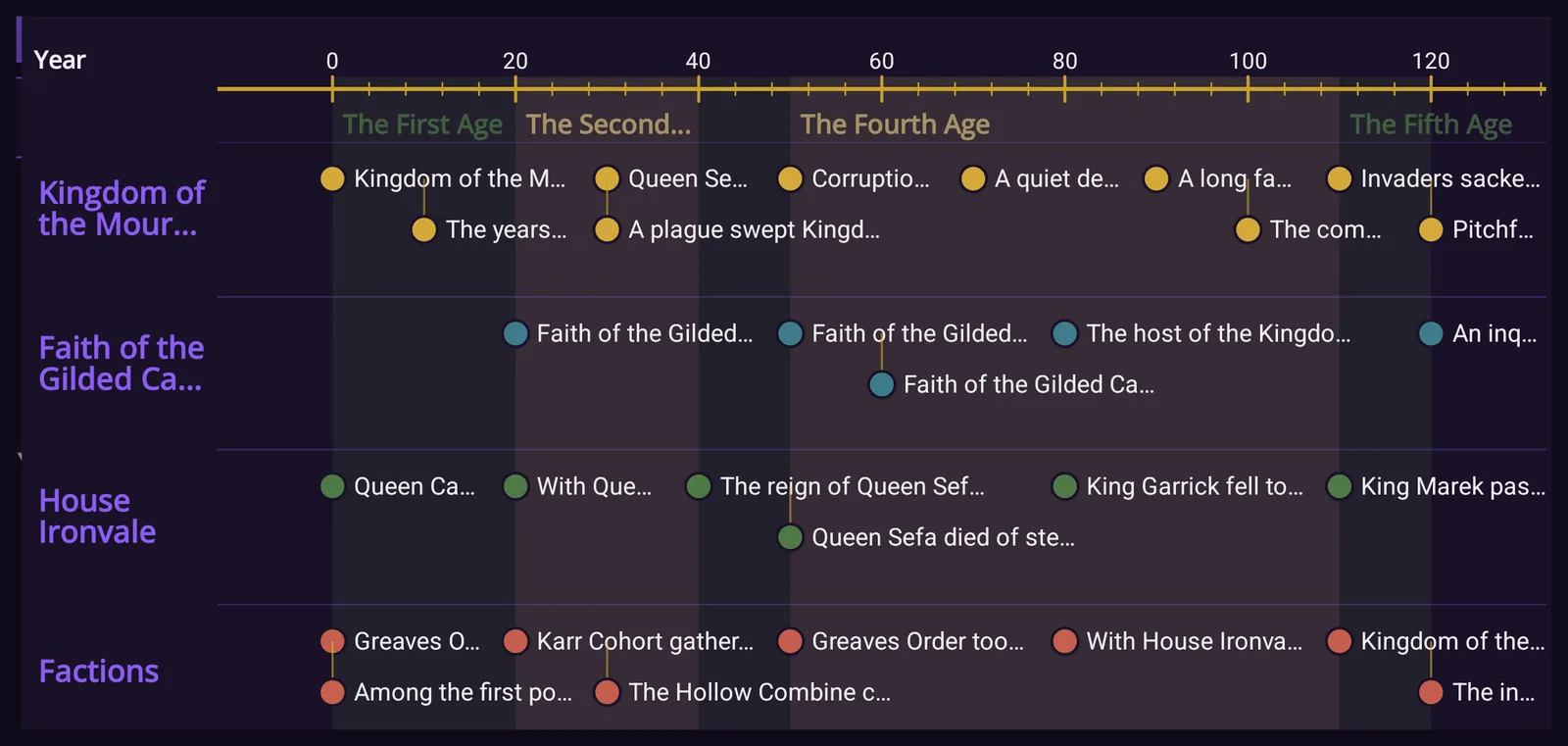 A hundred and twenty years at a glance: the realm in gold, the faith in sea blue, the house in green, the factions in red, and five ages shaded behind them.
That view is read-only, and deliberately so. You can pan it, zoom it, tap any event to read its line in full, and change nothing about it. A chronicle is meant to be a record of something that happened, in whatever order the dials decided it should happen, and a record you can quietly correct after the fact stops being a record at all.
What you can do instead is fork it. One action hands the chronicle over to the separate Timeline Maker, which builds a new, fully editable timeline out of whatever the engine rolled, while the original chronicle stays behind exactly as it landed, untouched. That struck us as the only honest arrangement to make. The Timeline Maker exists for timelines you're actively authoring. The History Engine exists for ones you're only ever discovering. The copy is where the authoring belongs. Same shape of picture, a fundamentally different relationship to the truth underneath it.
 Flip the chronicle to its timeline, open it full screen, tap an event to read its line whole, then Open in Timeline Maker: an editable copy, while the chronicle behind it stays as it landed.
Roll Your Own Chronicle
We didn't plan Westrun's murders, and we certainly didn't plan two independent sub-seeds landing on the same house name and marching it to war. Seventeen numbers, twenty-three events, and a hundred and twenty years turned out to be more than enough room for a tragedy to write itself.
The History Engine lives inside Fantasy World Generator, free, offline, and one seed away from whatever chronicle it's about to hand you.
Download Fantasy World Generator
Roll a seed, and see what your own kingdom survives.