September 9, 2026 · chara_bachtsevani

#guide #worldbuilding #tools

Eight Generators Worth Using If You Build Worlds

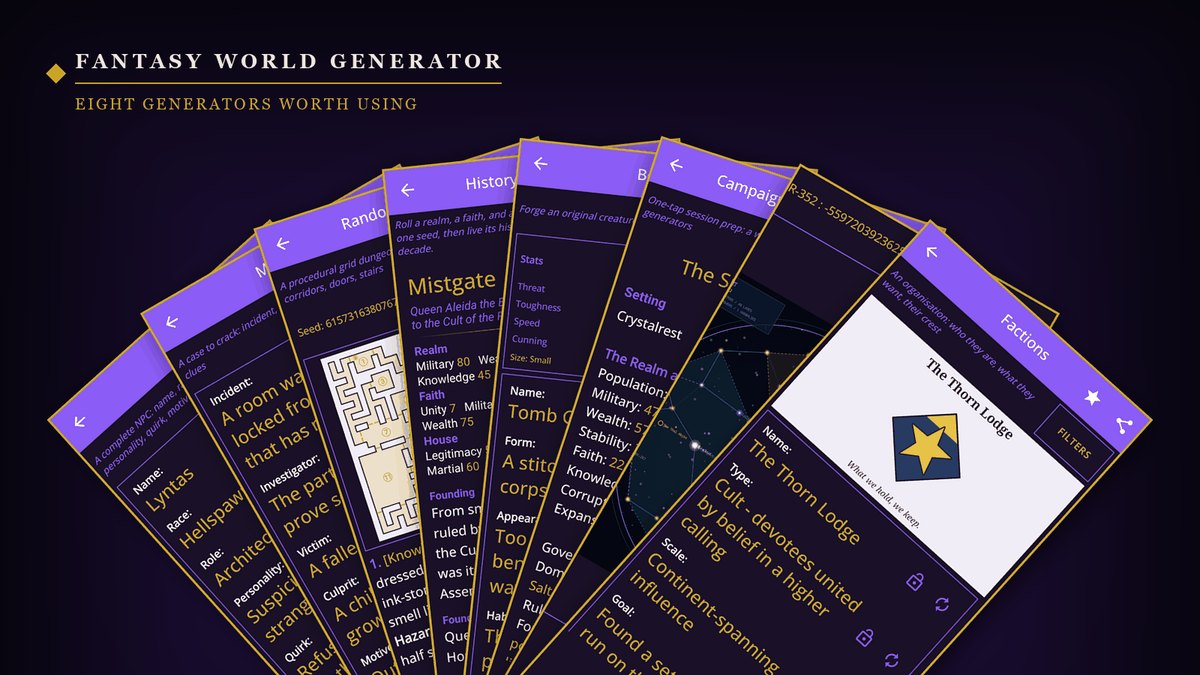
Worldbuilding rarely happens at a desk with an afternoon set aside for it. It happens in the gaps: a name needed mid-session with six players staring at you, a faction's secret sketched out on the back of a bus ticket, a dungeon assembled in the ninety seconds before your players notice you've gone quiet and started scrolling instead of narrating. Fantasy World Generator now holds close to fifty tools built for those exact gaps, and narrowing the list down to eight favorites feels almost unfair to everything left off it, the town maps and sigils and rumor tables that just barely missed the cut this time around. Here they are anyway, all free, all offline, and none of them asking so much as an email address before they hand you what you actually needed three minutes ago.

1. NPCs

A minor character deserves more than a name and a job title scribbled on an index card and forgotten by the following week. Ask this generator for one and it hands back a person rather than a placeholder: a role in the scene, a personality that suggests how they'll behave once pressed, a want they'd never say aloud even under threat, a secret that might matter three sessions from now or might never surface at all and simply sit there, buried under everything else that happens, for the rest of the campaign. It's the kind of detail that makes a stranger at a market stall feel like they had a whole life running somewhere off the page long before your players ever walked up and started talking to them, a life that will presumably keep running long after the party moves on to the next town without a second thought.
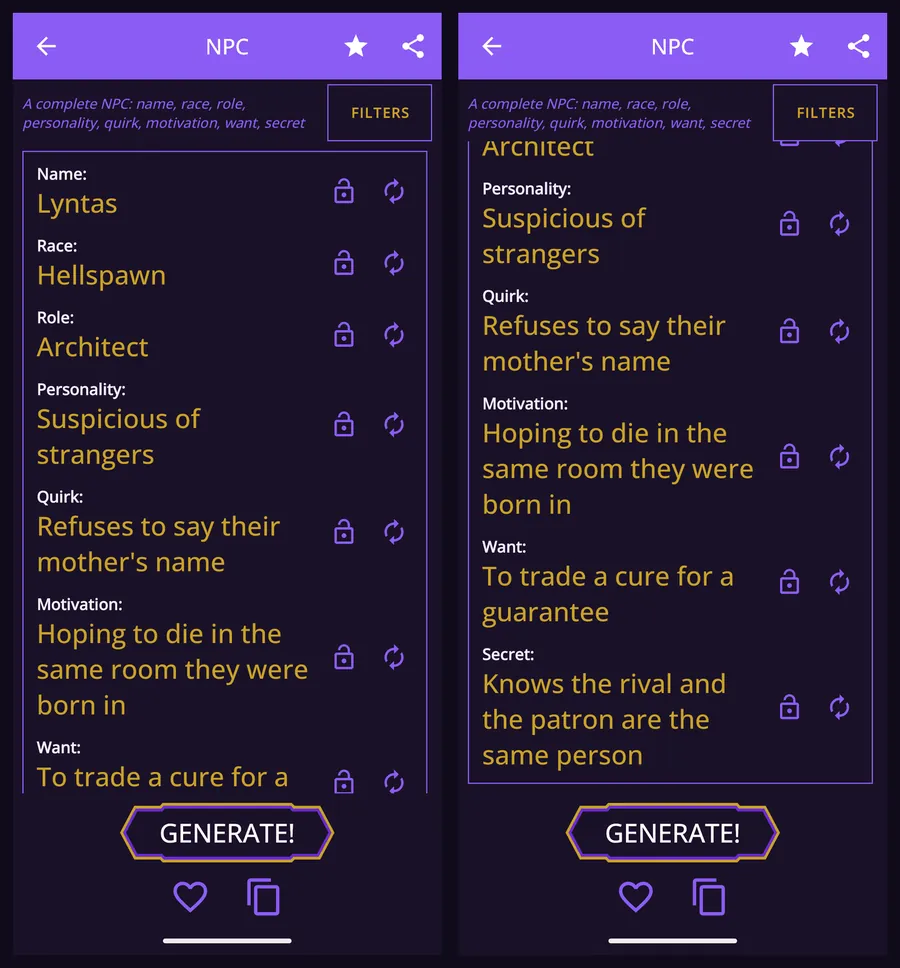
A generated NPC, Lyntas, showing name, race, role, personality, quirk and motivation, then scrolled to reveal a Want and a Secret. One roll, one person. The card runs past the bottom of the screen, so the right panel is the same NPC scrolled down to the Want and the Secret.

2. Bestiary

Most creature generators hand you a stat block and call the job finished there. This one insists on quite a bit more: an appearance worth actually describing instead of gesturing at, a habitat that explains why the thing is standing right where it's standing, a weakness that feels earned rather than arbitrarily bolted on for balance, and a scrap of lore suggesting the creature had a place in the world long before your players stumbled into the fight it's currently about to lose. The numbers are still there once the fight actually breaks out and initiative gets rolled, but the creature feels like something that was already alive, already hunting, already surviving somewhere out there, before you ever needed it to be dangerous.
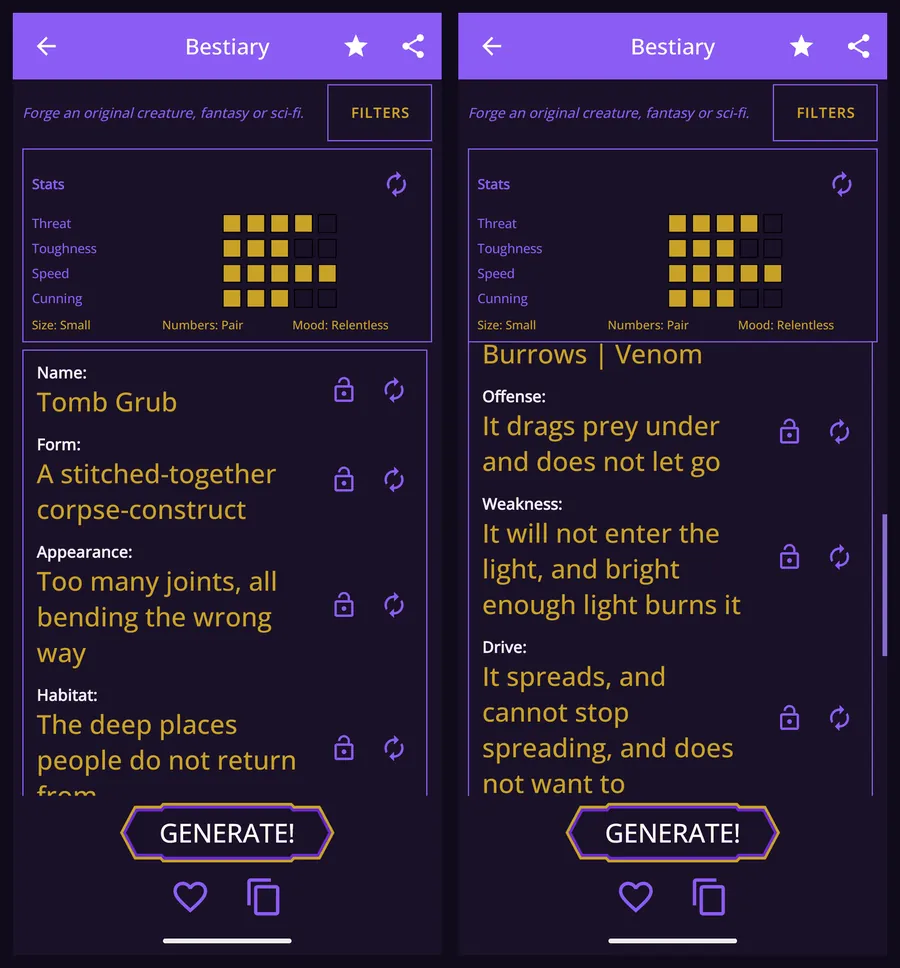
The Bestiary showing a creature called the Tomb Grub, with threat, toughness, speed and cunning bars above its form, appearance and habitat, then its offense, weakness and drive. The stat block stays pinned to the top while the creature is described around it: form, appearance, habitat, and the weakness that ends the fight.

3. Random Dungeon

This one draws a full procedural dungeon on the spot, rooms threaded together by maze corridors, doors, stairs leading up and down into darkness neither of you has mapped yet, every room numbered and keyed with a single line of dressing that tells you what's waiting inside it before your players even open the door. Filters let you tune the size, how densely the rooms cluster together, the style of the corridors, whether dead ends get trimmed away altogether or left standing to swallow the unwary, and whether the whole thing renders hand-drawn like something sketched by torchlight or in a cleaner, more schematic style. Type the same seed back in later and the identical dungeon rebuilds itself down to the last corridor, which matters far more than it sounds like it should the first time you lose a map you actually wanted to keep.
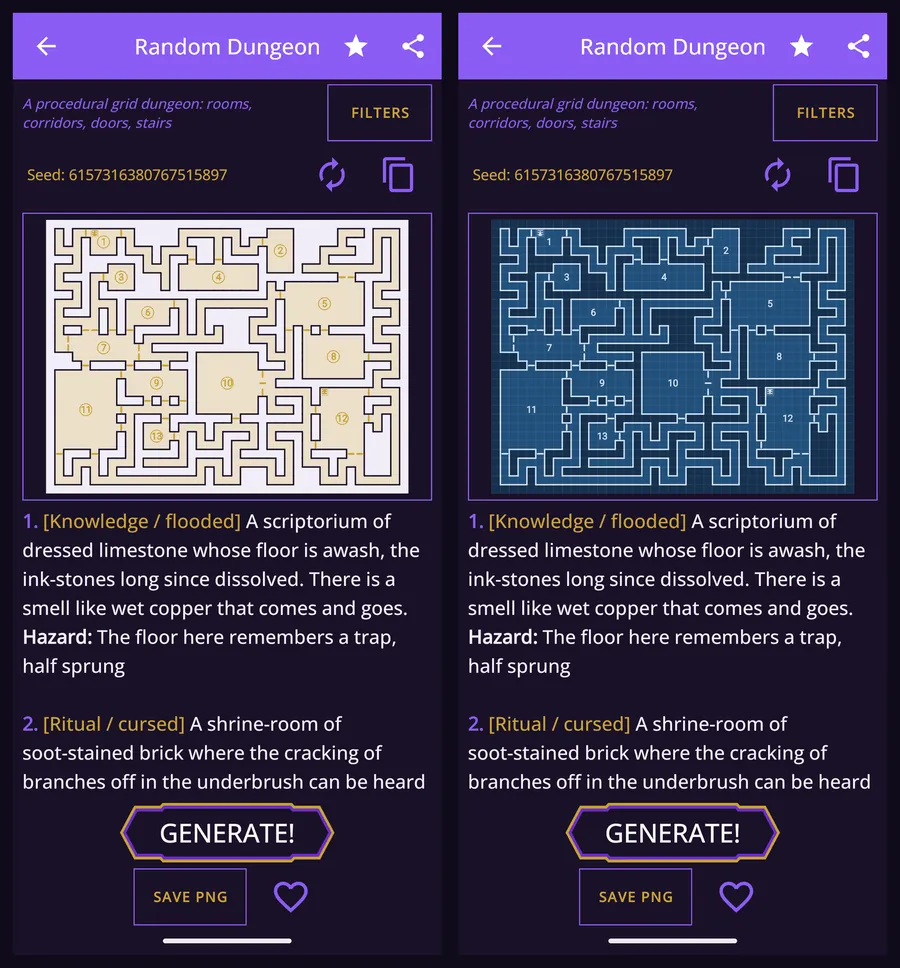
The same procedural dungeon drawn twice from one seed, once in the hand-drawn parchment style and once as a blueprint schematic, with the numbered room key below both. One seed, rendered twice. Hand-drawn on the left, schematic on the right, identical down to the last corridor, with the same numbered room key under each.

4. History Engine

This is the tool that still catches us off guard, and we're the ones who built it. Hand it a single seed and it rolls out a realm, a faith, and a ruling house from that one starting point, then lives out their shared history decade by decade: golden ages that curdle without warning, plagues that reshape an entire border, a schism that splits a faith clean down the middle and never quite heals over the centuries that follow. What you're left holding at the end of it isn't a list of facts arranged in order. It's a chronicle, the kind of thing a scholar somewhere in your world might have spent an entire lifetime compiling in some dusty archive, delivered to you instead in roughly the time it takes to read it start to finish.
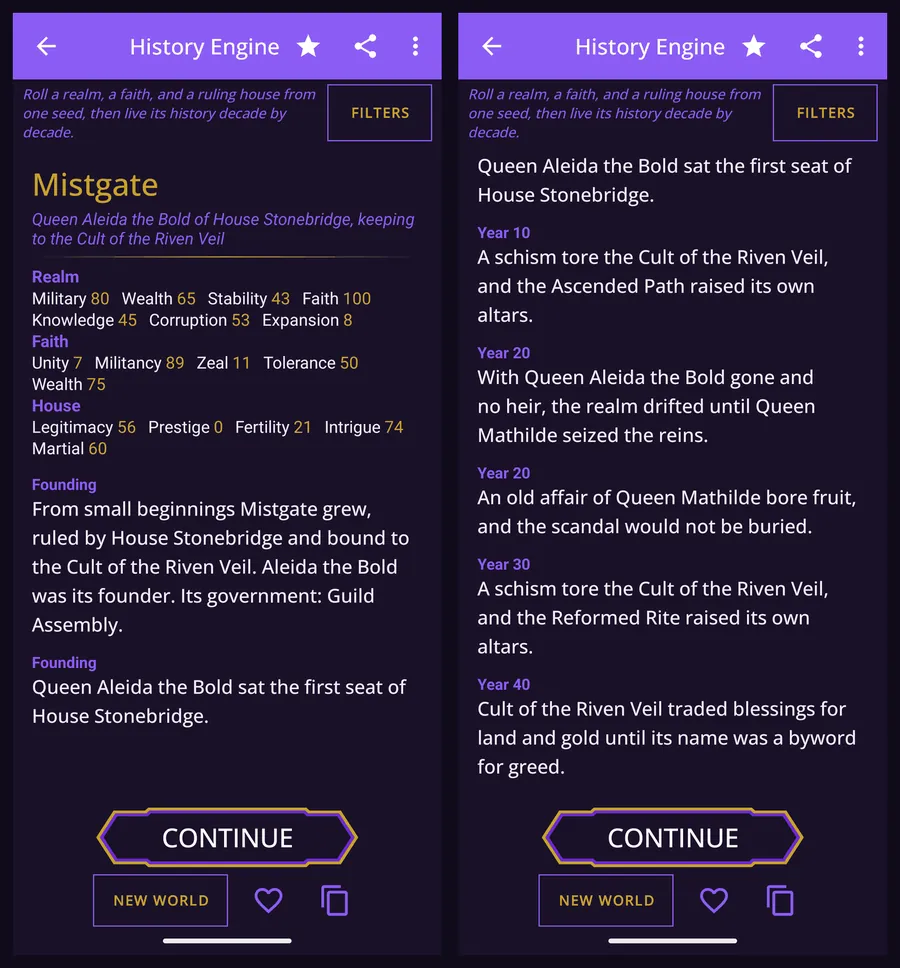
The History Engine showing the realm Mistgate with its realm, faith and house statistics and its founding entries, then the chronicle entries for years 10 through 40. Mistgate at its founding, and Mistgate forty years on. The realm, faith and house numbers move as the chronicle advances: the schism at Year 10 takes the faith's Unity from 7 to 0.

5. Mystery

Built to crack a case for nearly any setting you can imagine dropping it into, this generator rolls an incident, a victim, a culprit with an actual motive rather than a name attached to a crime, the method behind it, a real clue sitting deceptively close to a red herring designed purely to waste your time, a complication, and an optional twist for anyone who wants the floor to drop out from under the answer they thought they already had. It was never built with a single genre in mind. A vanished heirloom in a fantasy court works the same way underneath as a body in a locked starship corridor or a disappearance in an ordinary present-day town, because the case itself doesn't care what century it's set in. Set the tone to Grounded for something a real detective could plausibly believe, Strange for the kind of case that ends in something genuinely uncanny, or leave it Mixed and let the tone decide itself as the pieces come together.
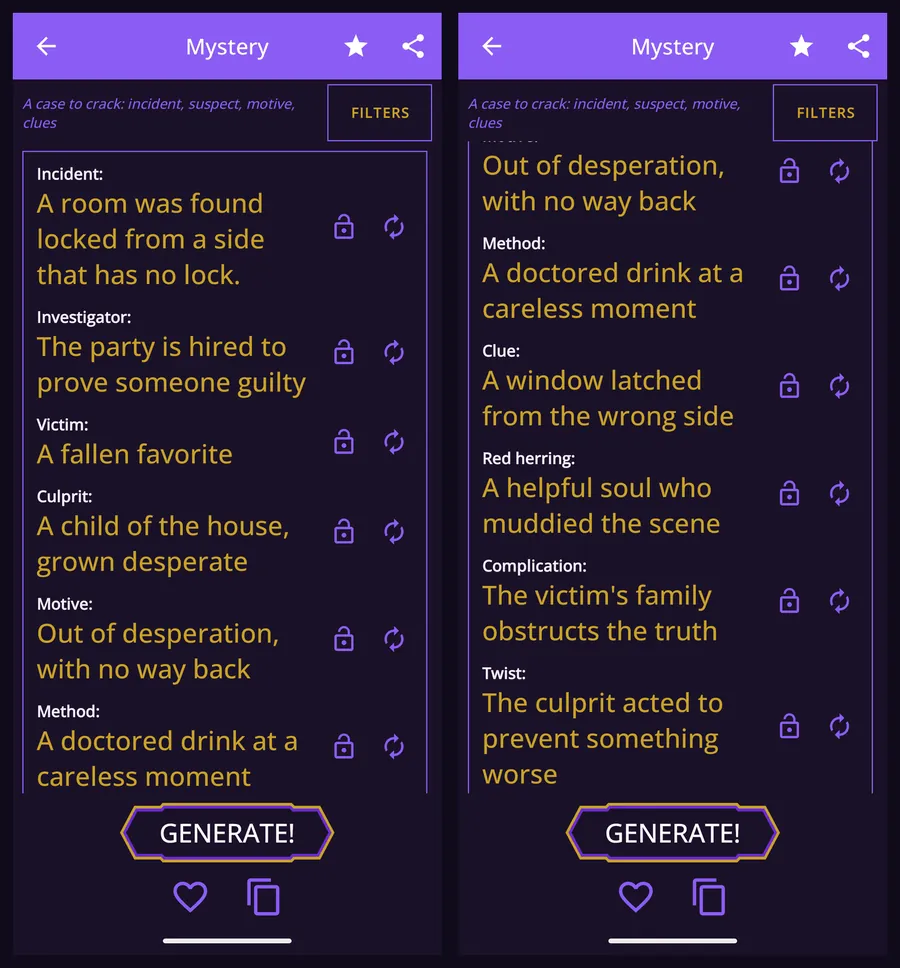
A generated mystery showing incident, investigator, victim, culprit, motive and method, then the clue, the red herring, the complication and the twist. A room found locked from a side that has no lock, and every piece needed to work it out: clue, red herring, complication, and a twist that reframes the culprit.

6. Factions

Every world eventually needs an organization with its own agenda running underneath the main plot, and this generator builds one from nothing at all: a guild, a crime syndicate, a holy order, a mercenary company, a cult, a crew, whatever shape the scene happens to call for. Each faction comes out fully formed with a name, a type, a scale, a goal, the method it's willing to use to get there, its resources, a rival it hasn't forgiven and probably never will, a secret it's hiding even from its own members, and a telltale quirk that gives the whole thing away to anyone paying close enough attention. It even generates its own crest, drawn fresh with the faction's name worked directly into the design. Set a Nature filter toward Honourable, Criminal, or Zealous, and the goals and methods it rolls lean accordingly, so a holy order built as Zealous comes out a wholly different, far more dangerous animal than one left purely to chance.
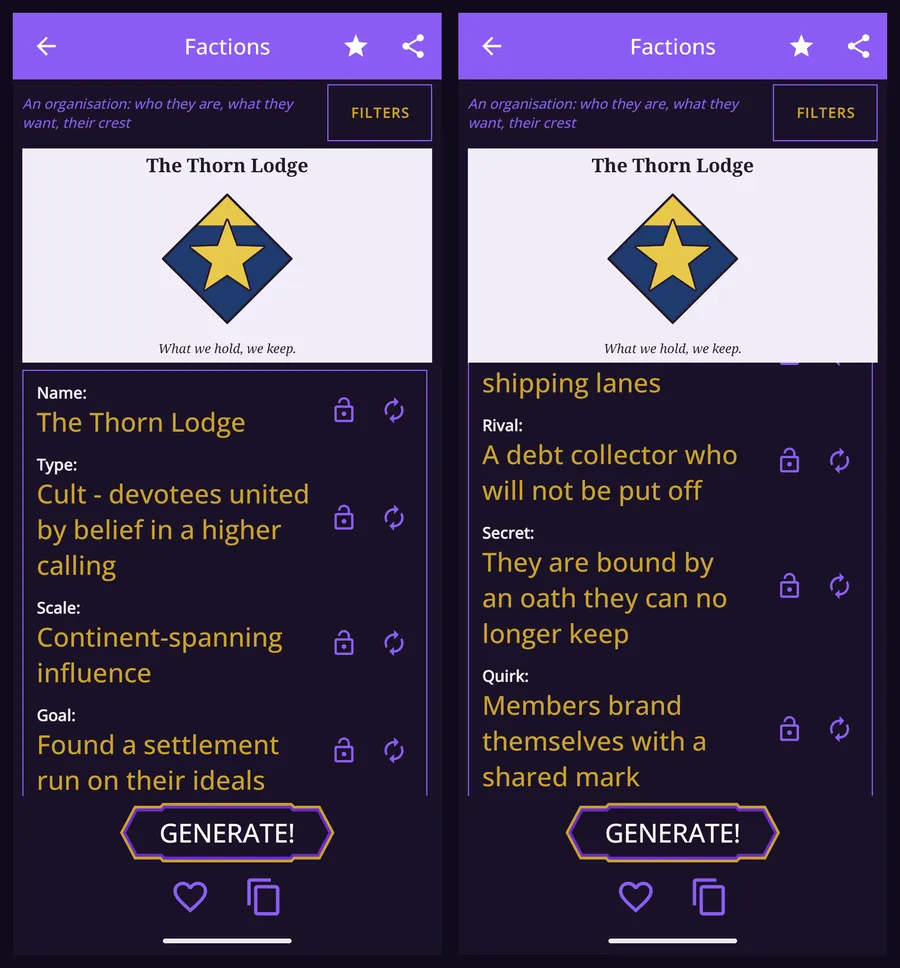
A generated faction called The Thorn Lodge with its own crest and the motto “What we hold, we keep”, showing its type, scale and goal, then its rival, its secret and its quirk. Nature set to Zealous. The crest is drawn fresh for the faction, with its name and its motto worked into it, and it stays pinned while you read the rest.

7. Star Chart

Proof that this toolkit was never only built for swords and half-remembered prophecy. This generator draws a full circular sector chart for a science-fiction setting: named star systems scattered generously across it, trade lanes rendered in four distinct visual styles, routes worth naming in their own right, nebulae drifting between the territories like something half-seen, political borders drawn in exactly where one power's claim runs out and a rival's begins to encroach, black holes marked right where you'd least want to drift off course, and rim exits leading off into whatever waits beyond the edge of the charted map. A dial frame and legend hold the whole composition together, density is yours to tune up or down as you like, and the finished chart saves as an image the moment it finally looks the way you pictured it.
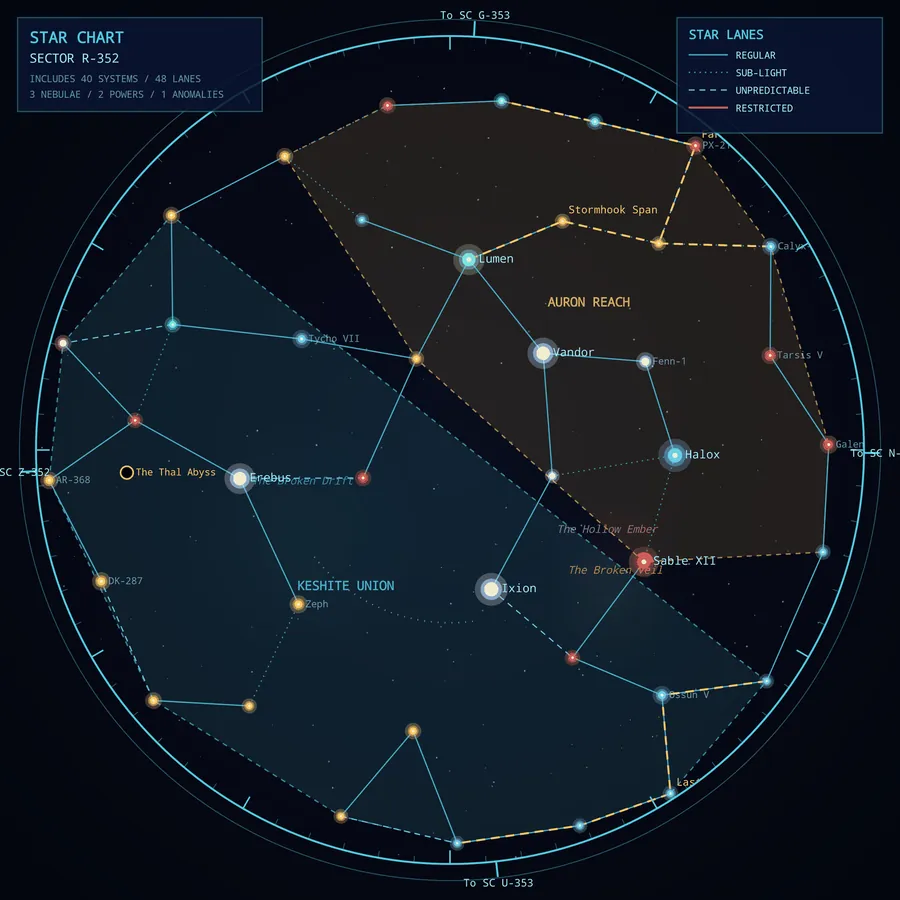
A circular science-fiction sector chart showing named star systems, trade lanes in four styles, political borders, nebulae, a black hole and exits at the rim. Sector R-352, saved straight out of the app with Save PNG rather than screenshotted. Named systems, four kinds of lane in the legend, borders where one claim ends, a black hole called The Thal Abyss, and rim exits leading off the chart.

8. Campaign Assembler

Everything above can also be summoned together, all at once, which is precisely what this generator is for. One tap rolls an entire session pack: a setting realm to build the night around, an adventure, a quest hook, a handful of NPCs, a place or two worth visiting, a rumor circulating through them, an encounter waiting to happen, and an omen hanging over the whole thing, each piece drawn from the very generators sitting elsewhere in the toolkit. Filters let you set the tone toward grim or heroic before anything rolls, and choose which sections belong in tonight's pack and which can sit this one out. If a single entry comes back wrong for the story, you don't have to start over: tap the dice beside it and reroll just that piece, leaving everything else just as it landed.

The Campaign Assembler rolling a full session pack and then rerolling a single entry, the omen, while the rest of the pack stays put. One tap and the whole pack lands: realm, adventure, quest hook, cast, rumors, encounter, omen. Then the dice beside the omen, and only the omen changes.

More Than Generators

Two tools sit outside the eight above, and not because they missed the cut. They're simply too large to fit inside a single entry on a list like this one.

The Oracle and Solo Engine is closer to an entire system than a generator: it answers the questions a game master would normally settle by instinct, rolling against odds you set yourself before every question, and keeps its own running lists of NPCs and open threads as a session unfolds, built specifically for the nights when no one else is sitting at the table with you.

The Campaign Board works differently still, and it's worth being precise about how. It isn't something a generator fills in for you. It's a web of nodes, places, NPCs, factions, plot threads, that you place and name yourself, then connect with arrows to show how they relate: this faction watches that town, this NPC guards that secret. Open any node to attach favorites you've already saved from the other generators, pin the ones you'll need mid-session to a quick-access drawer, and the whole board becomes a map of your campaign exactly as you understand it, not as anything else decided it should look.

All of it lives inside Fantasy World Generator, free, offline, and still growing well past the fifty tools it already holds.


Download Fantasy World Generator

Open whichever generator matches the gap you're standing in right now, and see what it hands you back. Whatever your worlds are actually built from, fantasy or otherwise, there's a decent chance one of these eight already knows the shape of it.

Eight Generators Worth Using If You Build Worlds

Worldbuilding rarely happens at a desk with an afternoon set aside for it. It happens in the gaps: a name needed mid-session with six players staring at you, a faction's secret sketched out on the back of a bus ticket, a dungeon assembled in the ninety seconds before your players notice you've gone quiet and started scrolling instead of narrating. Fantasy World Generator now holds close to fifty tools built for those exact gaps, and narrowing the list down to eight favorites feels almost unfair to everything left off it, the town maps and sigils and rumor tables that just barely missed the cut this time around. Here they are anyway, all free, all offline, and none of them asking so much as an email address before they hand you what you actually needed three minutes ago.

1. NPCs

A minor character deserves more than a name and a job title scribbled on an index card and forgotten by the following week. Ask this generator for one and it hands back a person rather than a placeholder: a role in the scene, a personality that suggests how they'll behave once pressed, a want they'd never say aloud even under threat, a secret that might matter three sessions from now or might never surface at all and simply sit there, buried under everything else that happens, for the rest of the campaign. It's the kind of detail that makes a stranger at a market stall feel like they had a whole life running somewhere off the page long before your players ever walked up and started talking to them, a life that will presumably keep running long after the party moves on to the next town without a second thought.

A generated NPC, Lyntas, showing name, race, role, personality, quirk and motivation, then scrolled to reveal a Want and a Secret. One roll, one person. The card runs past the bottom of the screen, so the right panel is the same NPC scrolled down to the Want and the Secret.

2. Bestiary

Most creature generators hand you a stat block and call the job finished there. This one insists on quite a bit more: an appearance worth actually describing instead of gesturing at, a habitat that explains why the thing is standing right where it's standing, a weakness that feels earned rather than arbitrarily bolted on for balance, and a scrap of lore suggesting the creature had a place in the world long before your players stumbled into the fight it's currently about to lose. The numbers are still there once the fight actually breaks out and initiative gets rolled, but the creature feels like something that was already alive, already hunting, already surviving somewhere out there, before you ever needed it to be dangerous.

The Bestiary showing a creature called the Tomb Grub, with threat, toughness, speed and cunning bars above its form, appearance and habitat, then its offense, weakness and drive. The stat block stays pinned to the top while the creature is described around it: form, appearance, habitat, and the weakness that ends the fight.

3. Random Dungeon

This one draws a full procedural dungeon on the spot, rooms threaded together by maze corridors, doors, stairs leading up and down into darkness neither of you has mapped yet, every room numbered and keyed with a single line of dressing that tells you what's waiting inside it before your players even open the door. Filters let you tune the size, how densely the rooms cluster together, the style of the corridors, whether dead ends get trimmed away altogether or left standing to swallow the unwary, and whether the whole thing renders hand-drawn like something sketched by torchlight or in a cleaner, more schematic style. Type the same seed back in later and the identical dungeon rebuilds itself down to the last corridor, which matters far more than it sounds like it should the first time you lose a map you actually wanted to keep.

The same procedural dungeon drawn twice from one seed, once in the hand-drawn parchment style and once as a blueprint schematic, with the numbered room key below both. One seed, rendered twice. Hand-drawn on the left, schematic on the right, identical down to the last corridor, with the same numbered room key under each.

4. History Engine

This is the tool that still catches us off guard, and we're the ones who built it. Hand it a single seed and it rolls out a realm, a faith, and a ruling house from that one starting point, then lives out their shared history decade by decade: golden ages that curdle without warning, plagues that reshape an entire border, a schism that splits a faith clean down the middle and never quite heals over the centuries that follow. What you're left holding at the end of it isn't a list of facts arranged in order. It's a chronicle, the kind of thing a scholar somewhere in your world might have spent an entire lifetime compiling in some dusty archive, delivered to you instead in roughly the time it takes to read it start to finish.

The History Engine showing the realm Mistgate with its realm, faith and house statistics and its founding entries, then the chronicle entries for years 10 through 40. Mistgate at its founding, and Mistgate forty years on. The realm, faith and house numbers move as the chronicle advances: the schism at Year 10 takes the faith's Unity from 7 to 0.

5. Mystery

Built to crack a case for nearly any setting you can imagine dropping it into, this generator rolls an incident, a victim, a culprit with an actual motive rather than a name attached to a crime, the method behind it, a real clue sitting deceptively close to a red herring designed purely to waste your time, a complication, and an optional twist for anyone who wants the floor to drop out from under the answer they thought they already had. It was never built with a single genre in mind. A vanished heirloom in a fantasy court works the same way underneath as a body in a locked starship corridor or a disappearance in an ordinary present-day town, because the case itself doesn't care what century it's set in. Set the tone to Grounded for something a real detective could plausibly believe, Strange for the kind of case that ends in something genuinely uncanny, or leave it Mixed and let the tone decide itself as the pieces come together.

A generated mystery showing incident, investigator, victim, culprit, motive and method, then the clue, the red herring, the complication and the twist. A room found locked from a side that has no lock, and every piece needed to work it out: clue, red herring, complication, and a twist that reframes the culprit.

6. Factions

Every world eventually needs an organization with its own agenda running underneath the main plot, and this generator builds one from nothing at all: a guild, a crime syndicate, a holy order, a mercenary company, a cult, a crew, whatever shape the scene happens to call for. Each faction comes out fully formed with a name, a type, a scale, a goal, the method it's willing to use to get there, its resources, a rival it hasn't forgiven and probably never will, a secret it's hiding even from its own members, and a telltale quirk that gives the whole thing away to anyone paying close enough attention. It even generates its own crest, drawn fresh with the faction's name worked directly into the design. Set a Nature filter toward Honourable, Criminal, or Zealous, and the goals and methods it rolls lean accordingly, so a holy order built as Zealous comes out a wholly different, far more dangerous animal than one left purely to chance.

A generated faction called The Thorn Lodge with its own crest and the motto “What we hold, we keep”, showing its type, scale and goal, then its rival, its secret and its quirk. Nature set to Zealous. The crest is drawn fresh for the faction, with its name and its motto worked into it, and it stays pinned while you read the rest.

7. Star Chart

Proof that this toolkit was never only built for swords and half-remembered prophecy. This generator draws a full circular sector chart for a science-fiction setting: named star systems scattered generously across it, trade lanes rendered in four distinct visual styles, routes worth naming in their own right, nebulae drifting between the territories like something half-seen, political borders drawn in exactly where one power's claim runs out and a rival's begins to encroach, black holes marked right where you'd least want to drift off course, and rim exits leading off into whatever waits beyond the edge of the charted map. A dial frame and legend hold the whole composition together, density is yours to tune up or down as you like, and the finished chart saves as an image the moment it finally looks the way you pictured it.

A circular science-fiction sector chart showing named star systems, trade lanes in four styles, political borders, nebulae, a black hole and exits at the rim. Sector R-352, saved straight out of the app with Save PNG rather than screenshotted. Named systems, four kinds of lane in the legend, borders where one claim ends, a black hole called The Thal Abyss, and rim exits leading off the chart.

8. Campaign Assembler

Everything above can also be summoned together, all at once, which is precisely what this generator is for. One tap rolls an entire session pack: a setting realm to build the night around, an adventure, a quest hook, a handful of NPCs, a place or two worth visiting, a rumor circulating through them, an encounter waiting to happen, and an omen hanging over the whole thing, each piece drawn from the very generators sitting elsewhere in the toolkit. Filters let you set the tone toward grim or heroic before anything rolls, and choose which sections belong in tonight's pack and which can sit this one out. If a single entry comes back wrong for the story, you don't have to start over: tap the dice beside it and reroll just that piece, leaving everything else just as it landed.

The Campaign Assembler rolling a full session pack and then rerolling a single entry, the omen, while the rest of the pack stays put. One tap and the whole pack lands: realm, adventure, quest hook, cast, rumors, encounter, omen. Then the dice beside the omen, and only the omen changes.

More Than Generators

Two tools sit outside the eight above, and not because they missed the cut. They're simply too large to fit inside a single entry on a list like this one.

The Oracle and Solo Engine is closer to an entire system than a generator: it answers the questions a game master would normally settle by instinct, rolling against odds you set yourself before every question, and keeps its own running lists of NPCs and open threads as a session unfolds, built specifically for the nights when no one else is sitting at the table with you.

The Campaign Board works differently still, and it's worth being precise about how. It isn't something a generator fills in for you. It's a web of nodes, places, NPCs, factions, plot threads, that you place and name yourself, then connect with arrows to show how they relate: this faction watches that town, this NPC guards that secret. Open any node to attach favorites you've already saved from the other generators, pin the ones you'll need mid-session to a quick-access drawer, and the whole board becomes a map of your campaign exactly as you understand it, not as anything else decided it should look.

All of it lives inside Fantasy World Generator, free, offline, and still growing well past the fifty tools it already holds.


Download Fantasy World Generator

Open whichever generator matches the gap you're standing in right now, and see what it hands you back. Whatever your worlds are actually built from, fantasy or otherwise, there's a decent chance one of these eight already knows the shape of it.

Want to be told when the next story drops?

Θέλετε να μάθετε πρώτοι για την επόμενή μας ιστορία;

Quiet updates, no spam. Only when something worth sharing is ready.

Διακριτικά νέα, χωρίς ενοχλήσεις. Μόνο όταν έχουμε κάτι αξιόλογο να πούμε.

SubscribeΕγγραφή