November 2, 2026 · CHARIS BACHTSEVANI

#lore #interactive-fiction

Balance Through Terror: How the Great Houses Hold the Kingdom

Cursed lands do not exist to those who condemn them.

Where the King’s Road fans out across the eastern kingdom, the signposts point every way a traveller might want to go: northeast to the Angel’s Leap, west to the Narrow Pass and the inns beyond it. One place has no post. The boglands have never had one. The kingdom sends its exiles into the swamp and then stops writing the swamp down. It never has to hunt them or even guard them, because their land has dropped off the map.
The game’s map of the kingdom with the Shattered City, Morra, the Rainfields, the Narrow Pass, Angel’s Leap and the Swamplands marked. The Swamplands fade into blank parchment, leaving only the words Cursed lands do not exist to those who condemn them. The kingdom’s own map, and what it does to the east.

That is the quietest of the ways the great houses keep their kingdom, and it is far from the only one.

This is the world of The Red Tomorrow, our dark fantasy interactive novel: over a hundred thousand words, a hundred and eighty-one illustrated chapters, and fifteen endings shaped by the choices you make along the way. You play Jonas, a former sellsword who has made his home among the kingdom’s exiles, and who rides west when men in the king’s service carry off his son. Every road he takes leads closer to the people who built the cage he lives in.

The Rising That Failed

The kingdom has never forgotten the war. The Father did not take the great houses by force. He took them by whispers: slithering words spoken over an altar built from stone quarried in a foreign land, and promises, demonic and magical alike, that poisoned the Archons one house at a time. When the whispering was done, the houses rose against their own king.

He fought to keep his realm as it had always been, true to traditions carved by millennia of stories, written and told alike. The common people took up arms for him and stood against the houses and their mages, carrying dozens of relics touched by the old gods into battle. It was not enough. The war was short, ended by mages whose power nobody who saw it has ever forgotten. Even the tower that gave the Shattered City its name fell in that war, split by the first of the Prophets.
Inside a gold frame, over the darkened towers of the Shattered City, two columns headed As it happened and As it was written. The king who kept his oath, the houses that broke theirs and the families who fought for him are struck through in red one by one and rewritten as the Heretic King, the Faithful and the Exiles. As it happened, and as it was written.

Then the winners wrote the history. The houses that broke their oaths became the faithful, and the king who kept his became the Heretic King. That is the only name he has now. The families who had fought for him were sent east to the boglands, and their descendants are there still. Most of the people living in the bogs today did nothing to be sent there. Their exile is inherited, a sentence passed for the crimes of fathers and grandfathers and handed down like a family name. The children carry it too, and so will theirs. Jonas curses the royal line for it on the cobbles of Morra, “the family that decreed swampfolk must never settle beyond their poisoned soil.”
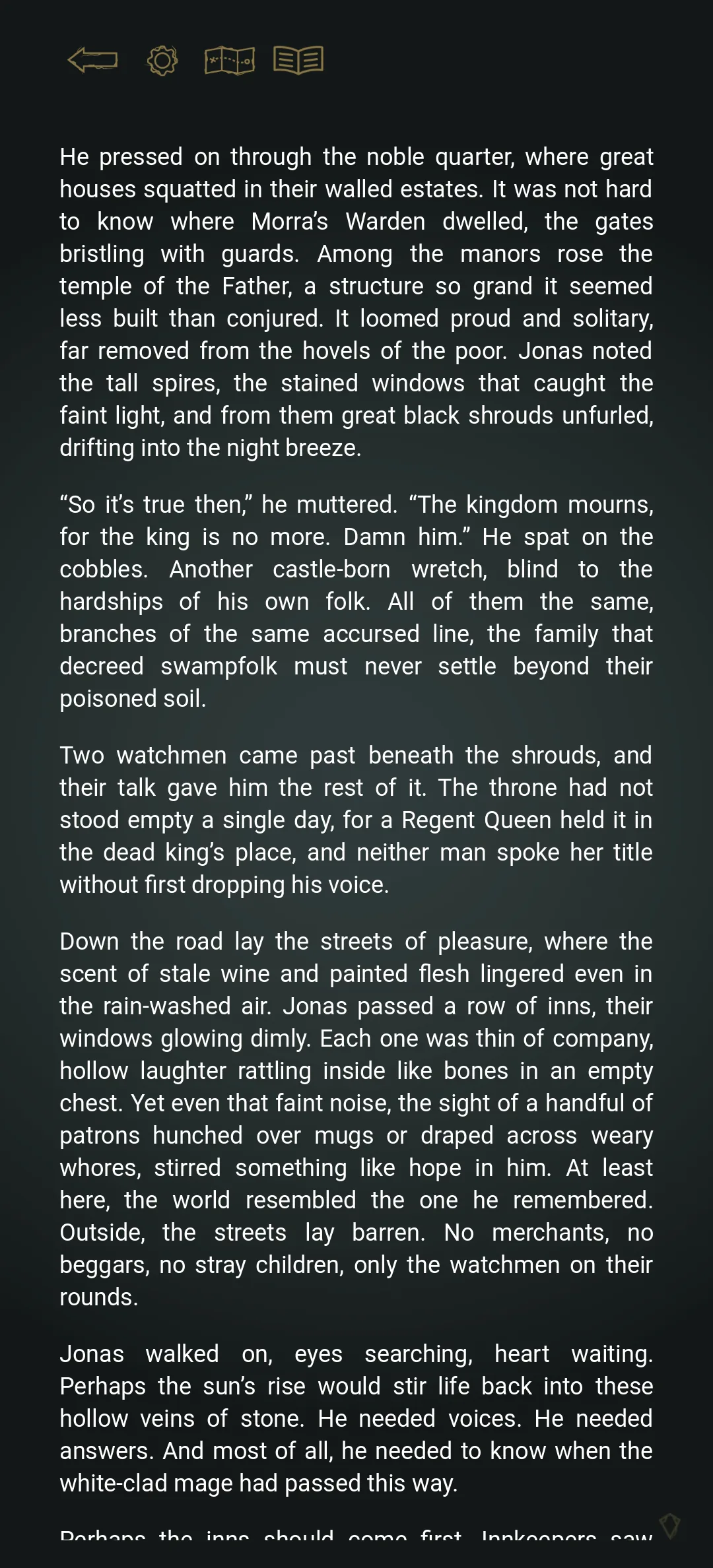
A chapter of the game in Morra: the noble quarter, the temple of the Father hung with black shrouds, and Jonas spitting on the cobbles for the dead king and his line. Morra’s noble quarter, the temple among the manors, and the line in its place.

It works because it costs the crown nothing. An exile born into exile needs no trial, no warden, and no wall. He only has to be born where he was born. Once a year, when the wells come open, the men of the boglands go out and fight what climbs from them. They have done it for generations, and not one stone in the rest of the kingdom marks that they exist.

Six Towers Over One City

The Shattered City takes its name from a ruin. A tower once stood there, tall enough, it is said, that those who climbed it would walk into the halls of the Father. During the houses’ rebellion against the Heretic King, the first of the Prophets broke it with his wrath, and its two halves fell sideways across the land. The city gate now stands in the breach where the peak was split.

Beyond the fallen tower, six thin spires still rise inside the walls. They are mage towers, one for each of the six Archon houses, and each is home to a single tower mage, the highest rank a mage can reach, who has sold that craft to the nobility. Jonas counts them from the road and sees them for what they are. Each tower is a weapon. Each is a promise to the rival houses that if they strike, ruin will answer in kind.

Balance through terror, he thinks. A peace that holds only as long as nobody wants everything reduced to ash.
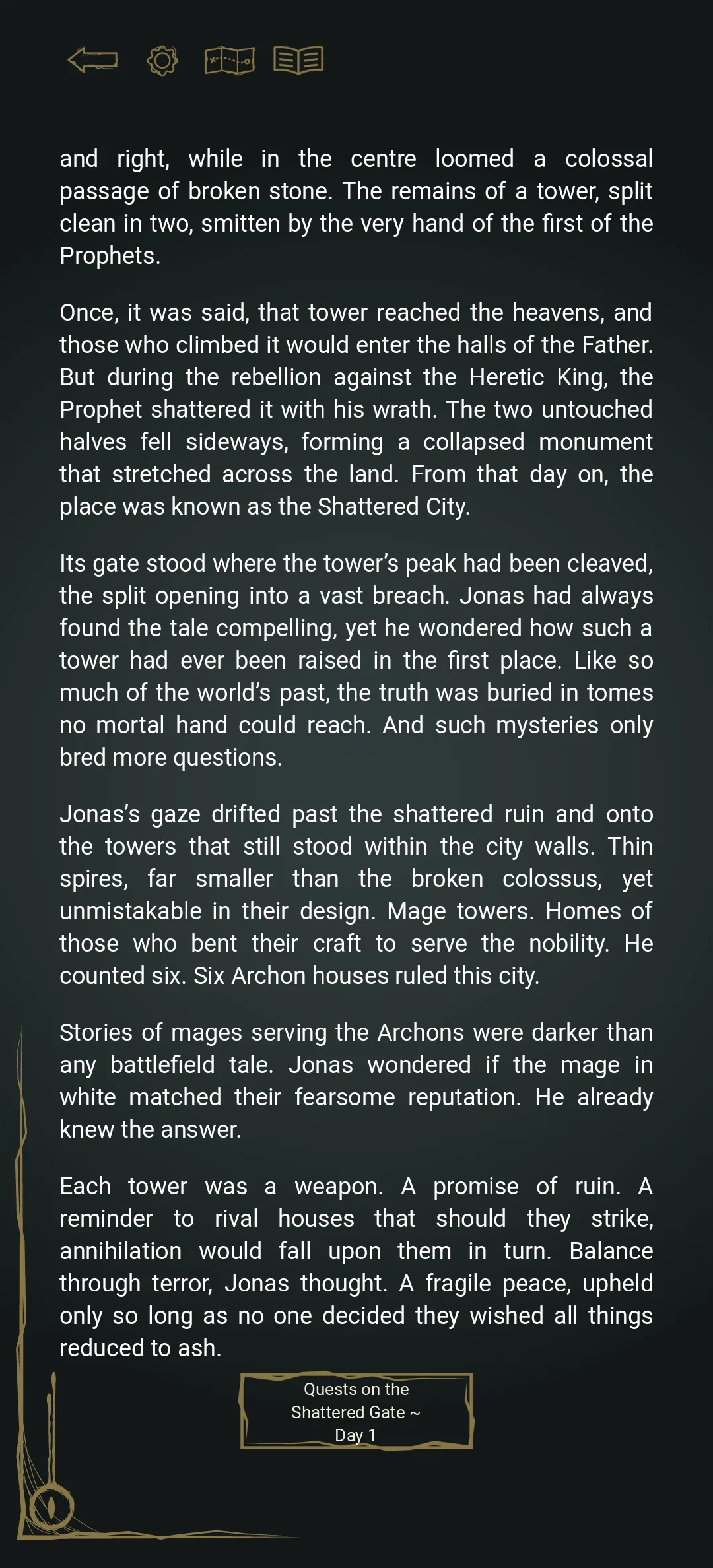
A chapter of the game describing the shattered tower, the six mage towers inside the walls, and Jonas’s thought that the peace between the houses is balance through terror. In the game: “Each tower was a weapon. A promise of ruin.”

The houses keep that peace with each other the same way they keep it over everyone else. Nobody is forbidden to rise against them. Anyone who tries is simply sure to burn.

And the Shattered City is only where the six houses keep their towers. Their rule covers the whole realm. Every noble born into one of them carries the title of Archon, and their armies march back and forth along the King’s Roads.

Demons to Fight, Mages to Terrify

Mages have always been the houses’ sharpest tool: mage knights, battle mages, and above them all the tower mages, one to each Archon tower and the highest of their kind. Ordinary people have never had any defence against them, and they know it.

For the first decades after the Father came, there were no demons to be seen anywhere. Now they are multiplying in towns and villages across the kingdom, branded with the marks of the houses that bind them. The houses now command both: demons as their soldiers, unmatched in a fight, and mages as their weapons of terror and mass destruction.
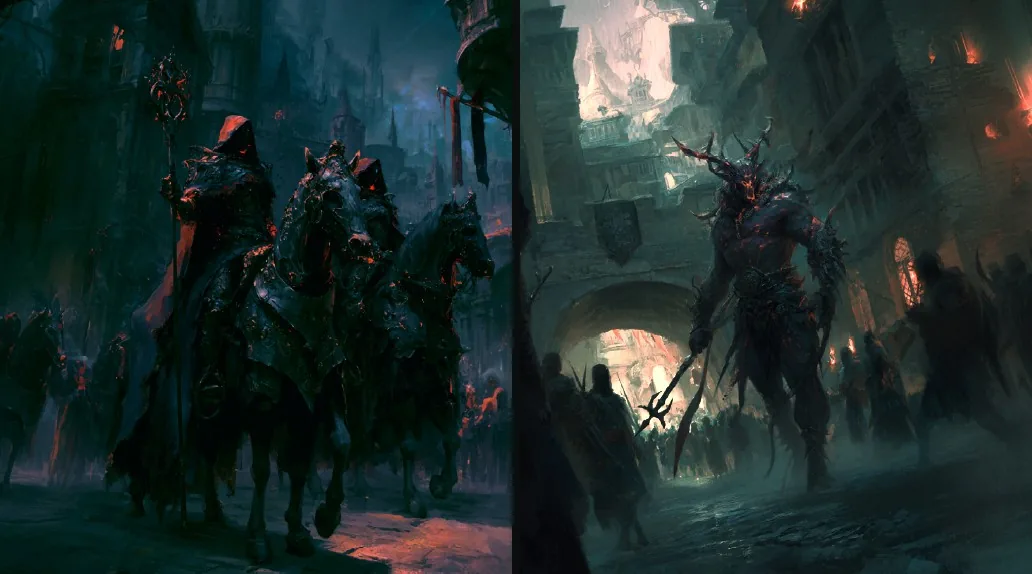
Two illustrations side by side: hooded, armoured knights on black horses in a dark city street, and a horned demon carrying a trident through a crowded street under an arch. The houses’ two tools: mage knights riding through the city, and a demon walking its streets.

Imagine a single creature with a demon’s strength and a tower mage’s power. One exists. The Prophet who stands beside the throne is both.

Six Houses, Six Hungers

Outside the Shattered Gate the houses pitch six great tents, each flying its own sigil, and each tent tells you exactly what kind of power stands behind it.
The opening screens of the six tent chapters in turn, each with its illustration: the Haedaen clerk, the Garron knight, the hooded Cosmian mage, the Lespian mason, the Donomie Archon and the Eremoppu merchant. Six tents, six envoys: the first screen of each, as the game shows it.

The Haedaens fly two mirrored, face-like outlines, the eyes marked as dots. Their tent is the one nobody enters. Inside sits a clerk who wears a mask like the priests of the Father’s church, turned to the back of his head, so that he shows a face whichever way he turns. It is the house of the Regent Queen herself, and of the Prophet now. The dead king was a Haedaen as well, and the Queen his close kin, so the crown never left the family. Sellswords who would happily fight a giant on the King’s Road won’t take a coin from them.

The Garrons are soldiers. No king has ever come from their line. Their tent is hung with scenes of war: a battle woven into a rug, a burning city painted on the far wall, halberds and shields set out like trophies.

The Cosmians have given the kingdom many kings, King Cosmos the Second within living memory. They deal in sorcery and hold the greatest libraries in the world. Their envoy is a hooded woman pacing beside a glass orb, and she offers one gold for a pouch of mushrooms and five for ten hearts taken from freshly dead men. She tells Jonas to take them from “the peasant graveyard that poisons the beauty of this city.”

The Lespians and the Donomie never ruled. Both are houses of masons, though the Donomie are the lesser in strength. The Eremoppu ruled in ancient days and now deal chiefly in trade. By coin, they might be the strongest house of all. Their envoy wears his wealth in gold teeth. His monocle shows him what any object is worth in the hearts of the men who look at it.

Six houses, and not one of them is trying to win the people’s love. Each holds a different lever: fear, war, learning, stone, and gold.

A Gate That Opens Only for Service

In the year Jonas arrives, the city’s army has marched off to prepare for the Prophet’s war against the dragons. In peacetime it is soldiers who carry out the Archons’ errands. With the soldiers gone, the nobles still expect their errands done.

So the houses have turned the city gate into a hiring hall. Without the city’s emblem, nobody passes, and the only way to earn one is to complete a task for one of the Archon houses. The smugglers who used to slip people inside have given up. Women are not let through at all, emblem or no emblem.
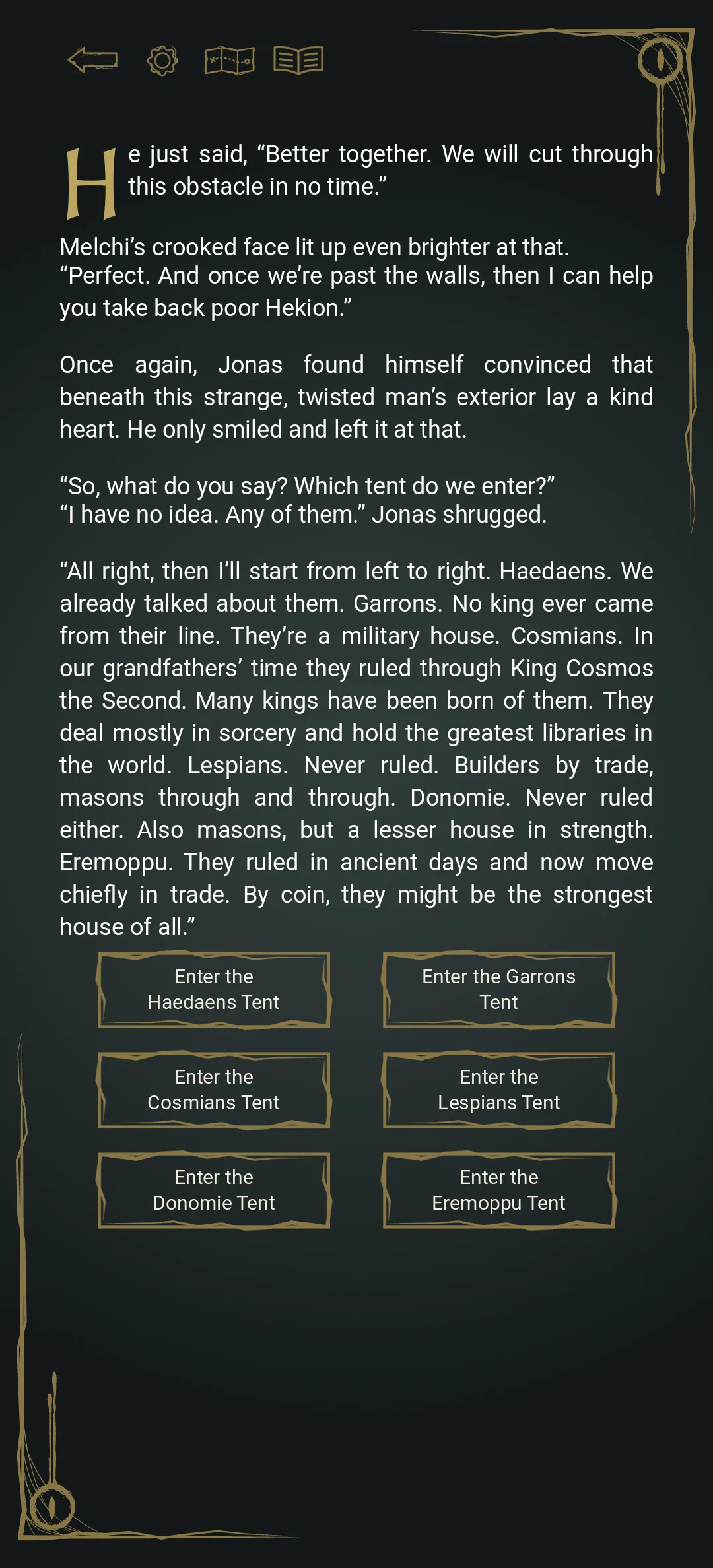
A chapter of the game in which Melchi describes the six houses one by one, above six buttons, one to enter each house’s tent. Melchi’s rundown of the six houses, and the only way through the gate: pick a tent.

The tasks themselves show how the houses fight. The Lespians want a forest stone the Donomie have claimed with forged papers that the Regent Queen has somehow recognised as genuine. The Lespian envoy’s solution is to have a stranger burn the Donomie manor to its foundations, and she doesn’t care who is still inside. Across the way, the Donomie want a Lespian carriage robbed before it reaches the Cliff Cities of the West, whether by stealth or by butchery.

The great houses rarely bleed for their quarrels. They pay others to bleed in their place, and they pay best for what is most shameful.

Justice by Decree

“The Archons are mad of late,” the crooked sellsword Melchi warns Jonas on the road. “Their mages execute folk for the smallest things.” Jonas asks why they would kill their own people over a quarrel with the Queen, and Melchi answers with a shrug: for the same reason a man swats a fly on his neck, because the sound it makes is irritating. “That is how the Archons see us.”

The clearest example waits in the Haedaen tent. The house wants a woman named Llorra dead and her head brought back, and it pays ten gold and a city emblem for the job. The clerk says she stole something and that what she took doesn’t matter. When Jonas and Melchi find her in the woods, she tells them the truth. She was a servant in the Haedaen palace, wronged by the sons of Lord Hador and cast out, and when word reached Hador he ordered her killed for it. No court heard her case. Melchi can hardly look at her. What troubles him is not the killing but who ordered it: she was condemned “not by a people’s court but by the decree of nobles.”
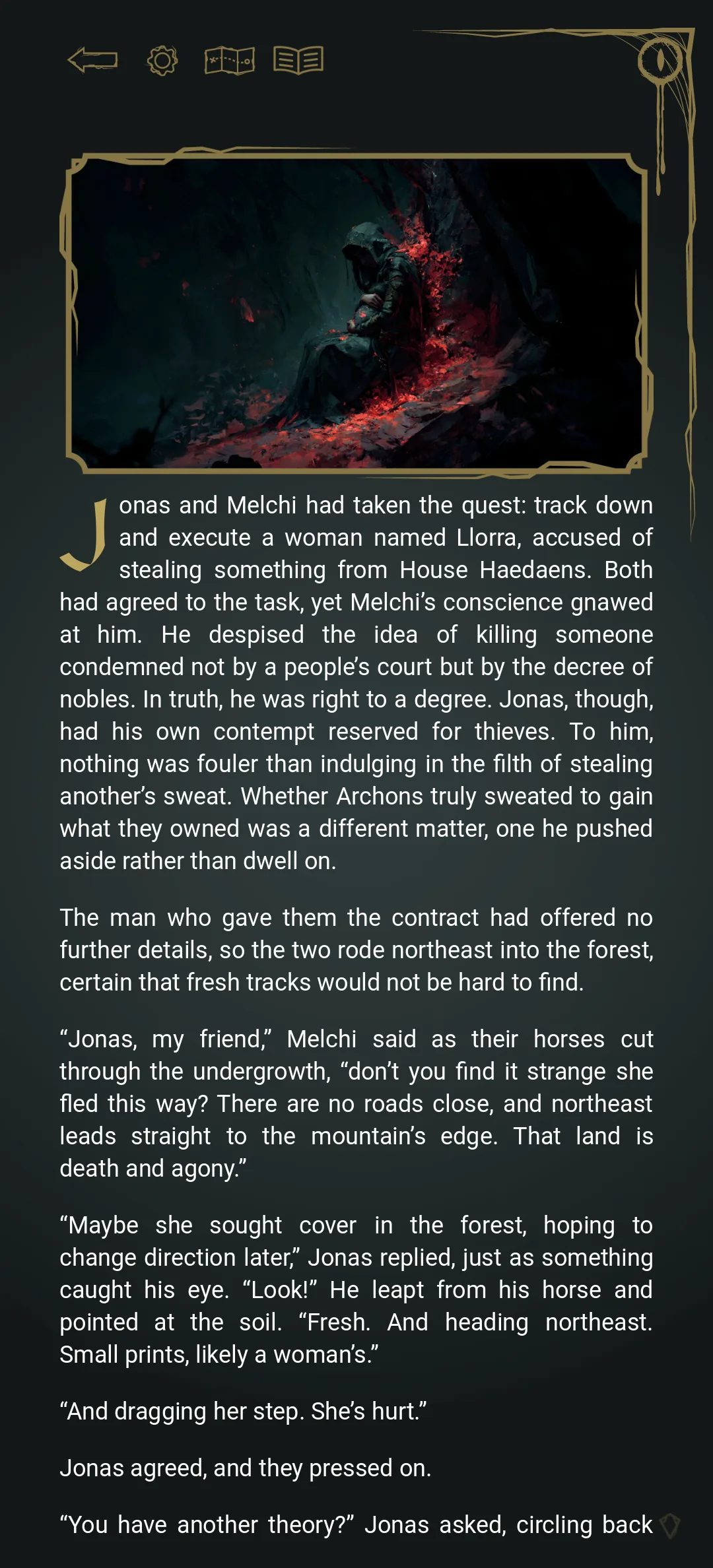
A chapter of the game opening on a hooded woman sitting alone in a dark forest, above text about Jonas and Melchi tracking a woman named Llorra for House Haedaens. Llorra, and the quest to hunt her.

In this kingdom that is the only court there is.

Coin, Sigil and Brand

Power here is something you can see, and something you pay for. The houses tax brutally, and what ordinary people scrape together goes up to the towers and the walled estates. Gold coins carry the king’s sigil, heavy, as one chapter puts it, “with the authority of a throne now cold and empty.” A raider on the King’s Road lets a wagon pass untouched once he sees the Regent Queen’s crest on it. The great houses burn their marks into the flesh of their bound demons, and the crown has been known to brand an exile’s forehead with its mark of shame.

Every one of these marks says the same thing: this belongs to someone. The coin, the wagon, the demon, the exile. Even the swampfolk bear the crown’s mark. Only the land it threw them onto bears none, not even a signpost, as if the kingdom would rather forget it exists.

A God Who Lives in the Spires

The faith supports the arrangement. In Morra, the Father’s temple stands among the walled estates of the great houses in the noble quarter, far from the hovels of the poor. It is so grand it seems conjured rather than built. The Church and the great houses both answer witchcraft with the pyre, and the old gods’ emblems, still cut into the oldest graves, are called blasphemy against the Father.

Melchi puts it more plainly than any priest would. “What sane man, far from the courts of kings, their libraries, and their mage-towers, puts his faith in the Father? The Father dwells in the spires with the Archons. We who live in the muck… we fight and bleed beside the old gods.”
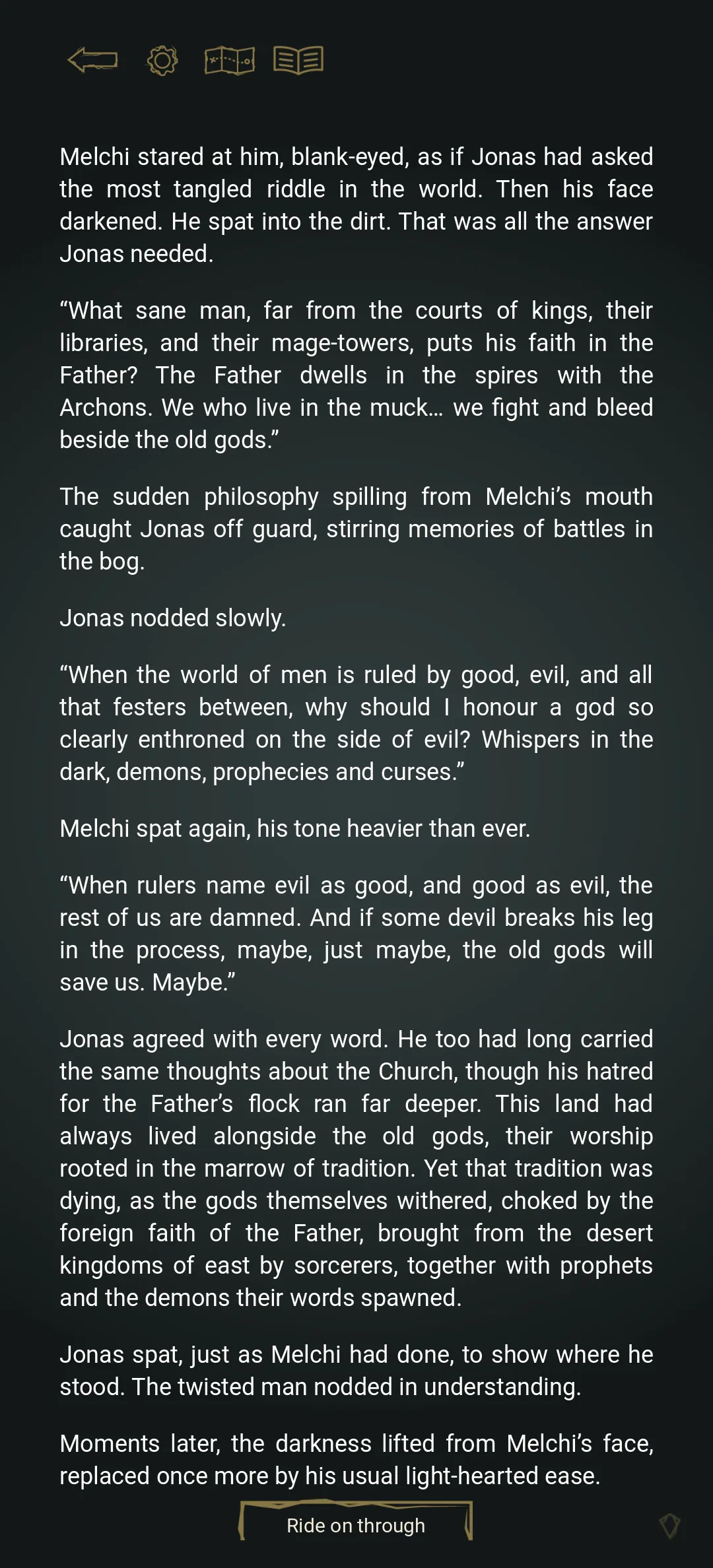
A chapter of the game on the road, where Melchi says the Father dwells in the spires with the Archons, and Jonas agrees with every word. The line in full, and what Melchi says after it.

The faith comes down from the towers, and the old gods are left to those at the bottom.

Governed Through Fear

Standing among the six tents, Jonas spits to the side. “Nothing is worse than being ruled by those who govern through fear.”

“Exactly,” Melchi grins.
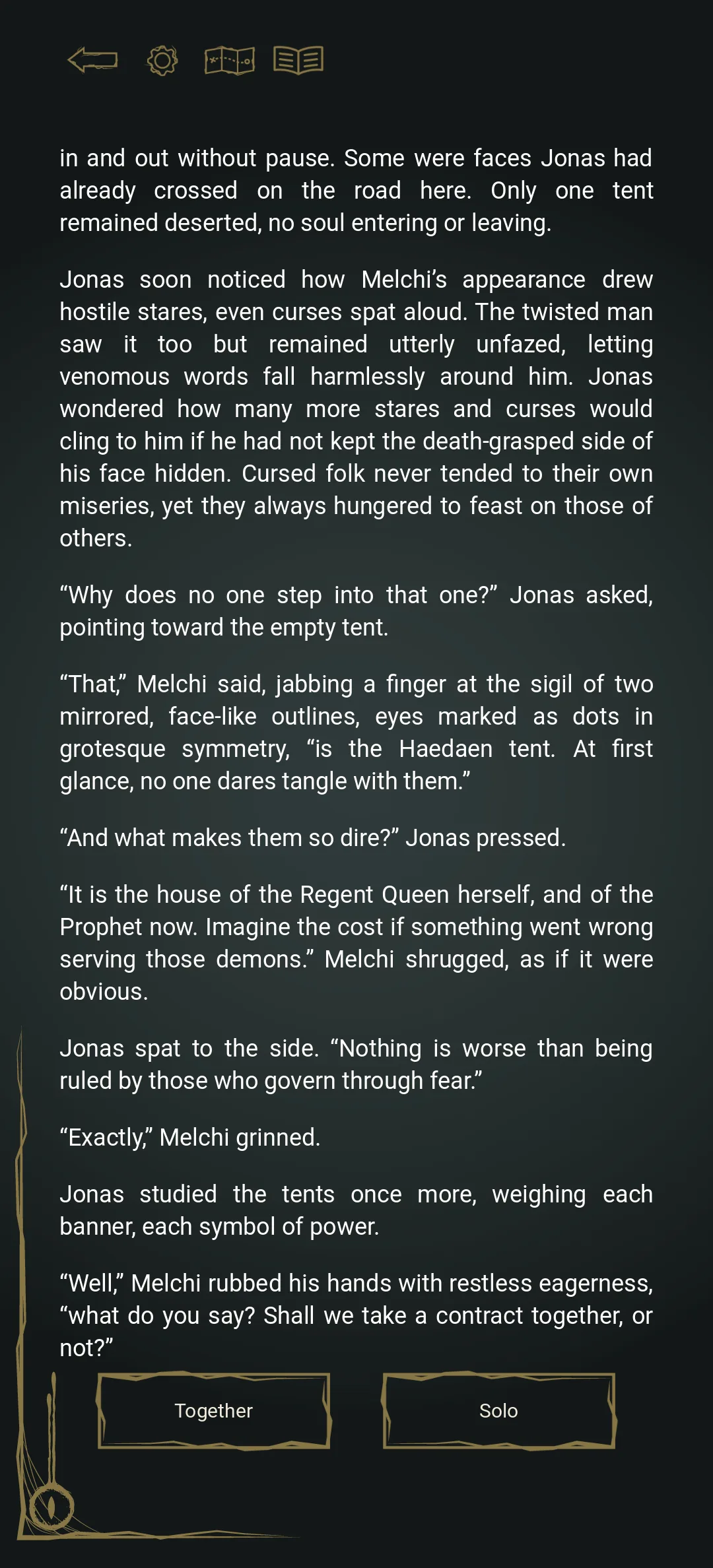
A chapter of the game outside the six tents, with the empty Haedaen tent, Jonas’s line about ruling through fear, and two choices: together, or solo. Outside the tents: “Nothing is worse than being ruled by those who govern through fear.”

The great houses have built a kingdom held together by taxes, demons and mages, where even the gate to a city is something you earn by doing their dirty work. The roads, the coins, the temples and the wagons are all marked as somebody’s property, and the people they have no use for are left off the map entirely. Jonas has to walk through every part of that kingdom to reach his son. In The Red Tomorrow, you decide whether Jonas bends to that power, pays its prices, or burns some of it down on the way. The story is free to begin, with fifteen endings shaped by the choices you make for him.

Download The Red Tomorrow

Six houses, one gate, and a kingdom that marks everything it owns. Find out what it will ask of you.

Balance Through Terror: How the Great Houses Hold the Kingdom

Cursed lands do not exist to those who condemn them.

Where the King’s Road fans out across the eastern kingdom, the signposts point every way a traveller might want to go: northeast to the Angel’s Leap, west to the Narrow Pass and the inns beyond it. One place has no post. The boglands have never had one. The kingdom sends its exiles into the swamp and then stops writing the swamp down. It never has to hunt them or even guard them, because their land has dropped off the map.

The game’s map of the kingdom with the Shattered City, Morra, the Rainfields, the Narrow Pass, Angel’s Leap and the Swamplands marked. The Swamplands fade into blank parchment, leaving only the words Cursed lands do not exist to those who condemn them. The kingdom’s own map, and what it does to the east.

That is the quietest of the ways the great houses keep their kingdom, and it is far from the only one.

This is the world of The Red Tomorrow, our dark fantasy interactive novel: over a hundred thousand words, a hundred and eighty-one illustrated chapters, and fifteen endings shaped by the choices you make along the way. You play Jonas, a former sellsword who has made his home among the kingdom’s exiles, and who rides west when men in the king’s service carry off his son. Every road he takes leads closer to the people who built the cage he lives in.

The Rising That Failed

The kingdom has never forgotten the war. The Father did not take the great houses by force. He took them by whispers: slithering words spoken over an altar built from stone quarried in a foreign land, and promises, demonic and magical alike, that poisoned the Archons one house at a time. When the whispering was done, the houses rose against their own king.

He fought to keep his realm as it had always been, true to traditions carved by millennia of stories, written and told alike. The common people took up arms for him and stood against the houses and their mages, carrying dozens of relics touched by the old gods into battle. It was not enough. The war was short, ended by mages whose power nobody who saw it has ever forgotten. Even the tower that gave the Shattered City its name fell in that war, split by the first of the Prophets.

Inside a gold frame, over the darkened towers of the Shattered City, two columns headed As it happened and As it was written. The king who kept his oath, the houses that broke theirs and the families who fought for him are struck through in red one by one and rewritten as the Heretic King, the Faithful and the Exiles. As it happened, and as it was written.

Then the winners wrote the history. The houses that broke their oaths became the faithful, and the king who kept his became the Heretic King. That is the only name he has now. The families who had fought for him were sent east to the boglands, and their descendants are there still. Most of the people living in the bogs today did nothing to be sent there. Their exile is inherited, a sentence passed for the crimes of fathers and grandfathers and handed down like a family name. The children carry it too, and so will theirs. Jonas curses the royal line for it on the cobbles of Morra, “the family that decreed swampfolk must never settle beyond their poisoned soil.”

A chapter of the game in Morra: the noble quarter, the temple of the Father hung with black shrouds, and Jonas spitting on the cobbles for the dead king and his line. Morra’s noble quarter, the temple among the manors, and the line in its place.

It works because it costs the crown nothing. An exile born into exile needs no trial, no warden, and no wall. He only has to be born where he was born. Once a year, when the wells come open, the men of the boglands go out and fight what climbs from them. They have done it for generations, and not one stone in the rest of the kingdom marks that they exist.

Six Towers Over One City

The Shattered City takes its name from a ruin. A tower once stood there, tall enough, it is said, that those who climbed it would walk into the halls of the Father. During the houses’ rebellion against the Heretic King, the first of the Prophets broke it with his wrath, and its two halves fell sideways across the land. The city gate now stands in the breach where the peak was split.

Beyond the fallen tower, six thin spires still rise inside the walls. They are mage towers, one for each of the six Archon houses, and each is home to a single tower mage, the highest rank a mage can reach, who has sold that craft to the nobility. Jonas counts them from the road and sees them for what they are. Each tower is a weapon. Each is a promise to the rival houses that if they strike, ruin will answer in kind.

Balance through terror, he thinks. A peace that holds only as long as nobody wants everything reduced to ash.

A chapter of the game describing the shattered tower, the six mage towers inside the walls, and Jonas’s thought that the peace between the houses is balance through terror. In the game: “Each tower was a weapon. A promise of ruin.”

The houses keep that peace with each other the same way they keep it over everyone else. Nobody is forbidden to rise against them. Anyone who tries is simply sure to burn.

And the Shattered City is only where the six houses keep their towers. Their rule covers the whole realm. Every noble born into one of them carries the title of Archon, and their armies march back and forth along the King’s Roads.

Demons to Fight, Mages to Terrify

Mages have always been the houses’ sharpest tool: mage knights, battle mages, and above them all the tower mages, one to each Archon tower and the highest of their kind. Ordinary people have never had any defence against them, and they know it.

For the first decades after the Father came, there were no demons to be seen anywhere. Now they are multiplying in towns and villages across the kingdom, branded with the marks of the houses that bind them. The houses now command both: demons as their soldiers, unmatched in a fight, and mages as their weapons of terror and mass destruction.

Two illustrations side by side: hooded, armoured knights on black horses in a dark city street, and a horned demon carrying a trident through a crowded street under an arch. The houses’ two tools: mage knights riding through the city, and a demon walking its streets.

Imagine a single creature with a demon’s strength and a tower mage’s power. One exists. The Prophet who stands beside the throne is both.

Six Houses, Six Hungers

Outside the Shattered Gate the houses pitch six great tents, each flying its own sigil, and each tent tells you exactly what kind of power stands behind it.

The opening screens of the six tent chapters in turn, each with its illustration: the Haedaen clerk, the Garron knight, the hooded Cosmian mage, the Lespian mason, the Donomie Archon and the Eremoppu merchant. Six tents, six envoys: the first screen of each, as the game shows it.

The Haedaens fly two mirrored, face-like outlines, the eyes marked as dots. Their tent is the one nobody enters. Inside sits a clerk who wears a mask like the priests of the Father’s church, turned to the back of his head, so that he shows a face whichever way he turns. It is the house of the Regent Queen herself, and of the Prophet now. The dead king was a Haedaen as well, and the Queen his close kin, so the crown never left the family. Sellswords who would happily fight a giant on the King’s Road won’t take a coin from them.

The Garrons are soldiers. No king has ever come from their line. Their tent is hung with scenes of war: a battle woven into a rug, a burning city painted on the far wall, halberds and shields set out like trophies.

The Cosmians have given the kingdom many kings, King Cosmos the Second within living memory. They deal in sorcery and hold the greatest libraries in the world. Their envoy is a hooded woman pacing beside a glass orb, and she offers one gold for a pouch of mushrooms and five for ten hearts taken from freshly dead men. She tells Jonas to take them from “the peasant graveyard that poisons the beauty of this city.”

The Lespians and the Donomie never ruled. Both are houses of masons, though the Donomie are the lesser in strength. The Eremoppu ruled in ancient days and now deal chiefly in trade. By coin, they might be the strongest house of all. Their envoy wears his wealth in gold teeth. His monocle shows him what any object is worth in the hearts of the men who look at it.

Six houses, and not one of them is trying to win the people’s love. Each holds a different lever: fear, war, learning, stone, and gold.

A Gate That Opens Only for Service

In the year Jonas arrives, the city’s army has marched off to prepare for the Prophet’s war against the dragons. In peacetime it is soldiers who carry out the Archons’ errands. With the soldiers gone, the nobles still expect their errands done.

So the houses have turned the city gate into a hiring hall. Without the city’s emblem, nobody passes, and the only way to earn one is to complete a task for one of the Archon houses. The smugglers who used to slip people inside have given up. Women are not let through at all, emblem or no emblem.

A chapter of the game in which Melchi describes the six houses one by one, above six buttons, one to enter each house’s tent. Melchi’s rundown of the six houses, and the only way through the gate: pick a tent.

The tasks themselves show how the houses fight. The Lespians want a forest stone the Donomie have claimed with forged papers that the Regent Queen has somehow recognised as genuine. The Lespian envoy’s solution is to have a stranger burn the Donomie manor to its foundations, and she doesn’t care who is still inside. Across the way, the Donomie want a Lespian carriage robbed before it reaches the Cliff Cities of the West, whether by stealth or by butchery.

The great houses rarely bleed for their quarrels. They pay others to bleed in their place, and they pay best for what is most shameful.

Justice by Decree

“The Archons are mad of late,” the crooked sellsword Melchi warns Jonas on the road. “Their mages execute folk for the smallest things.” Jonas asks why they would kill their own people over a quarrel with the Queen, and Melchi answers with a shrug: for the same reason a man swats a fly on his neck, because the sound it makes is irritating. “That is how the Archons see us.”

The clearest example waits in the Haedaen tent. The house wants a woman named Llorra dead and her head brought back, and it pays ten gold and a city emblem for the job. The clerk says she stole something and that what she took doesn’t matter. When Jonas and Melchi find her in the woods, she tells them the truth. She was a servant in the Haedaen palace, wronged by the sons of Lord Hador and cast out, and when word reached Hador he ordered her killed for it. No court heard her case. Melchi can hardly look at her. What troubles him is not the killing but who ordered it: she was condemned “not by a people’s court but by the decree of nobles.”

A chapter of the game opening on a hooded woman sitting alone in a dark forest, above text about Jonas and Melchi tracking a woman named Llorra for House Haedaens. Llorra, and the quest to hunt her.

In this kingdom that is the only court there is.

Coin, Sigil and Brand

Power here is something you can see, and something you pay for. The houses tax brutally, and what ordinary people scrape together goes up to the towers and the walled estates. Gold coins carry the king’s sigil, heavy, as one chapter puts it, “with the authority of a throne now cold and empty.” A raider on the King’s Road lets a wagon pass untouched once he sees the Regent Queen’s crest on it. The great houses burn their marks into the flesh of their bound demons, and the crown has been known to brand an exile’s forehead with its mark of shame.

Every one of these marks says the same thing: this belongs to someone. The coin, the wagon, the demon, the exile. Even the swampfolk bear the crown’s mark. Only the land it threw them onto bears none, not even a signpost, as if the kingdom would rather forget it exists.

A God Who Lives in the Spires

The faith supports the arrangement. In Morra, the Father’s temple stands among the walled estates of the great houses in the noble quarter, far from the hovels of the poor. It is so grand it seems conjured rather than built. The Church and the great houses both answer witchcraft with the pyre, and the old gods’ emblems, still cut into the oldest graves, are called blasphemy against the Father.

Melchi puts it more plainly than any priest would. “What sane man, far from the courts of kings, their libraries, and their mage-towers, puts his faith in the Father? The Father dwells in the spires with the Archons. We who live in the muck… we fight and bleed beside the old gods.”

A chapter of the game on the road, where Melchi says the Father dwells in the spires with the Archons, and Jonas agrees with every word. The line in full, and what Melchi says after it.

The faith comes down from the towers, and the old gods are left to those at the bottom.

Governed Through Fear

Standing among the six tents, Jonas spits to the side. “Nothing is worse than being ruled by those who govern through fear.”

“Exactly,” Melchi grins.

A chapter of the game outside the six tents, with the empty Haedaen tent, Jonas’s line about ruling through fear, and two choices: together, or solo. Outside the tents: “Nothing is worse than being ruled by those who govern through fear.”

The great houses have built a kingdom held together by taxes, demons and mages, where even the gate to a city is something you earn by doing their dirty work. The roads, the coins, the temples and the wagons are all marked as somebody’s property, and the people they have no use for are left off the map entirely. Jonas has to walk through every part of that kingdom to reach his son. In The Red Tomorrow, you decide whether Jonas bends to that power, pays its prices, or burns some of it down on the way. The story is free to begin, with fifteen endings shaped by the choices you make for him.

Download The Red Tomorrow

Six houses, one gate, and a kingdom that marks everything it owns. Find out what it will ask of you.

Want to be told when the next story drops?

Θέλετε να μάθετε πρώτοι για την επόμενή μας ιστορία;

Quiet updates, no spam. Only when something worth sharing is ready.

Διακριτικά νέα, χωρίς ενοχλήσεις. Μόνο όταν έχουμε κάτι αξιόλογο να πούμε.

SubscribeΕγγραφή